Committee hears bill to authorize remote notarization of physical documents
February 19, 2026 | Legislative Sessions, Washington
This article was created by AI summarizing key points discussed. AI makes mistakes, so for full details and context, please refer to the video of the full meeting. Please report any errors so we can fix them. Report an error »
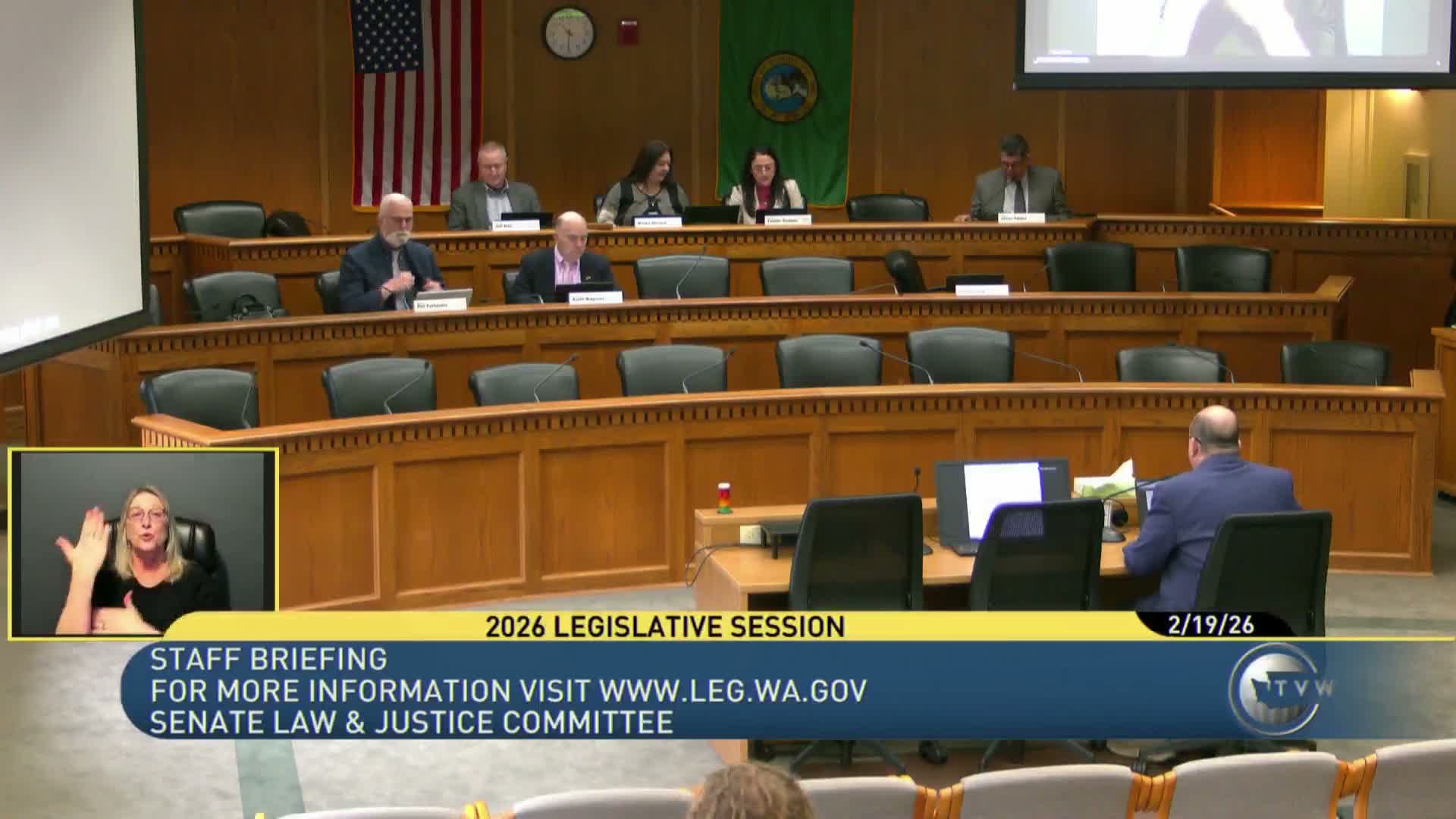
Substitute House Bill 2,158, presented Feb. 19 to the Law and Justice Committee, would expand Washington law to allow remote notarization of tangible documents and authorize remote oaths or affirmations.
Tim Ford, staff counsel, said the bill "relates to electronic notarial acts" and modifies the 2018 revised uniform law on notarial acts to provide a process for notarizing a tangible record that is not physically before the notary. The bill requires a remotely located person to sign the tangible record and make a declaration that it is the same record used during the remote notarial act; the signer must then mail the physical document to the notary within three days so the notary can execute a contemporaneous certificate. Ford also described a requirement that notaries create an audiovisual recording of remote oaths or acknowledgments and retain that recording for at least 10 years.
Representative Hunter Abell, prime sponsor, described the bill as bipartisan and said it grew from pandemic experience: "This bill allows us to engage in the remote electronic notarization of physical documents," and he characterized it as an "access to justice bill" that can help people with limited mobility and those in rural areas obtain notarial services.
Committee members asked about practical steps for record retention; Ford said the Department of Licensing has adopted rules to designate repositories and that staff could provide details on those rules. There were no formal amendments or votes recorded during the committee hearing; Chair Dhingra closed the public hearing on the bill after Abell's testimony.
The bill is sponsored by Rep. Hunter Abell and was brought to the committee at the request of the Uniform Law Commission, a nonprofit that drafts uniform legislation for state law harmonization. The committee did not take final action at the Feb. 19 hearing; next steps were indicated as scheduling for executive session.
The article will be updated if the committee posts amendments or takes a vote.
Tim Ford, staff counsel, said the bill "relates to electronic notarial acts" and modifies the 2018 revised uniform law on notarial acts to provide a process for notarizing a tangible record that is not physically before the notary. The bill requires a remotely located person to sign the tangible record and make a declaration that it is the same record used during the remote notarial act; the signer must then mail the physical document to the notary within three days so the notary can execute a contemporaneous certificate. Ford also described a requirement that notaries create an audiovisual recording of remote oaths or acknowledgments and retain that recording for at least 10 years.
Representative Hunter Abell, prime sponsor, described the bill as bipartisan and said it grew from pandemic experience: "This bill allows us to engage in the remote electronic notarization of physical documents," and he characterized it as an "access to justice bill" that can help people with limited mobility and those in rural areas obtain notarial services.
Committee members asked about practical steps for record retention; Ford said the Department of Licensing has adopted rules to designate repositories and that staff could provide details on those rules. There were no formal amendments or votes recorded during the committee hearing; Chair Dhingra closed the public hearing on the bill after Abell's testimony.
The bill is sponsored by Rep. Hunter Abell and was brought to the committee at the request of the Uniform Law Commission, a nonprofit that drafts uniform legislation for state law harmonization. The committee did not take final action at the Feb. 19 hearing; next steps were indicated as scheduling for executive session.
The article will be updated if the committee posts amendments or takes a vote.
View the Full Meeting & All Its Details
This article offers just a summary. Unlock complete video, transcripts, and insights as a Founder Member.
✓
Watch full, unedited meeting videos
✓
Search every word spoken in unlimited transcripts
✓
AI summaries & real-time alerts (all government levels)
✓
Permanent access to expanding government content
30-day money-back guarantee
