Committee considers broad probate reforms to curb 'probates for profit' schemes
February 19, 2026 | Legislative Sessions, Washington
This article was created by AI summarizing key points discussed. AI makes mistakes, so for full details and context, please refer to the video of the full meeting. Please report any errors so we can fix them. Report an error »
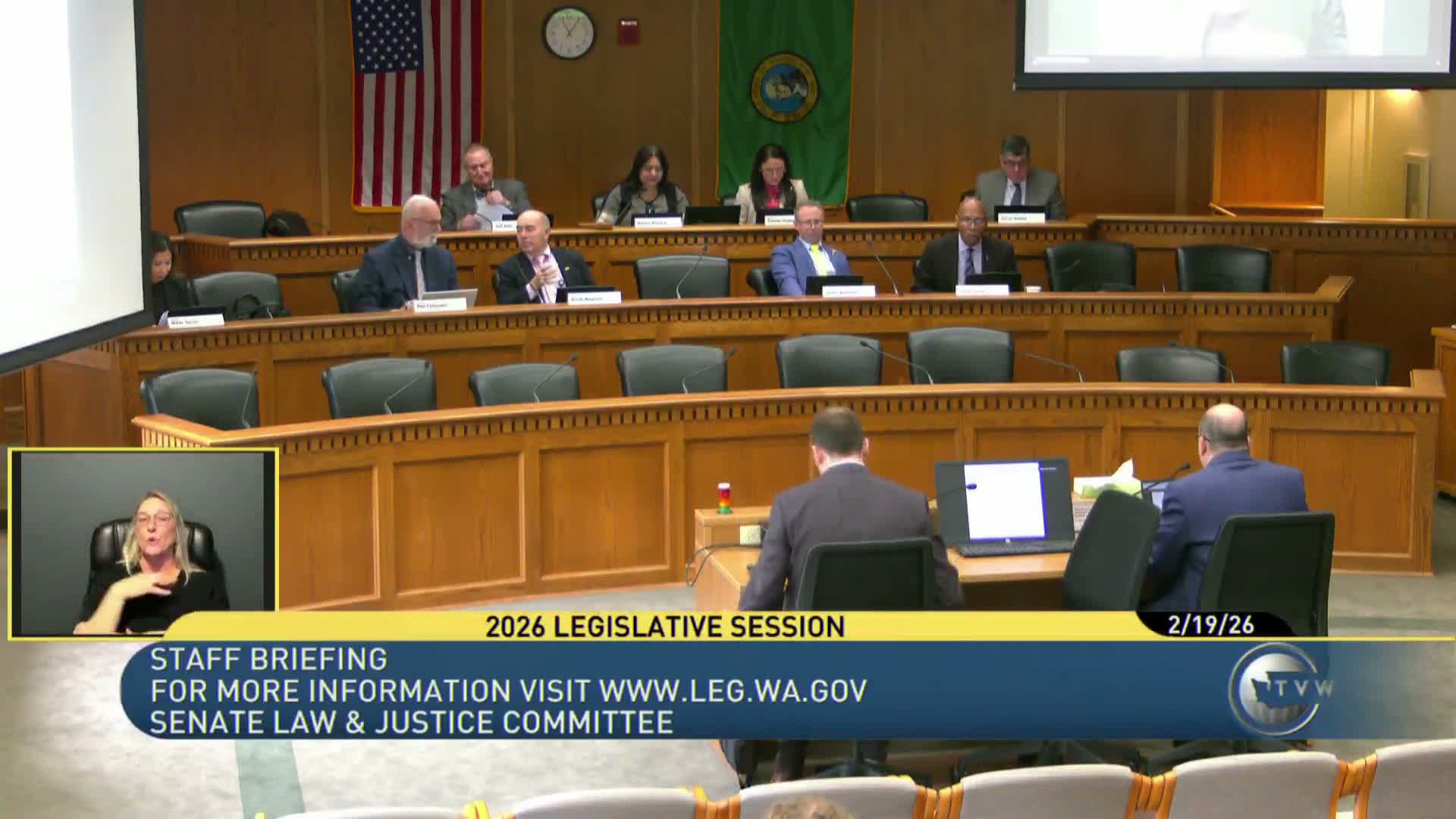
Substitute House Bill 2,445 drew extended testimony Feb. 19 as lawmakers considered measures aimed at preventing predatory third‑party probate administration.
Staff counsel Tim Ford outlined the legislation: increasing the 40‑day window for filing probate petitions to 60 days, adding disqualification criteria for prospective personal representatives (including recent revocation of letters, findings of dishonesty or theft, and acting in concert to transfer probate assets), narrowing venue rules to prioritize the decedent's county of residence or where assets are located, requiring more detailed oath and contact‑attempt disclosures in applications, and stripping nonintervention powers from certain "suitable" administrators so court supervision and interim reporting become more robust. The bill also adds requirements for agreements with transferees for value (often the mechanism used by so‑called 'probates for profit') and creates remedies, including potential treble damages for willful violations.
Representative Madison Richards, prime sponsor, said the bill "is about protecting grieving families" and closing a loophole that allowed opportunists to seize estates. Ben Carr of the Attorney General's Office characterized the measure as consumer protection designed to "ensure the integrity of the probate system in Washington," and cited investigations into large‑scale scams involving people who filed hundreds of probate petitions and siphoned estate equity. Rob Miller (Northwest Justice Project), Seth Dawson (trust and estate litigator), and Mitch Corey (estate planning attorney) testified in favor but urged careful drafting to avoid sweeping legitimate heir‑finding firms out of useful work. Several witnesses urged amendments to distinguish legitimate heir‑finding and probate assistance services from predatory operators.
Committee members asked for examples of prior wrongdoing; the AGO referenced an investigation into John Bretzke Elliott and associates who allegedly siphoned millions from over 200 estates. Sponsors and AGO staff said the bill does not ban heir‑finding but seeks to impose guardrails: limits on the number of third‑party probates a person can initiate, contract filing with courts, bonding and accounting requirements, and timelines giving heirs time to receive information before entering fee agreements. The committee closed the public hearing on HB 2,445 and asked for written recommendations and potential amendment language to address concerns about breadth and potential unintended consequences.
Staff counsel Tim Ford outlined the legislation: increasing the 40‑day window for filing probate petitions to 60 days, adding disqualification criteria for prospective personal representatives (including recent revocation of letters, findings of dishonesty or theft, and acting in concert to transfer probate assets), narrowing venue rules to prioritize the decedent's county of residence or where assets are located, requiring more detailed oath and contact‑attempt disclosures in applications, and stripping nonintervention powers from certain "suitable" administrators so court supervision and interim reporting become more robust. The bill also adds requirements for agreements with transferees for value (often the mechanism used by so‑called 'probates for profit') and creates remedies, including potential treble damages for willful violations.
Representative Madison Richards, prime sponsor, said the bill "is about protecting grieving families" and closing a loophole that allowed opportunists to seize estates. Ben Carr of the Attorney General's Office characterized the measure as consumer protection designed to "ensure the integrity of the probate system in Washington," and cited investigations into large‑scale scams involving people who filed hundreds of probate petitions and siphoned estate equity. Rob Miller (Northwest Justice Project), Seth Dawson (trust and estate litigator), and Mitch Corey (estate planning attorney) testified in favor but urged careful drafting to avoid sweeping legitimate heir‑finding firms out of useful work. Several witnesses urged amendments to distinguish legitimate heir‑finding and probate assistance services from predatory operators.
Committee members asked for examples of prior wrongdoing; the AGO referenced an investigation into John Bretzke Elliott and associates who allegedly siphoned millions from over 200 estates. Sponsors and AGO staff said the bill does not ban heir‑finding but seeks to impose guardrails: limits on the number of third‑party probates a person can initiate, contract filing with courts, bonding and accounting requirements, and timelines giving heirs time to receive information before entering fee agreements. The committee closed the public hearing on HB 2,445 and asked for written recommendations and potential amendment language to address concerns about breadth and potential unintended consequences.
View the Full Meeting & All Its Details
This article offers just a summary. Unlock complete video, transcripts, and insights as a Founder Member.
✓
Watch full, unedited meeting videos
✓
Search every word spoken in unlimited transcripts
✓
AI summaries & real-time alerts (all government levels)
✓
Permanent access to expanding government content
30-day money-back guarantee
