House passes bill clarifying Climate Commitment Act accounts after heated debate over transportation funding
February 16, 2026 | Legislative Sessions, Washington
This article was created by AI summarizing key points discussed. AI makes mistakes, so for full details and context, please refer to the video of the full meeting. Please report any errors so we can fix them. Report an error »
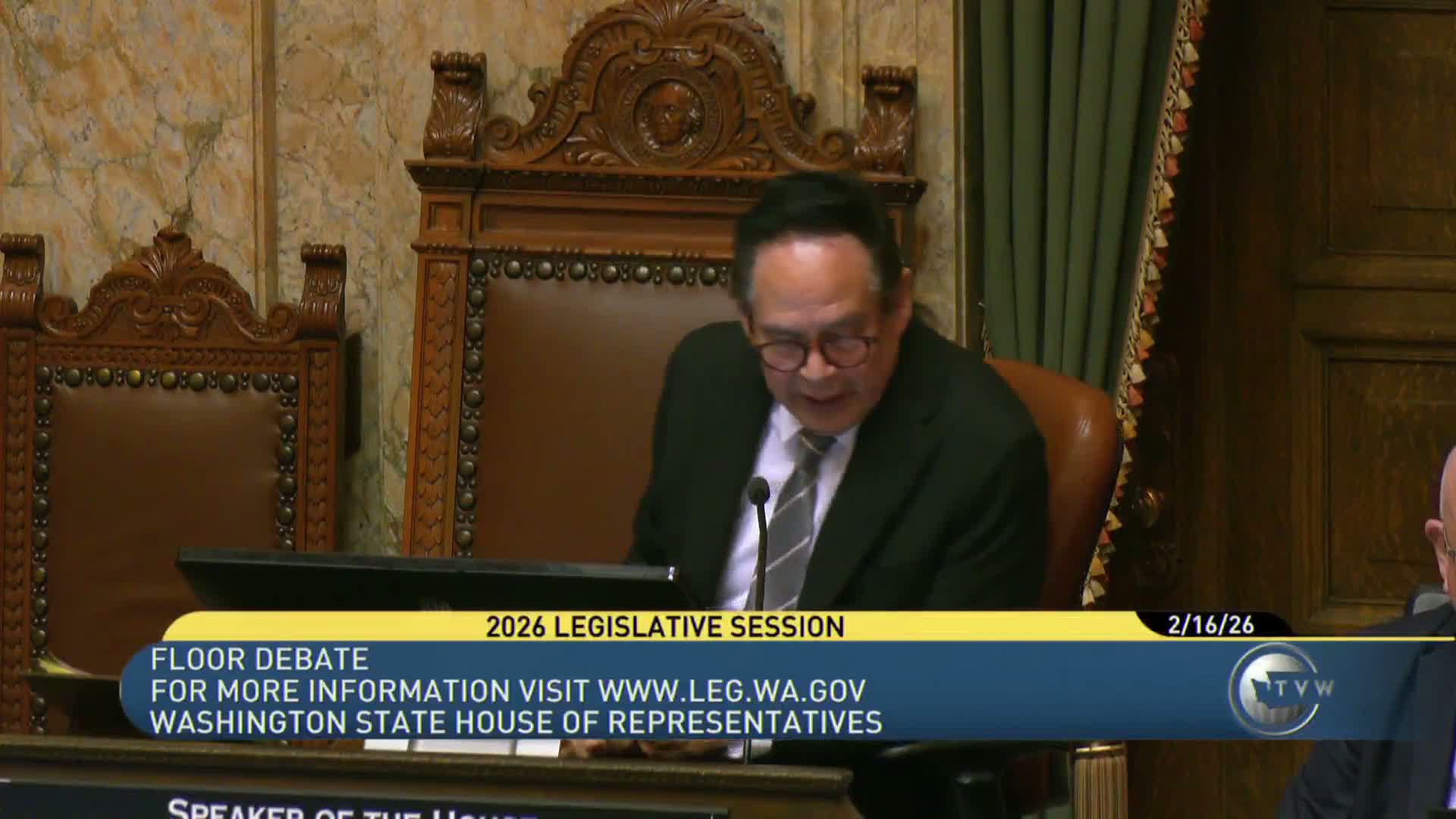
Engrossed Second Substitute House Bill 22-51, which revises how proceeds from the Climate Commitment Act (CCA) are allocated and clarifies allowable uses for CCA accounts, passed the House after extensive floor debate and several amendment votes.
Representative Tina Fitzgibbon, who moved the amendment and urged support for the bill, said the legislation "expands some of the allowable uses of Climate Commitment Act accounts to include new and innovative types of carbon storage and sequestration" and would "direct agencies to interpret tribal consultation to encompass more consultation than they have been doing." Supporters framed the bill as necessary housekeeping to make account rules clearer and to plan for a projected decline in auction revenue as greenhouse-gas emissions fall.
Members debating the bill focused heavily on transportation priorities. Representative Barkas, who offered a large, technical amendment changing distribution formulas and allowing additional transportation uses, argued the change would let the state use CCA funds for "transportation infrastructure, painting, preservation, repairs and improvements that protect against climate forces" and for "infrastructure safety improvements, including replacing intersections with roundabouts." Opponents warned that reallocating significant funds to transportation and promising larger dedicated sums to programs such as the Forest Riparian Easement Program (FREP) could strain an expected declining revenue stream from CCA auctions.
Floor votes on several amendments split the House. Amendment 18-33, which broadened allowable sequestration uses and emphasized tribal consultation, was adopted (51–39–1). Amendment 18-32, restoring payments to agricultural fuel purchasers as an allowable use, was adopted. An amendment to increase FREP intent language from $10 million to $30 million (19-90) was rejected after members cited fiscal concerns and legal uncertainty. Representative Orcutt and other members urged adoption of transportation-focused changes to ensure small landowners and rural communities receive compensation linked to recent rule changes; those arguments failed to carry a majority on that amendment.
After extended debate across many members and districts—who cited bridges out of service, dangerous two-lane highways, local examples of fatalities, and the limits of current transportation budgets—the bill passed by roll call: 56 yays, 41 nays, 1 excused. Representative Fitzgibbon said the bill attempts to "plan for the future" and to make allocations more transparent; opponents reiterated concerns about spreading limited revenue too thin and prioritization choices.
The bill will next proceed per legislative procedures toward the other chamber or to enrollment as required. The debate underscored a continuing policy fault line over whether CCA dollars should be used primarily for direct greenhouse-gas reduction programs or repurposed for transportation safety and infrastructure needs that some members say have immediate public-safety benefits.
Representative Tina Fitzgibbon, who moved the amendment and urged support for the bill, said the legislation "expands some of the allowable uses of Climate Commitment Act accounts to include new and innovative types of carbon storage and sequestration" and would "direct agencies to interpret tribal consultation to encompass more consultation than they have been doing." Supporters framed the bill as necessary housekeeping to make account rules clearer and to plan for a projected decline in auction revenue as greenhouse-gas emissions fall.
Members debating the bill focused heavily on transportation priorities. Representative Barkas, who offered a large, technical amendment changing distribution formulas and allowing additional transportation uses, argued the change would let the state use CCA funds for "transportation infrastructure, painting, preservation, repairs and improvements that protect against climate forces" and for "infrastructure safety improvements, including replacing intersections with roundabouts." Opponents warned that reallocating significant funds to transportation and promising larger dedicated sums to programs such as the Forest Riparian Easement Program (FREP) could strain an expected declining revenue stream from CCA auctions.
Floor votes on several amendments split the House. Amendment 18-33, which broadened allowable sequestration uses and emphasized tribal consultation, was adopted (51–39–1). Amendment 18-32, restoring payments to agricultural fuel purchasers as an allowable use, was adopted. An amendment to increase FREP intent language from $10 million to $30 million (19-90) was rejected after members cited fiscal concerns and legal uncertainty. Representative Orcutt and other members urged adoption of transportation-focused changes to ensure small landowners and rural communities receive compensation linked to recent rule changes; those arguments failed to carry a majority on that amendment.
After extended debate across many members and districts—who cited bridges out of service, dangerous two-lane highways, local examples of fatalities, and the limits of current transportation budgets—the bill passed by roll call: 56 yays, 41 nays, 1 excused. Representative Fitzgibbon said the bill attempts to "plan for the future" and to make allocations more transparent; opponents reiterated concerns about spreading limited revenue too thin and prioritization choices.
The bill will next proceed per legislative procedures toward the other chamber or to enrollment as required. The debate underscored a continuing policy fault line over whether CCA dollars should be used primarily for direct greenhouse-gas reduction programs or repurposed for transportation safety and infrastructure needs that some members say have immediate public-safety benefits.
Don't Miss a Word: See the Full Meeting!
Go beyond summaries. Unlock every video, transcript, and key insight with a Founder Membership.
✓
Get instant access to full meeting videos
✓
Search and clip any phrase from complete transcripts
✓
Receive AI-powered summaries & custom alerts
✓
Enjoy lifetime, unrestricted access to government data
30-day money-back guarantee
