Virginia transportation secretary lays out priorities, flags WMATA capital shortfall
February 19, 2026 | 2026 Legislature VA, Virginia
This article was created by AI summarizing key points discussed. AI makes mistakes, so for full details and context, please refer to the video of the full meeting. Please report any errors so we can fix them. Report an error »
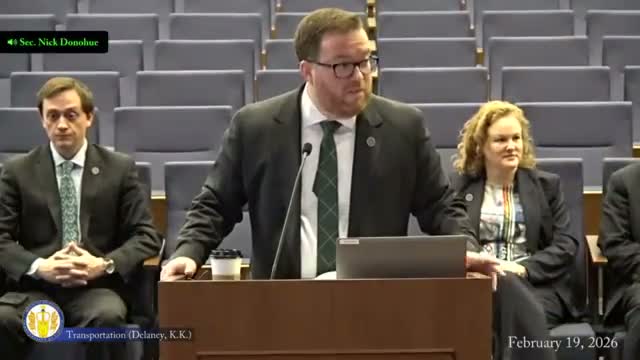
RICHMOND — Virginia Secretary of Transportation Nick Donahue outlined the new administration’s early priorities to the House Transportation Committee, emphasizing "a real focus on transparency and accountability" and pressing for long-term funding to maintain and expand the Commonwealth’s transportation assets.
Donahue, who described his background in previous transportation administrations, told legislators the department’s immediate goals include delivering more than 4,000 projects in the current six-year improvement program, advancing major regional projects and reversing troubling safety trends on Virginia’s highways.
"At the end of the day, our fiduciary responsibility is to the taxpayers of Virginia," Donahue said, adding the secretariat will track whether decisions deliver results for districts and communities.
He highlighted several large projects coming or under way: a Hampton Roads tunnel expansion (presented as roughly $3.9 billion) and a Hampton Roads Express Lanes network (roughly $7.8 billion), the Transforming Rail in Virginia initiative (about $6 billion) and the Long Bridge passenger-only track across the Potomac, which Donahue said the administration hopes will be complete around 2030 and enable closer to hourly Amtrak service along the I‑95 corridor.
Donahue urged renewed attention to WMATA’s backlog and funding structure, saying inflation has eroded the buying power of the region’s earlier fixed contribution and that Virginia "need[s] 136,000,000 in additional capital funding for WMATA" to establish a sustainable bond program and avoid repeated funding requests to the General Assembly.
He also described two separate WMATA funding needs: an operating shortfall that has been met temporarily from general fund surpluses and a capital state‑of‑good‑repair backlog. Donahue said WMATA management has taken internal steps such as fare increases and has identified roughly $120,000,000 in operating savings over two years.
On maintenance and resiliency, Donahue said the Commonwealth spends about $2.4 billion annually on roadway operation and upkeep but faces rising construction costs (he cited roughly a 37% increase over six years). He credited the federal Infrastructure Investment and Jobs Act with providing bridge funding that improved conditions but warned that additional funding and planning will be needed for climate‑related risks; he noted the state has about $40 million per year in federal resiliency funds but that that amount falls short of projected needs.
Donahue also flagged safety concerns, noting highway fatalities rose from about 703 in 2014 to more than 900 in recent years and that bicyclist and pedestrian fatalities have "almost doubled since 2014." He said the secretariat will pursue both behavior‑focused and infrastructure solutions.
The secretary closed by highlighting economic opportunities tied to the Wallops Island spaceport (a Rocket Lab Electron launch in weeks and a later Neutron launch) and discussing advanced air mobility and drone delivery as longer‑term topics the Commonwealth will explore.
Donahue invited ongoing committee engagement as his office develops rail plans, resiliency methodologies and process improvements for environmental reviews that the legislature has allowed VDOT to assume from the Federal Highway Administration.
The committee did not take votes on legislation during Donahue’s presentation; the session moved to questions from members.
Donahue, who described his background in previous transportation administrations, told legislators the department’s immediate goals include delivering more than 4,000 projects in the current six-year improvement program, advancing major regional projects and reversing troubling safety trends on Virginia’s highways.
"At the end of the day, our fiduciary responsibility is to the taxpayers of Virginia," Donahue said, adding the secretariat will track whether decisions deliver results for districts and communities.
He highlighted several large projects coming or under way: a Hampton Roads tunnel expansion (presented as roughly $3.9 billion) and a Hampton Roads Express Lanes network (roughly $7.8 billion), the Transforming Rail in Virginia initiative (about $6 billion) and the Long Bridge passenger-only track across the Potomac, which Donahue said the administration hopes will be complete around 2030 and enable closer to hourly Amtrak service along the I‑95 corridor.
Donahue urged renewed attention to WMATA’s backlog and funding structure, saying inflation has eroded the buying power of the region’s earlier fixed contribution and that Virginia "need[s] 136,000,000 in additional capital funding for WMATA" to establish a sustainable bond program and avoid repeated funding requests to the General Assembly.
He also described two separate WMATA funding needs: an operating shortfall that has been met temporarily from general fund surpluses and a capital state‑of‑good‑repair backlog. Donahue said WMATA management has taken internal steps such as fare increases and has identified roughly $120,000,000 in operating savings over two years.
On maintenance and resiliency, Donahue said the Commonwealth spends about $2.4 billion annually on roadway operation and upkeep but faces rising construction costs (he cited roughly a 37% increase over six years). He credited the federal Infrastructure Investment and Jobs Act with providing bridge funding that improved conditions but warned that additional funding and planning will be needed for climate‑related risks; he noted the state has about $40 million per year in federal resiliency funds but that that amount falls short of projected needs.
Donahue also flagged safety concerns, noting highway fatalities rose from about 703 in 2014 to more than 900 in recent years and that bicyclist and pedestrian fatalities have "almost doubled since 2014." He said the secretariat will pursue both behavior‑focused and infrastructure solutions.
The secretary closed by highlighting economic opportunities tied to the Wallops Island spaceport (a Rocket Lab Electron launch in weeks and a later Neutron launch) and discussing advanced air mobility and drone delivery as longer‑term topics the Commonwealth will explore.
Donahue invited ongoing committee engagement as his office develops rail plans, resiliency methodologies and process improvements for environmental reviews that the legislature has allowed VDOT to assume from the Federal Highway Administration.
The committee did not take votes on legislation during Donahue’s presentation; the session moved to questions from members.
View the Full Meeting & All Its Details
This article offers just a summary. Unlock complete video, transcripts, and insights as a Founder Member.
✓
Watch full, unedited meeting videos
✓
Search every word spoken in unlimited transcripts
✓
AI summaries & real-time alerts (all government levels)
✓
Permanent access to expanding government content
30-day money-back guarantee
