Panel backs virtual pharmacist supervision for opioid treatment programs to expand take-home dosing
February 19, 2026 | 2026 Legislature VA, Virginia
This article was created by AI summarizing key points discussed. AI makes mistakes, so for full details and context, please refer to the video of the full meeting. Please report any errors so we can fix them. Report an error »
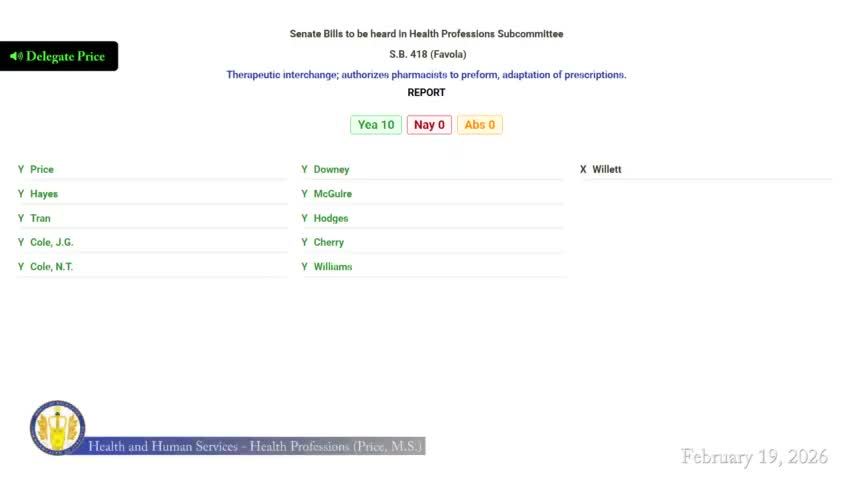
Senator Favola presented SB 421 to allow a licensed pharmacist to remotely supervise the assembly of antagonist drugs and the preparation of take-home opioid treatment medication, enabling patients at opioid treatment programs (OTPs) to leave clinics with their doses. Sponsor said the change reflects telemedicine practices and existing pilot programs.
Tara Jones, a University of Virginia law student working with the State and Local Government Policy Clinic, told the subcommittee SB 421 will "make it easier for people in recovery from opioid addiction to get the treatment they need by allowing virtual pharmaceutical supervision for take-home doses and opioid treatment programs." Jones said more than 50 OTPs operate across the Commonwealth and that federal law permits the approach; she added Virginia has piloted the method in several sites.
Dr. Shay Tinsley, a licensed psychotherapist and clinic director, described barriers clients face when pharmacists are not on site, saying patients sometimes "drive up to 5 hours for the medication" only to be told to return because no pharmacist is present. Robert Melvin of the R Street Institute also testified in support, saying removing operational barriers can let OTPs expand capacity to meet demand.
Committee members asked whether the practice is already in use; the sponsor said eight pilots currently use remote licensed pharmacists and that the Board of Pharmacy and DBHDS staff had been consulted. The subcommittee voted to report SB 421 by a 10-0 recorded vote. The bill authorizes remote supervision under regulatory safeguards rather than changing criminal or controlled-substance law.
Tara Jones, a University of Virginia law student working with the State and Local Government Policy Clinic, told the subcommittee SB 421 will "make it easier for people in recovery from opioid addiction to get the treatment they need by allowing virtual pharmaceutical supervision for take-home doses and opioid treatment programs." Jones said more than 50 OTPs operate across the Commonwealth and that federal law permits the approach; she added Virginia has piloted the method in several sites.
Dr. Shay Tinsley, a licensed psychotherapist and clinic director, described barriers clients face when pharmacists are not on site, saying patients sometimes "drive up to 5 hours for the medication" only to be told to return because no pharmacist is present. Robert Melvin of the R Street Institute also testified in support, saying removing operational barriers can let OTPs expand capacity to meet demand.
Committee members asked whether the practice is already in use; the sponsor said eight pilots currently use remote licensed pharmacists and that the Board of Pharmacy and DBHDS staff had been consulted. The subcommittee voted to report SB 421 by a 10-0 recorded vote. The bill authorizes remote supervision under regulatory safeguards rather than changing criminal or controlled-substance law.
View the Full Meeting & All Its Details
This article offers just a summary. Unlock complete video, transcripts, and insights as a Founder Member.
✓
Watch full, unedited meeting videos
✓
Search every word spoken in unlimited transcripts
✓
AI summaries & real-time alerts (all government levels)
✓
Permanent access to expanding government content
30-day money-back guarantee
