DPH task force debates whether to house 'lived experience' in its own subcommittee or across all workgroups
February 19, 2026 | Department of Public Health, Departments and Agencies, Organizations, Executive, Connecticut
This article was created by AI summarizing key points discussed. AI makes mistakes, so for full details and context, please refer to the video of the full meeting. Please report any errors so we can fix them. Report an error »
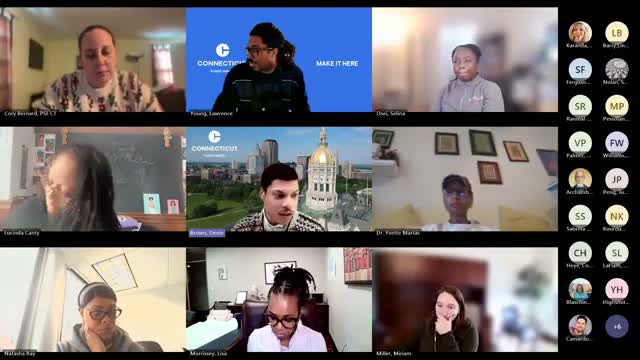
The Department of Public Health-led maternal health task force spent the meeting narrowing how it will structure subcommittees and how to include people with lived experience in its work.
Facilitators proposed four topic subcommittees—data, doula-friendly hospitals, perinatal mental health, and community & lived experience—and asked the group whether lived-experience participants should be concentrated in a single committee or represented across each technical committee. Members raised concerns that isolating lived experience risks marginalizing voices, while spreading lived-experience participants across committees risks losing qualitative insights.
"Lived experience is data and information," said Doctor Canty, arguing that qualitative testimony needs a clear, protected methodology to ensure contributions inform the task force’s work rather than being treated as anecdote.
Several members urged the group to define practical details before recruiting broadly: what roles people would play, expected time commitments, whether stipends would be offered, and what timeframe of experience (for example, births in the past 0–3 years) would be sought. Facilitators said those operational details are part of the subcommittee planning and that staff will circulate follow-up materials by email.
Proponents of a dedicated lived-experience subcommittee said it would protect space for qualitative voices and allow careful methodology for collecting stories; others said embedding people with lived experience on the subject subcommittees would better ensure those perspectives shape technical recommendations from the start.
The group agreed to continue refining the approach in subcommittee planning sessions and to share a proposed path forward and a follow-up survey inviting members to select which subcommittees they want to join. The facilitators said the aim is to move toward quarterly full-task-force meetings with monthly subcommittee meetings once membership is finalized.
Facilitators proposed four topic subcommittees—data, doula-friendly hospitals, perinatal mental health, and community & lived experience—and asked the group whether lived-experience participants should be concentrated in a single committee or represented across each technical committee. Members raised concerns that isolating lived experience risks marginalizing voices, while spreading lived-experience participants across committees risks losing qualitative insights.
"Lived experience is data and information," said Doctor Canty, arguing that qualitative testimony needs a clear, protected methodology to ensure contributions inform the task force’s work rather than being treated as anecdote.
Several members urged the group to define practical details before recruiting broadly: what roles people would play, expected time commitments, whether stipends would be offered, and what timeframe of experience (for example, births in the past 0–3 years) would be sought. Facilitators said those operational details are part of the subcommittee planning and that staff will circulate follow-up materials by email.
Proponents of a dedicated lived-experience subcommittee said it would protect space for qualitative voices and allow careful methodology for collecting stories; others said embedding people with lived experience on the subject subcommittees would better ensure those perspectives shape technical recommendations from the start.
The group agreed to continue refining the approach in subcommittee planning sessions and to share a proposed path forward and a follow-up survey inviting members to select which subcommittees they want to join. The facilitators said the aim is to move toward quarterly full-task-force meetings with monthly subcommittee meetings once membership is finalized.
Don't Miss a Word: See the Full Meeting!
Go beyond summaries. Unlock every video, transcript, and key insight with a Founder Membership.
✓
Get instant access to full meeting videos
✓
Search and clip any phrase from complete transcripts
✓
Receive AI-powered summaries & custom alerts
✓
Enjoy lifetime, unrestricted access to government data
30-day money-back guarantee
