Harford County, state advisers outline how small businesses can win government contracts
This article was created by AI summarizing key points discussed. AI makes mistakes, so for full details and context, please refer to the video of the full meeting. Please report any errors so we can fix them. Report an error »
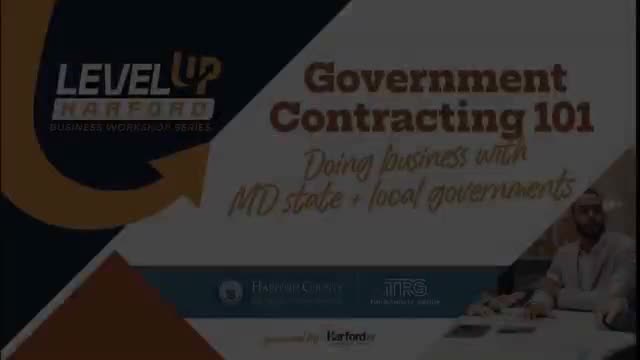
Harford County procurement officials and a state contracting consultant on Friday told a packed seminar that local firms can increase their chances of winning government work by registering on the county bid portal, understanding solicitation types and thresholds, and tailoring compliant proposals.
Spencer Vaughn, identified in the seminar as Harford County’s director of procurement, said the county wants to ‘‘grow local business’’ and that his team’s intent is to ‘‘provide the best value to our citizens.’’ Vaughn encouraged vendors to contact procurement staff with questions and said the county is reviewing updates to its procurement code to reduce barriers for small firms.
Keith Walcott, a procurement agent with Harford County, walked attendees through the county’s process. ‘‘Bonfire is where we're gonna post any of our solicitations,’’ he said, urging vendors to register on that portal. Walcott summarized the county’s purchasing thresholds explained in the presentation: typically one quote for very small purchases, a three-quote process in the $5,000–$24,999 range, formal competitive solicitations at $25,000 and above, and Board of Estimates review for higher-dollar awards. He also said construction projects exceeding $100,000 generally require contractor prequalification and warned that insurance requirements are often the toughest contracting hurdle.
Monica Randall of The Randall Group led the state-focused portion of the seminar, emphasizing that federal work first requires a SAM.gov registration and Maryland contracts are listed on EMaryland Market Advantage (EMMA). Randall advised vendors to set NAICS/UNSPSC codes and alerts so they receive relevant opportunities and to use procurement forecasts and pre-bid meetings to influence requirements before solicitations are finalized. ‘‘If you want to go after some of that $600,000,000,000 in a given year, you must first be registered in sam.gov,’’ she said.
Speakers urged practical steps to improve proposals and compliance: read solicitations multiple times, tailor proposal responses to each agency, attend pre-bid meetings and Q&A periods, and avoid adding materials the solicitation does not request. Randall relayed that federal contracting officers scrutinize proposals and that plainly AI‑generated, unedited responses can risk disqualification.
The presenters also described certification programs and goals that can affect competitiveness: the State’s Small Business Reserve (SBR) program, Minority Business Enterprise (MBE) goals, and veteran preferences. Randall said certifications do not substitute for capability and urged businesses to pursue certificates that fit their offerings. She framed a recommended strategy into three tracks — short-term work to ‘‘eat now,’’ procurement-forecast engagement to ‘‘eat later,’’ and in-person events and counseling to build relationships.
No formal votes or county actions were taken at the seminar. Presenters closed by offering one-on-one counseling and follow-up resources for Harford County vendors.
The county’s procurement team and The Randall Group provided contact information and encouraged vendors to register on Bonfire and EMMA, secure required state registrations (SDAT) for county work, and reach out for assistance with prequalification, insurance and proposal preparation. The seminar concluded with an offer of free one-on-one sessions to review businesses’ readiness for state and federal contracting.
Spencer Vaughn, identified in the seminar as Harford County’s director of procurement, said the county wants to ‘‘grow local business’’ and that his team’s intent is to ‘‘provide the best value to our citizens.’’ Vaughn encouraged vendors to contact procurement staff with questions and said the county is reviewing updates to its procurement code to reduce barriers for small firms.
Keith Walcott, a procurement agent with Harford County, walked attendees through the county’s process. ‘‘Bonfire is where we're gonna post any of our solicitations,’’ he said, urging vendors to register on that portal. Walcott summarized the county’s purchasing thresholds explained in the presentation: typically one quote for very small purchases, a three-quote process in the $5,000–$24,999 range, formal competitive solicitations at $25,000 and above, and Board of Estimates review for higher-dollar awards. He also said construction projects exceeding $100,000 generally require contractor prequalification and warned that insurance requirements are often the toughest contracting hurdle.
Monica Randall of The Randall Group led the state-focused portion of the seminar, emphasizing that federal work first requires a SAM.gov registration and Maryland contracts are listed on EMaryland Market Advantage (EMMA). Randall advised vendors to set NAICS/UNSPSC codes and alerts so they receive relevant opportunities and to use procurement forecasts and pre-bid meetings to influence requirements before solicitations are finalized. ‘‘If you want to go after some of that $600,000,000,000 in a given year, you must first be registered in sam.gov,’’ she said.
Speakers urged practical steps to improve proposals and compliance: read solicitations multiple times, tailor proposal responses to each agency, attend pre-bid meetings and Q&A periods, and avoid adding materials the solicitation does not request. Randall relayed that federal contracting officers scrutinize proposals and that plainly AI‑generated, unedited responses can risk disqualification.
The presenters also described certification programs and goals that can affect competitiveness: the State’s Small Business Reserve (SBR) program, Minority Business Enterprise (MBE) goals, and veteran preferences. Randall said certifications do not substitute for capability and urged businesses to pursue certificates that fit their offerings. She framed a recommended strategy into three tracks — short-term work to ‘‘eat now,’’ procurement-forecast engagement to ‘‘eat later,’’ and in-person events and counseling to build relationships.
No formal votes or county actions were taken at the seminar. Presenters closed by offering one-on-one counseling and follow-up resources for Harford County vendors.
The county’s procurement team and The Randall Group provided contact information and encouraged vendors to register on Bonfire and EMMA, secure required state registrations (SDAT) for county work, and reach out for assistance with prequalification, insurance and proposal preparation. The seminar concluded with an offer of free one-on-one sessions to review businesses’ readiness for state and federal contracting.
View the Full Meeting & All Its Details
This article offers just a summary. Unlock complete video, transcripts, and insights as a Founder Member.
✓
Watch full, unedited meeting videos
✓
Search every word spoken in unlimited transcripts
✓
AI summaries & real-time alerts (all government levels)
✓
Permanent access to expanding government content
30-day money-back guarantee
