Senate committee advances bill to bar minors from AI companions until 18, leaving implementation questions
February 19, 2026 | 2026 Legislature OK, Oklahoma
This article was created by AI summarizing key points discussed. AI makes mistakes, so for full details and context, please refer to the video of the full meeting. Please report any errors so we can fix them. Report an error »
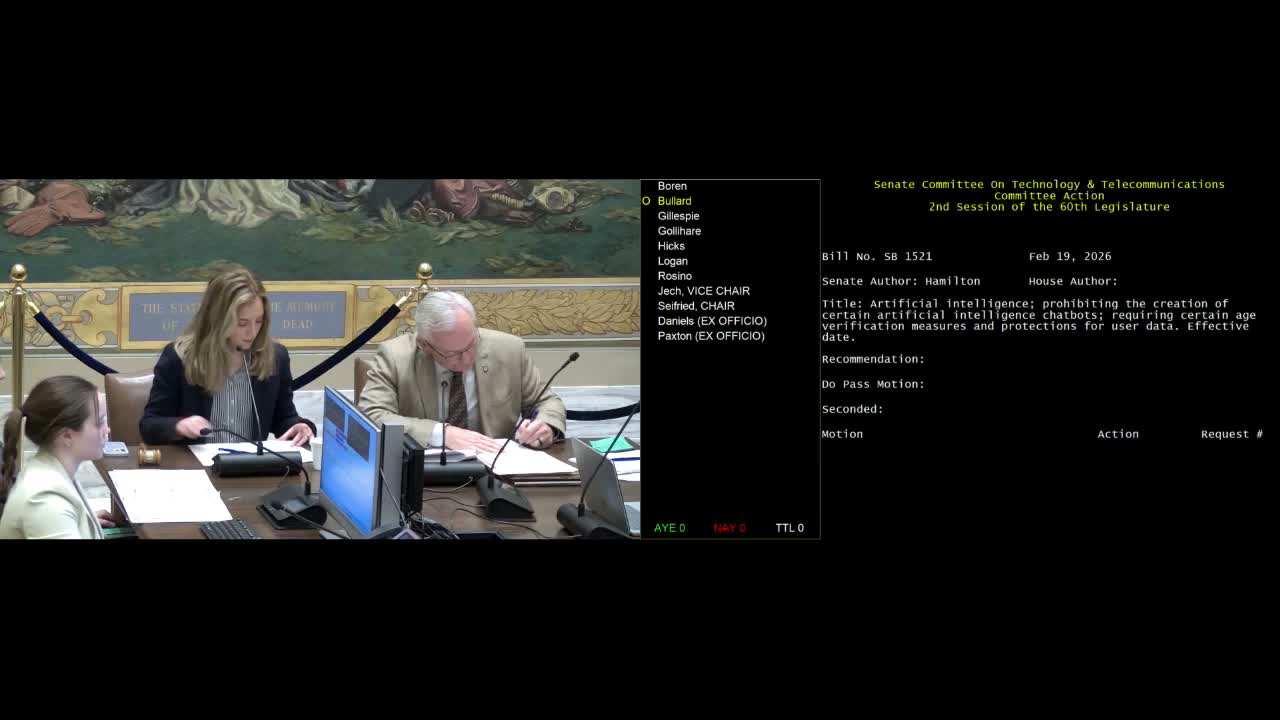
Senator Hamilton told the committee that Senate Bill 15 21 aims to "limit or prohibit minors access to artificial intelligence companions until they have attained the age of 18 years," citing interviews, academic experts and news investigations describing harmful interactions with AI companion services.
Hamilton said he had solicited input from medical and AI experts and from organizations focused on child protection and described rapid advances in AI capability in recent years. He cited research and media investigations that found frequent problematic interactions with companion-style AI profiles that claimed to be underage.
Committee members focused on how the bill would work in practice. Senator Hicks asked what would count as a "reasonable age verification measure;" Hamilton said legislators were considering requiring a government-issued ID upload via a third-party verifier (for example, providers like ID.me) but acknowledged implementation details—including how to prevent adults from enabling minors by uploading their own ID—remain unresolved.
Hamilton defended a proposed 30-minute reverification interval as a conservative measure to repeatedly remind users that they are interacting with a machine rather than a human. He told the committee he relied on guidance from groups such as the Center for Democracy & Technology when choosing that approach.
Vice Chair Yek urged consistent statutory definitions across bills that regulate digital platforms; Hamilton agreed. Committee members asked about penalties for explicit conduct and whether existing statutes already address some harms; Hamilton said the bill is intended to add protections without duplicating existing criminal statutes.
After questions and debate that emphasized the difficulty of operationalizing age checks, the committee voted 8-0 to advance the bill. Senators asked the sponsor and staff to refine the verification standards, clarify which identity documents will be acceptable, and examine whether the AG or another agency needs resources to enforce the law.
Hamilton said he had solicited input from medical and AI experts and from organizations focused on child protection and described rapid advances in AI capability in recent years. He cited research and media investigations that found frequent problematic interactions with companion-style AI profiles that claimed to be underage.
Committee members focused on how the bill would work in practice. Senator Hicks asked what would count as a "reasonable age verification measure;" Hamilton said legislators were considering requiring a government-issued ID upload via a third-party verifier (for example, providers like ID.me) but acknowledged implementation details—including how to prevent adults from enabling minors by uploading their own ID—remain unresolved.
Hamilton defended a proposed 30-minute reverification interval as a conservative measure to repeatedly remind users that they are interacting with a machine rather than a human. He told the committee he relied on guidance from groups such as the Center for Democracy & Technology when choosing that approach.
Vice Chair Yek urged consistent statutory definitions across bills that regulate digital platforms; Hamilton agreed. Committee members asked about penalties for explicit conduct and whether existing statutes already address some harms; Hamilton said the bill is intended to add protections without duplicating existing criminal statutes.
After questions and debate that emphasized the difficulty of operationalizing age checks, the committee voted 8-0 to advance the bill. Senators asked the sponsor and staff to refine the verification standards, clarify which identity documents will be acceptable, and examine whether the AG or another agency needs resources to enforce the law.
View the Full Meeting & All Its Details
This article offers just a summary. Unlock complete video, transcripts, and insights as a Founder Member.
✓
Watch full, unedited meeting videos
✓
Search every word spoken in unlimited transcripts
✓
AI summaries & real-time alerts (all government levels)
✓
Permanent access to expanding government content
30-day money-back guarantee
