Senate committee sends Larson’s out‑of‑school program funding plan to appropriations
February 15, 2026 | 2026 Legislature SD, South Dakota
This article was created by AI summarizing key points discussed. AI makes mistakes, so for full details and context, please refer to the video of the full meeting. Please report any errors so we can fix them. Report an error »
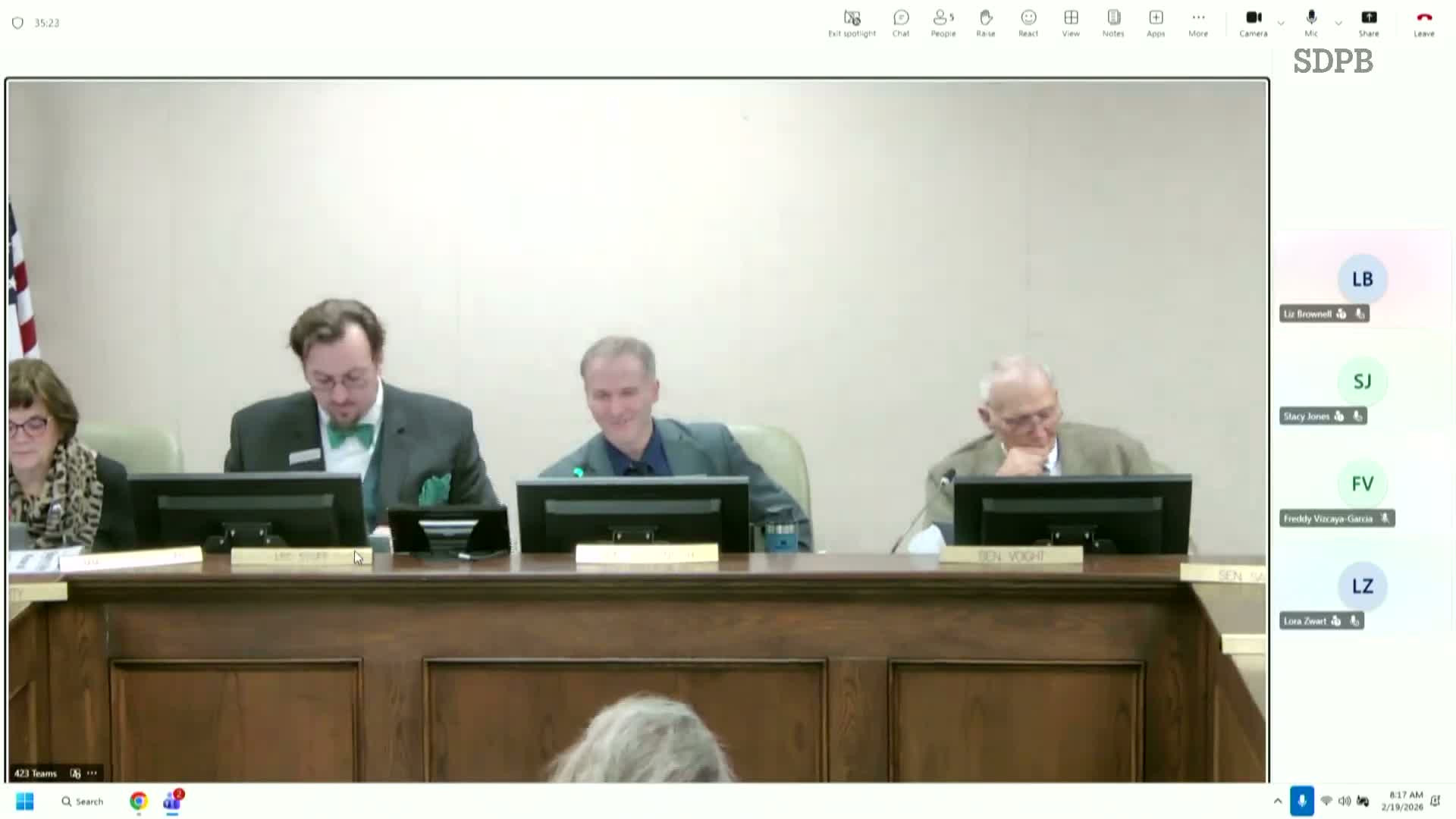
Sen. Liz Larson, D‑District 10, told the Senate Education Committee that Senate Bill 213 would establish a Building Opportunity Out‑of‑School Time program and seed it with a one‑time $2.5 million appropriation to the Department of Education.
"SB 213 is a one‑time $2,500,000 appropriation to the Department of Education to establish an out of school care grant program," Larson said, framing the proposal as both an education and workforce measure to expand supervised after‑school and summer programming.
Business and nonprofit supporters described demand and outcomes. Mike Bocherney, representing the South Dakota Association for the Education of Young Children and other groups, cited task‑force data saying roughly 42,000 school‑age children would participate if programs were available and that more than 32,000 children are unsupervised between 3 and 6 p.m. Bocherney said the bill pairs immediate family support with long‑term economic benefits.
Jennifer Stally of the Boys and Girls Clubs told the committee the grants would be limited to nonprofit providers or programs attached to school systems and said the one‑time funding (reported in committee as approximately $2.525 million) would be followed by ongoing funding generated by increasing the filing fee on business entities such as LLCs. Stally said the Department of Education would set grant criteria and that grantees would be limited to using no more than 10% of grant funds for administrative costs.
Opponents raised concerns about the proposed fee mechanism. Tom Diedrich, deputy secretary of state, said the change would concentrate increases on the Secretary of State’s annual filing fee (he described a roughly $35 increase from $55 to $90) and warned that removing that revenue from the office’s current balance could constrain its future discretionary uses.
Larson replied that the bill is a practical response to growing waiting lists and unmet need. After questions about allowable grant uses, staffing, transportation and administrative caps, the committee voted to move SB 213 to the Joint Committee on Appropriations with a do‑pass recommendation. The motion carried on a roll call showing four yeas, two nays and one excused.
Next steps: SB 213 goes to the Joint Committee on Appropriations for further consideration and fiscal review.
"SB 213 is a one‑time $2,500,000 appropriation to the Department of Education to establish an out of school care grant program," Larson said, framing the proposal as both an education and workforce measure to expand supervised after‑school and summer programming.
Business and nonprofit supporters described demand and outcomes. Mike Bocherney, representing the South Dakota Association for the Education of Young Children and other groups, cited task‑force data saying roughly 42,000 school‑age children would participate if programs were available and that more than 32,000 children are unsupervised between 3 and 6 p.m. Bocherney said the bill pairs immediate family support with long‑term economic benefits.
Jennifer Stally of the Boys and Girls Clubs told the committee the grants would be limited to nonprofit providers or programs attached to school systems and said the one‑time funding (reported in committee as approximately $2.525 million) would be followed by ongoing funding generated by increasing the filing fee on business entities such as LLCs. Stally said the Department of Education would set grant criteria and that grantees would be limited to using no more than 10% of grant funds for administrative costs.
Opponents raised concerns about the proposed fee mechanism. Tom Diedrich, deputy secretary of state, said the change would concentrate increases on the Secretary of State’s annual filing fee (he described a roughly $35 increase from $55 to $90) and warned that removing that revenue from the office’s current balance could constrain its future discretionary uses.
Larson replied that the bill is a practical response to growing waiting lists and unmet need. After questions about allowable grant uses, staffing, transportation and administrative caps, the committee voted to move SB 213 to the Joint Committee on Appropriations with a do‑pass recommendation. The motion carried on a roll call showing four yeas, two nays and one excused.
Next steps: SB 213 goes to the Joint Committee on Appropriations for further consideration and fiscal review.
View the Full Meeting & All Its Details
This article offers just a summary. Unlock complete video, transcripts, and insights as a Founder Member.
✓
Watch full, unedited meeting videos
✓
Search every word spoken in unlimited transcripts
✓
AI summaries & real-time alerts (all government levels)
✓
Permanent access to expanding government content
30-day money-back guarantee
