Committee advances bill requiring public vote for long‑term school capital certificates
February 15, 2026 | 2026 Legislature SD, South Dakota
This article was created by AI summarizing key points discussed. AI makes mistakes, so for full details and context, please refer to the video of the full meeting. Please report any errors so we can fix them. Report an error »
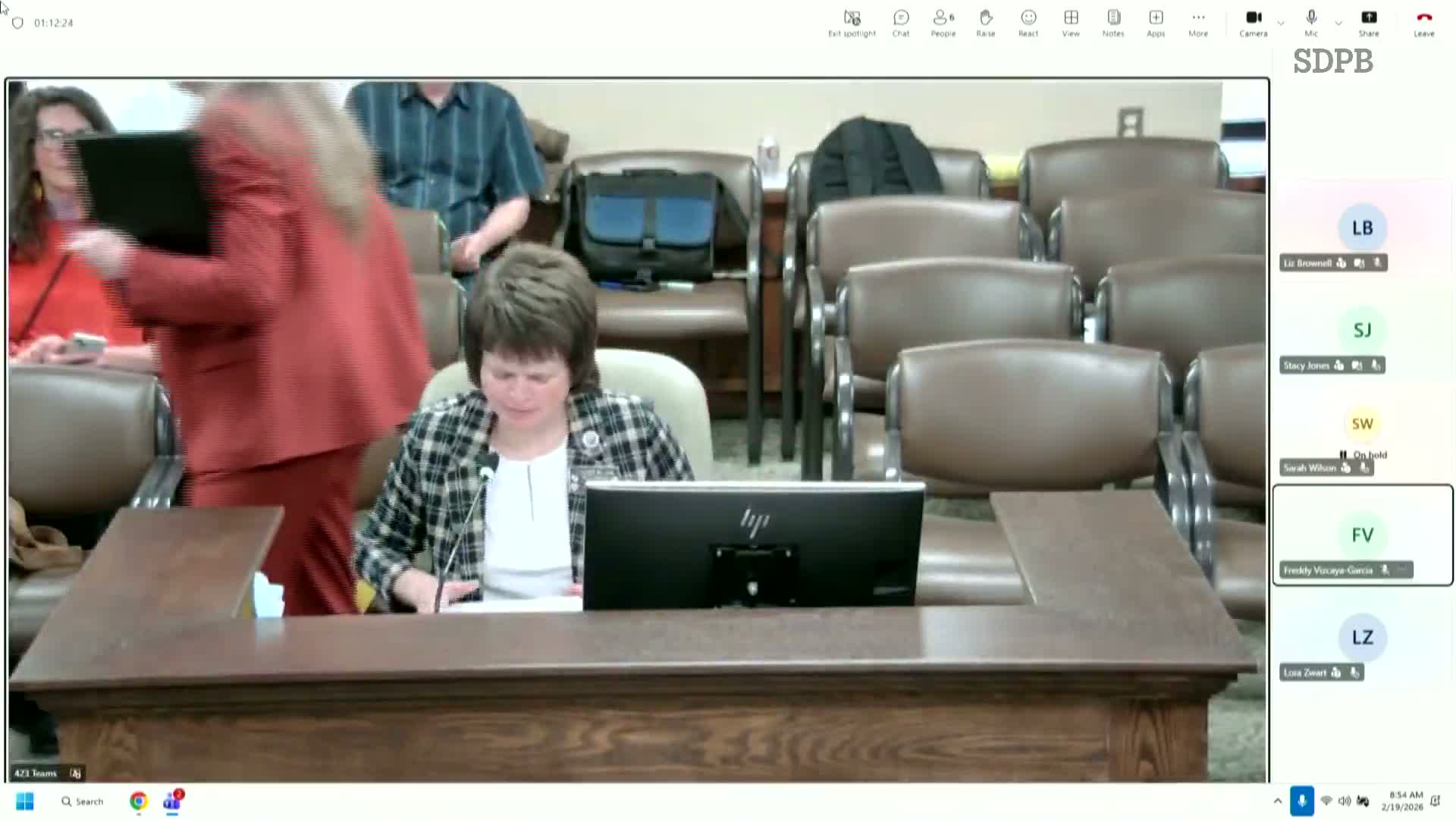
Sen. Lauren Nelson, R‑District 18, presented Senate Bill 229 to change how school districts may issue capital outlay certificates, proposing that issues with repayment schedules longer than 10 years require a public hearing and an election.
Nelson explained that under current law many districts can issue certificates without a public vote unless outstanding principal exceeds a statutory trigger tied to taxable valuation (1.5% in statute). She said that in some districts a series of certificates can be used to finance large projects without a referendum and urged greater transparency for longer‑term debt.
Proponents from across the state described situations they said illustrated the problem. Steve Sipson, a Mitchell resident and retired CPA, told the committee about local votes and subsequent additional certificates that increased long‑term debt and spurred litigation. Laura Zwart (Moody County) and Sarah Wilson (Brookings County) recounted local episodes where voters were denied an election and argued for clearer disclosure of repayment terms and interest.
Opponents including the Associated School Boards, school district lobbyists and administrators argued the proposal would impose costly required elections, risk voter fatigue, and weaken local boards’ ability to respond quickly to facility needs. Heath Larson (Associated School Boards) emphasized that certificates do not create a mill‑levy increase and cautioned against imposing additional election costs.
Sponsor Nelson said the bill — as amended — balances speedy responses for short‑term repairs (maturities under 10 years) while requiring public votes for longer maturities associated with large projects.
After extended testimony and questions, the committee voted to give SB 229 a do‑pass recommendation on a recorded roll call (4 yeas, 3 nays). The bill, with the amendment, will move forward for further floor consideration.
Nelson explained that under current law many districts can issue certificates without a public vote unless outstanding principal exceeds a statutory trigger tied to taxable valuation (1.5% in statute). She said that in some districts a series of certificates can be used to finance large projects without a referendum and urged greater transparency for longer‑term debt.
Proponents from across the state described situations they said illustrated the problem. Steve Sipson, a Mitchell resident and retired CPA, told the committee about local votes and subsequent additional certificates that increased long‑term debt and spurred litigation. Laura Zwart (Moody County) and Sarah Wilson (Brookings County) recounted local episodes where voters were denied an election and argued for clearer disclosure of repayment terms and interest.
Opponents including the Associated School Boards, school district lobbyists and administrators argued the proposal would impose costly required elections, risk voter fatigue, and weaken local boards’ ability to respond quickly to facility needs. Heath Larson (Associated School Boards) emphasized that certificates do not create a mill‑levy increase and cautioned against imposing additional election costs.
Sponsor Nelson said the bill — as amended — balances speedy responses for short‑term repairs (maturities under 10 years) while requiring public votes for longer maturities associated with large projects.
After extended testimony and questions, the committee voted to give SB 229 a do‑pass recommendation on a recorded roll call (4 yeas, 3 nays). The bill, with the amendment, will move forward for further floor consideration.
Don't Miss a Word: See the Full Meeting!
Go beyond summaries. Unlock every video, transcript, and key insight with a Founder Membership.
✓
Get instant access to full meeting videos
✓
Search and clip any phrase from complete transcripts
✓
Receive AI-powered summaries & custom alerts
✓
Enjoy lifetime, unrestricted access to government data
30-day money-back guarantee
