Residents urge protections for mobile-home homeowners and call for street-safety review after fatal crash
February 19, 2026 | Sonoma City, Sonoma County, California
This article was created by AI summarizing key points discussed. AI makes mistakes, so for full details and context, please refer to the video of the full meeting. Please report any errors so we can fix them. Report an error »
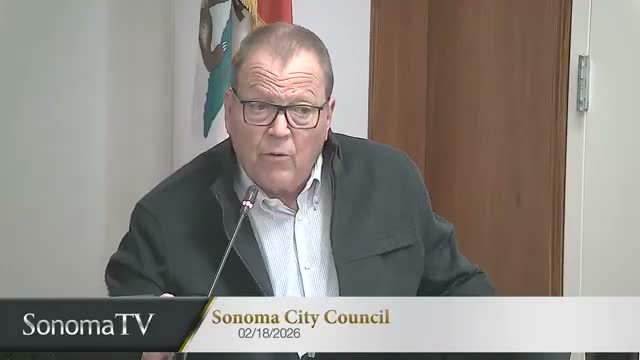
At the start of the Feb. 18 meeting, residents used the public-comment period to press the council on housing stability and street safety.
Lynn Marie De Vincent, Tri Park Committee coordinator for Sonoma's three mobile-home parks, told the council that those parks represent roughly 488 mobile homes—about 8.5% of the city's housing stock—and warned that recent private-equity purchases in neighboring jurisdictions have created a pattern of closures or conversions that put homeowners at risk. "If we mobile home park homeowners lose our homes, there is nowhere else around here that we can afford, and we will become homeless," De Vincent said, asking council to "direct staff on the closure and conversion ordinance to bring you options that are maximally protective for homeowners." She told the council that Petaluma mobile homeowners have spent more than $500,000 defending their investments.
Separately, resident Mike Menefee, responding to a fatal crash the prior evening, urged a review of vehicle, bicycle and pedestrian safety and said limited nighttime lighting and increased traffic volumes have made sections of Broadway and West Napa Street hazardous. "This isn't about blame," Menefee said. "It's about taking a hard look at lighting, maintenance, and safety, and making sure our streets are as safe at night as they are beautiful during the day." He noted that antique pedestal lighting has many bulbs out and a tree canopy reduces functional lighting.
Council did not take action on these non-agendized matters during the meeting but De Vincent's request dovetails with later agenda items and council priorities on housing and public safety; staff routinely tracks public comments and may return with options or add items to future study sessions. De Vincent asked council to prioritize ordinance options; Menefee sought near-term maintenance and a longer-term safety plan that could include improved lighting, signage and engineering remedies.
What happens next: Because these were non-agenda public comments, council did not vote; staff may follow up or bring policy options to a future study session or agenda item for potential ordinance change or capital maintenance work.
Lynn Marie De Vincent, Tri Park Committee coordinator for Sonoma's three mobile-home parks, told the council that those parks represent roughly 488 mobile homes—about 8.5% of the city's housing stock—and warned that recent private-equity purchases in neighboring jurisdictions have created a pattern of closures or conversions that put homeowners at risk. "If we mobile home park homeowners lose our homes, there is nowhere else around here that we can afford, and we will become homeless," De Vincent said, asking council to "direct staff on the closure and conversion ordinance to bring you options that are maximally protective for homeowners." She told the council that Petaluma mobile homeowners have spent more than $500,000 defending their investments.
Separately, resident Mike Menefee, responding to a fatal crash the prior evening, urged a review of vehicle, bicycle and pedestrian safety and said limited nighttime lighting and increased traffic volumes have made sections of Broadway and West Napa Street hazardous. "This isn't about blame," Menefee said. "It's about taking a hard look at lighting, maintenance, and safety, and making sure our streets are as safe at night as they are beautiful during the day." He noted that antique pedestal lighting has many bulbs out and a tree canopy reduces functional lighting.
Council did not take action on these non-agendized matters during the meeting but De Vincent's request dovetails with later agenda items and council priorities on housing and public safety; staff routinely tracks public comments and may return with options or add items to future study sessions. De Vincent asked council to prioritize ordinance options; Menefee sought near-term maintenance and a longer-term safety plan that could include improved lighting, signage and engineering remedies.
What happens next: Because these were non-agenda public comments, council did not vote; staff may follow up or bring policy options to a future study session or agenda item for potential ordinance change or capital maintenance work.
Don't Miss a Word: See the Full Meeting!
Go beyond summaries. Unlock every video, transcript, and key insight with a Founder Membership.
✓
Get instant access to full meeting videos
✓
Search and clip any phrase from complete transcripts
✓
Receive AI-powered summaries & custom alerts
✓
Enjoy lifetime, unrestricted access to government data
30-day money-back guarantee
