State Water Resources Control Board staff review EAR portal, DAC fee-reduction rules and data-entry expectations
February 20, 2026 | State Water Resources Control Board, Boards and Commissions, Executive, California
This article was created by AI summarizing key points discussed. AI makes mistakes, so for full details and context, please refer to the video of the full meeting. Please report any errors so we can fix them. Report an error »
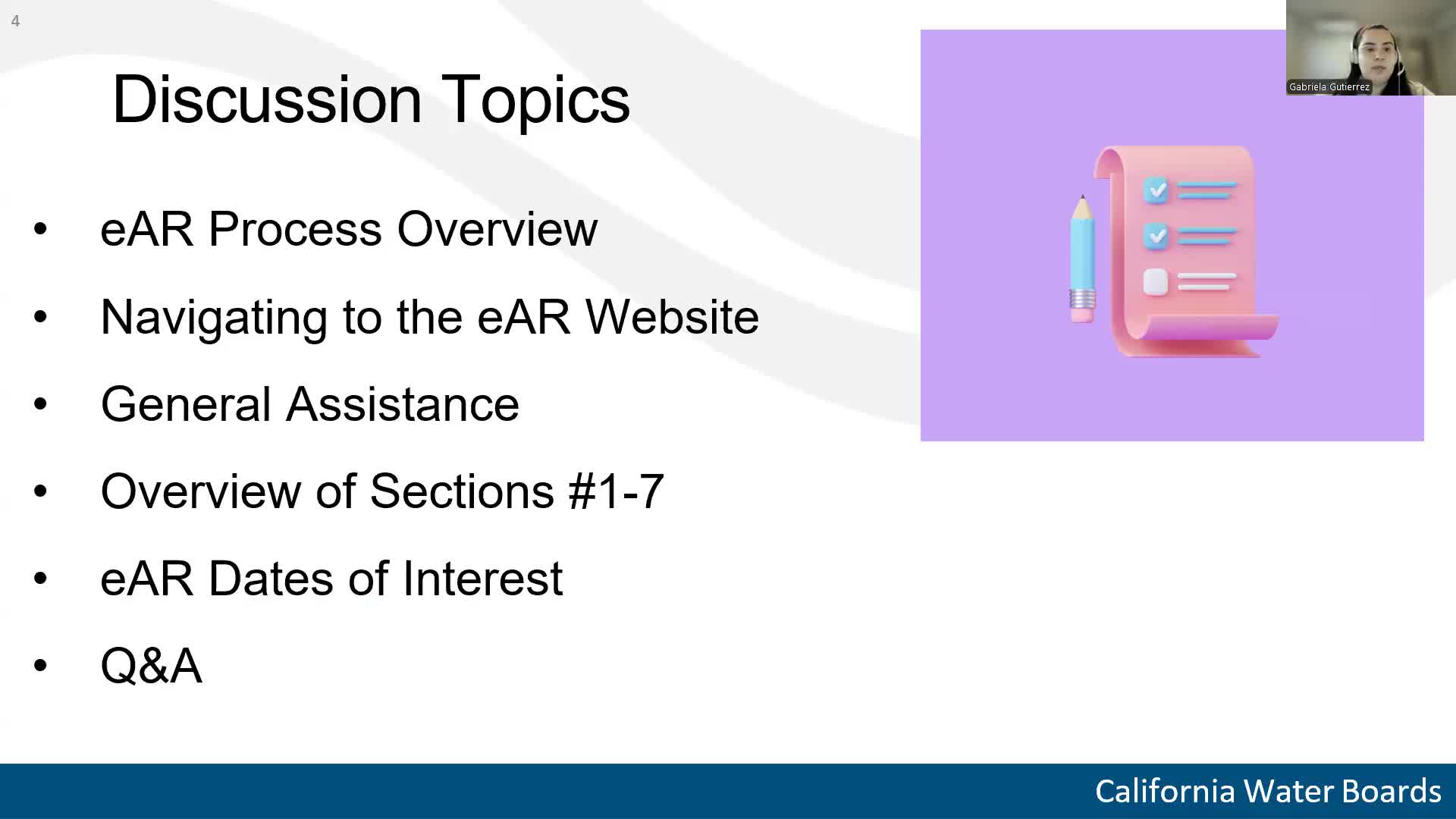
State Water Resources Control Board staff summarized how water systems should complete and submit the Electronic Annual Report (EAR) and where reporters can get help.
Gabriela Gutierrez, a customer service team member with the EAR program, opened the session and outlined the reporter workflow: start an EAR, submit it, await regulator review, and resubmit if the regulator returns the report for revisions. "We have found in the past years, that some water systems forget to resubmit after making those revisions," she said, urging reporters to complete the resubmission step so an EAR can be marked complete.
Why it matters: the EAR is the statewide reporting mechanism for drinking-water systems. Errors or missed conditional questions will appear as errors on the finalized page and prevent submission. Staff said some fields on the EAR are prefilled from the agency database and cannot be edited in the form; systems should contact their regulating agency to correct those base records.
Staff walked attendees through the EAR website and portal features. Sydney Sally, a newly introduced EAR customer service team member, showed the public EAR website accordions that contain login and reporting information, FAQs and technical-resources links, and pointed out where to find tutorial videos and downloadable EAR worksheets. "There'll be different accordions… those are drop downs, to that will give you more information about each 1 of those topics," she said.
DAC fee reduction and eligibility: Staff reviewed the disadvantaged-community (DAC) fee-reduction process in Section 1. For new DAC requests, applicants must check a disclaimer box and, for large water systems (1,000 or more service connections), also complete and upload a DAC certification form. Gabriela Gutierrez said the Division of Drinking Water begins reviewing DAC applications in August and approved DACs are applied to invoices for the subsequent billing cycle. She also clarified that DAC fee reductions apply only to community water systems regulated by the state and noted a planned change: for fiscal years 2026–27 the State Water Resources Control Board will determine DAC status, a change staff said will not affect the 2025–26 invoices mailed in December.
Sections 1–7 and data-entry rules: Staff summarized each section: mandatory vs. conditionally mandatory questions (highlighted in yellow or salmon on the form), contact editing rules, population-entry rules based on system classification (community, nontransient noncommunity, transient noncommunity, wholesaler), service-connection reporting (metered/unmetered; active/inactive), and source inventories for groundwater and surface-water intakes. They emphasized that some gray fields are pulled from the agency database and cannot be changed in the EAR; to correct those fields reporters must contact their regulating agency.
Portals and separate reports: Staff reminded attendees that the EAR and the SAFER Clearinghouse (which now hosts the annual inventory report and some supply/delivery questions formerly in Section 6) are separate portals and that both reports may be required depending on the system.
Support and resources: Staff encouraged systems that need help to apply for third-party technical assistance (application opened Feb. 1; deadline March 1) and pointed attendees to the EAR customer service request form and email address for specific section help. They also said the brown-bag recording and the Q&A transcript will be posted on the EAR website.
What’s next: staff announced additional brown-bag trainings for Section 8 (Feb. 26) and for sections 9 through finalizing the EAR (March 5) and reminded systems that the EAR is due to the Division on April 1.
The brown-bag closed after a question-and-answer period; staff asked attendees with specific issues (for example, finance questions for bankrupt systems) to email customer service or raise the issue in a future brown-bag for individualized guidance.
Gabriela Gutierrez, a customer service team member with the EAR program, opened the session and outlined the reporter workflow: start an EAR, submit it, await regulator review, and resubmit if the regulator returns the report for revisions. "We have found in the past years, that some water systems forget to resubmit after making those revisions," she said, urging reporters to complete the resubmission step so an EAR can be marked complete.
Why it matters: the EAR is the statewide reporting mechanism for drinking-water systems. Errors or missed conditional questions will appear as errors on the finalized page and prevent submission. Staff said some fields on the EAR are prefilled from the agency database and cannot be edited in the form; systems should contact their regulating agency to correct those base records.
Staff walked attendees through the EAR website and portal features. Sydney Sally, a newly introduced EAR customer service team member, showed the public EAR website accordions that contain login and reporting information, FAQs and technical-resources links, and pointed out where to find tutorial videos and downloadable EAR worksheets. "There'll be different accordions… those are drop downs, to that will give you more information about each 1 of those topics," she said.
DAC fee reduction and eligibility: Staff reviewed the disadvantaged-community (DAC) fee-reduction process in Section 1. For new DAC requests, applicants must check a disclaimer box and, for large water systems (1,000 or more service connections), also complete and upload a DAC certification form. Gabriela Gutierrez said the Division of Drinking Water begins reviewing DAC applications in August and approved DACs are applied to invoices for the subsequent billing cycle. She also clarified that DAC fee reductions apply only to community water systems regulated by the state and noted a planned change: for fiscal years 2026–27 the State Water Resources Control Board will determine DAC status, a change staff said will not affect the 2025–26 invoices mailed in December.
Sections 1–7 and data-entry rules: Staff summarized each section: mandatory vs. conditionally mandatory questions (highlighted in yellow or salmon on the form), contact editing rules, population-entry rules based on system classification (community, nontransient noncommunity, transient noncommunity, wholesaler), service-connection reporting (metered/unmetered; active/inactive), and source inventories for groundwater and surface-water intakes. They emphasized that some gray fields are pulled from the agency database and cannot be changed in the EAR; to correct those fields reporters must contact their regulating agency.
Portals and separate reports: Staff reminded attendees that the EAR and the SAFER Clearinghouse (which now hosts the annual inventory report and some supply/delivery questions formerly in Section 6) are separate portals and that both reports may be required depending on the system.
Support and resources: Staff encouraged systems that need help to apply for third-party technical assistance (application opened Feb. 1; deadline March 1) and pointed attendees to the EAR customer service request form and email address for specific section help. They also said the brown-bag recording and the Q&A transcript will be posted on the EAR website.
What’s next: staff announced additional brown-bag trainings for Section 8 (Feb. 26) and for sections 9 through finalizing the EAR (March 5) and reminded systems that the EAR is due to the Division on April 1.
The brown-bag closed after a question-and-answer period; staff asked attendees with specific issues (for example, finance questions for bankrupt systems) to email customer service or raise the issue in a future brown-bag for individualized guidance.
View the Full Meeting & All Its Details
This article offers just a summary. Unlock complete video, transcripts, and insights as a Founder Member.
✓
Watch full, unedited meeting videos
✓
Search every word spoken in unlimited transcripts
✓
AI summaries & real-time alerts (all government levels)
✓
Permanent access to expanding government content
30-day money-back guarantee
