Senate hearing on omnibus transportation bill covers digital IDs, ferry funding and contentious traffic-camera revenue shift
February 19, 2026 | Legislative Sessions, Washington
This article was created by AI summarizing key points discussed. AI makes mistakes, so for full details and context, please refer to the video of the full meeting. Please report any errors so we can fix them. Report an error »
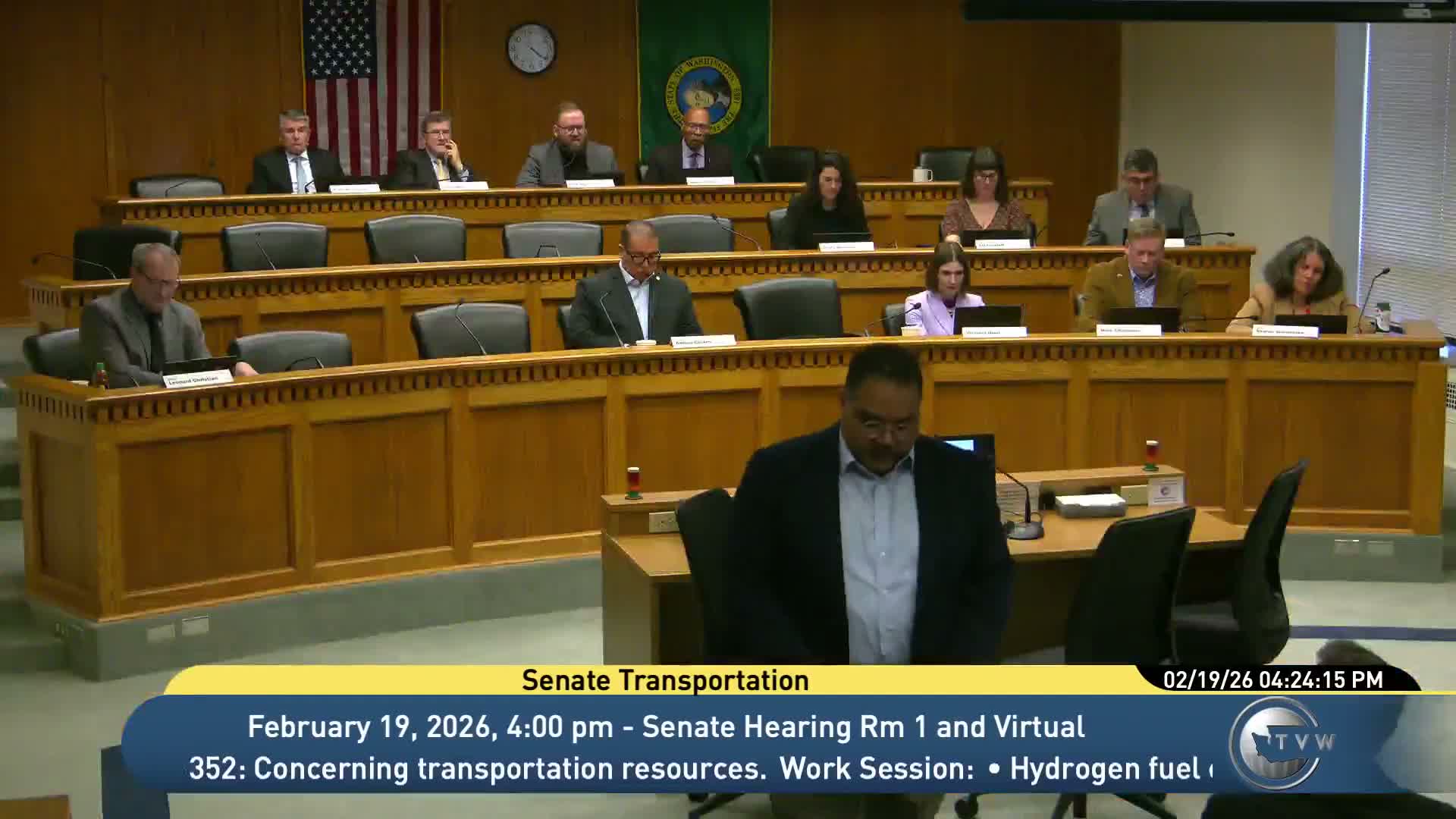
The Senate Transportation Committee held a public hearing Feb. 19 on Senate Bill 6,352, an omnibus transportation-resources bill that staffs said continues and revises provisions from last session’s ESSB 5,801.
Kelly Simpson, committee staff, introduced the measure as a lengthy resources bill with revenue and policy changes. Staff analyst Brian Moore walked members through several headline provisions: a mobile driver’s license and identicard program to be implemented by July 1, 2028 with a proposed $1 fee on applications to help fund implementation; a reduced-fee identicard for older drivers who surrender a license; renaming certain electric vehicle fees as "fix our road fees"; clarifications to fuel tax distributions; and a reallocation of a 0.1% sales-tax dedication so 25% would go to the Puget Sound Capital Construction account, 50% to Puget Sound Ferry operations, and 25% to the multimodal transportation account.
Moore also summarized changes to aircraft-related revenue: repeal of the luxury aircraft tax enacted in the previous session and increases to aircraft fuel and excise taxes to deposit into a sustainable aviation account. He noted the fiscal interactions: repeal of the luxury tax would reduce revenue but some of that loss would be partially offset by fuel and excise increases.
Several sections prompted extended public testimony. Transportation and transit stakeholders generally supported expanded eligibility for bus and bus-facility grants (allowing safety and security enhancements) and favored continuing the statewide school-based bicycle education grant (testimony cited program reach growing from roughly 39,000 students in its first biennium to about 60,000 this school year and projected 100,000 in 2027).
A point of sharp contention involved section 702, which would change traffic-camera revenue sharing to send 10% of gross revenues to the Cooper Jones active transportation safety account (staff described current law as 25% of net after costs). Multiple city officials testified that moving from 25% of net to 10% of gross would substantially increase the state’s share and reduce funds available for local safety projects. "For Bellevue's 14 new cameras scheduled for implementation later this year, our annual payment to the state would increase from approximately $327,000 to $644,000," Bellevue City Council member Jared Neuwenhouse said. Kenmore Mayor Nigel Herbig said the change would cost his city roughly $500,000 per year and proposed instead a small flat per-camera contribution.
Local government witnesses from Bellevue, Tacoma and Kenmore urged the committee to reconsider the revenue-sharing provision and suggested alternatives to preserve local reinvestment in intersection upgrades, safe routes to schools and active-transportation infrastructure. Tacoma’s testimony included an estimate that collection rates and administrative costs mean the proposed change could reduce net program funding by about $454,000 for the city’s pilot camera.
Other provisions covered in staff briefing and testimony included expanded clean-energy siting on WSDOT right of way, modifications to fish-passage barrier permitting, traffic-safety programs for older drivers, changes to automated enforcement rebuttal procedures, and a one-year delay proposed for a tow-truck reimbursement program established in the prior session. Committee staff said executive action will occur next week to give members time to work on amendments.
The hearing closed without votes. The committee recorded sign-ins (noting 12 pro, 935 con, and 3 other) and adjourned; executive action is scheduled the following week.
Kelly Simpson, committee staff, introduced the measure as a lengthy resources bill with revenue and policy changes. Staff analyst Brian Moore walked members through several headline provisions: a mobile driver’s license and identicard program to be implemented by July 1, 2028 with a proposed $1 fee on applications to help fund implementation; a reduced-fee identicard for older drivers who surrender a license; renaming certain electric vehicle fees as "fix our road fees"; clarifications to fuel tax distributions; and a reallocation of a 0.1% sales-tax dedication so 25% would go to the Puget Sound Capital Construction account, 50% to Puget Sound Ferry operations, and 25% to the multimodal transportation account.
Moore also summarized changes to aircraft-related revenue: repeal of the luxury aircraft tax enacted in the previous session and increases to aircraft fuel and excise taxes to deposit into a sustainable aviation account. He noted the fiscal interactions: repeal of the luxury tax would reduce revenue but some of that loss would be partially offset by fuel and excise increases.
Several sections prompted extended public testimony. Transportation and transit stakeholders generally supported expanded eligibility for bus and bus-facility grants (allowing safety and security enhancements) and favored continuing the statewide school-based bicycle education grant (testimony cited program reach growing from roughly 39,000 students in its first biennium to about 60,000 this school year and projected 100,000 in 2027).
A point of sharp contention involved section 702, which would change traffic-camera revenue sharing to send 10% of gross revenues to the Cooper Jones active transportation safety account (staff described current law as 25% of net after costs). Multiple city officials testified that moving from 25% of net to 10% of gross would substantially increase the state’s share and reduce funds available for local safety projects. "For Bellevue's 14 new cameras scheduled for implementation later this year, our annual payment to the state would increase from approximately $327,000 to $644,000," Bellevue City Council member Jared Neuwenhouse said. Kenmore Mayor Nigel Herbig said the change would cost his city roughly $500,000 per year and proposed instead a small flat per-camera contribution.
Local government witnesses from Bellevue, Tacoma and Kenmore urged the committee to reconsider the revenue-sharing provision and suggested alternatives to preserve local reinvestment in intersection upgrades, safe routes to schools and active-transportation infrastructure. Tacoma’s testimony included an estimate that collection rates and administrative costs mean the proposed change could reduce net program funding by about $454,000 for the city’s pilot camera.
Other provisions covered in staff briefing and testimony included expanded clean-energy siting on WSDOT right of way, modifications to fish-passage barrier permitting, traffic-safety programs for older drivers, changes to automated enforcement rebuttal procedures, and a one-year delay proposed for a tow-truck reimbursement program established in the prior session. Committee staff said executive action will occur next week to give members time to work on amendments.
The hearing closed without votes. The committee recorded sign-ins (noting 12 pro, 935 con, and 3 other) and adjourned; executive action is scheduled the following week.
View the Full Meeting & All Its Details
This article offers just a summary. Unlock complete video, transcripts, and insights as a Founder Member.
✓
Watch full, unedited meeting videos
✓
Search every word spoken in unlimited transcripts
✓
AI summaries & real-time alerts (all government levels)
✓
Permanent access to expanding government content
30-day money-back guarantee
