Committee hears bill to improve WSDOT notice for utility relocations tied to fish‑barrier projects
February 19, 2026 | Legislative Sessions, Washington
This article was created by AI summarizing key points discussed. AI makes mistakes, so for full details and context, please refer to the video of the full meeting. Please report any errors so we can fix them. Report an error »
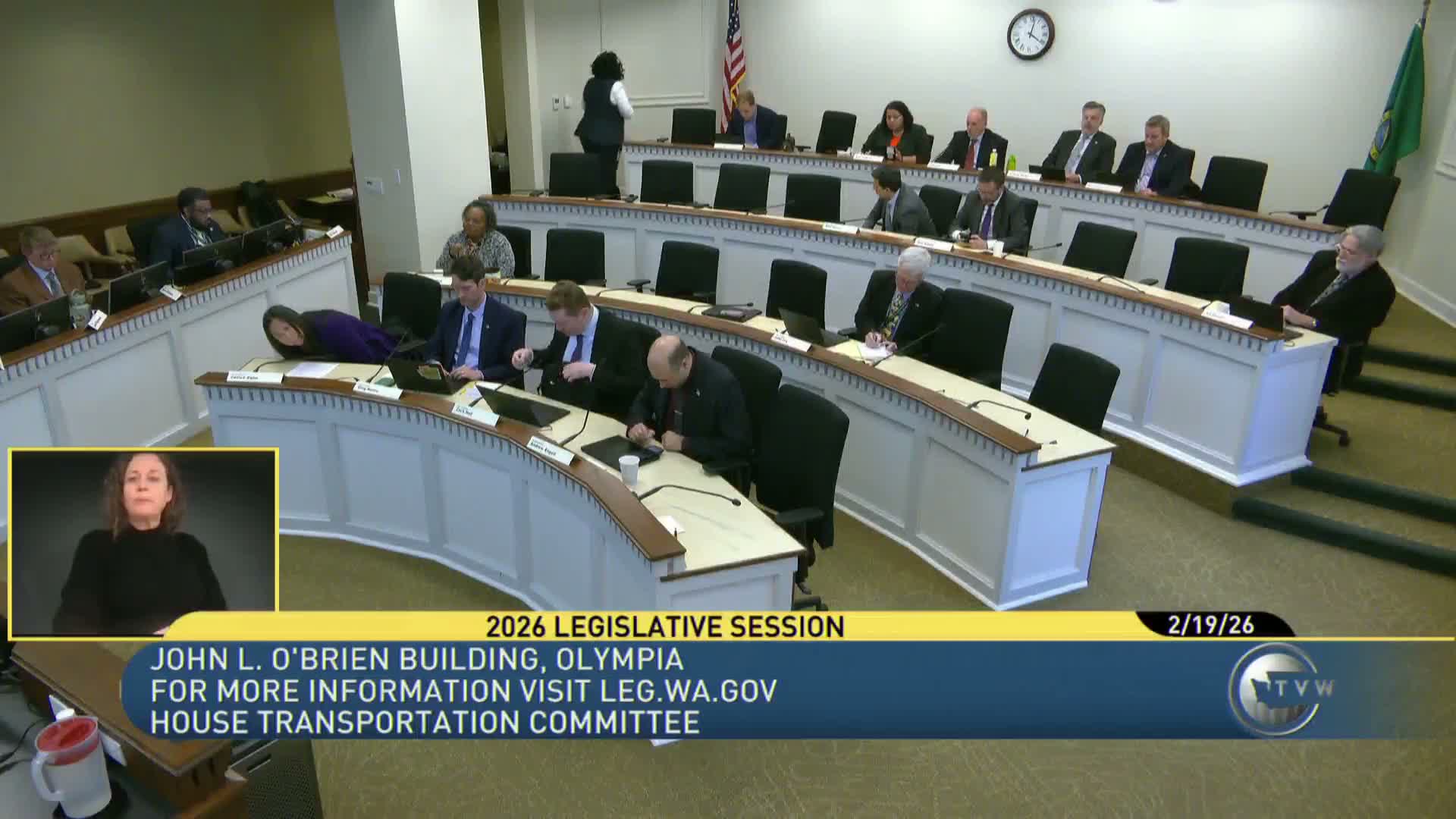
Second Substitute Senate Bill 5690 would direct the Washington State Department of Transportation to adopt policies that proactively provide utility owners with information about planned state highway fish‑barrier removal projects to enable coordination and to maximize federal funding for utility relocation costs.
Jennifer Harris, committee staff, told the panel the bill formalizes notice and coordination expectations and asks WSDOT to report to the Legislature and the Office of Financial Management on legal, rule or policy changes that would help the department or utilities receive federal grant funding or reimbursements more efficiently. Harris also noted the bill takes effect 90 days after the end of the legislative session.
Committee staff summarized the fiscal implications: local jurisdictions could see indeterminate revenue increases if they receive federal grants, while costs depend on the number and distribution of awards. A WSDOT estimate provided to the committee said the department would likely need one full‑time equivalent to track federal grant opportunities; staff estimated that position at about $160,000 in the first biennium and roughly $300,000 in ongoing costs.
Supporters at the public hearing said the bill would reduce needless expense and improve project sequencing. Bill Clark of the Washington Public Utility District Association said better notice and joint planning would help PUDs and WSDOT secure and use federal funds for relocations. Kevin VanDerweig of Thurston PUD and Ian Cope of Grays Harbor PUD described rising relocation costs and the importance of earlier notice so utilities can include relocations in capital budgets; Cope said his PUD still has more than $1,000,000 in projects to complete that relate to these relocations.
The staff record cited a 2013 U.S. District Court injunction requiring the state to replace culverts that most impair fish passage by 2030; that injunction was upheld by the Ninth Circuit and left unresolved at the U.S. Supreme Court by an equally divided court in 2018. Committee staff told members WSDOT has completed work on 176 fish barriers as of June 2025.
No formal action was taken in the committee during the hearing; the chair closed the public hearing on the bill after testimony and returned the committee to other business.
Jennifer Harris, committee staff, told the panel the bill formalizes notice and coordination expectations and asks WSDOT to report to the Legislature and the Office of Financial Management on legal, rule or policy changes that would help the department or utilities receive federal grant funding or reimbursements more efficiently. Harris also noted the bill takes effect 90 days after the end of the legislative session.
Committee staff summarized the fiscal implications: local jurisdictions could see indeterminate revenue increases if they receive federal grants, while costs depend on the number and distribution of awards. A WSDOT estimate provided to the committee said the department would likely need one full‑time equivalent to track federal grant opportunities; staff estimated that position at about $160,000 in the first biennium and roughly $300,000 in ongoing costs.
Supporters at the public hearing said the bill would reduce needless expense and improve project sequencing. Bill Clark of the Washington Public Utility District Association said better notice and joint planning would help PUDs and WSDOT secure and use federal funds for relocations. Kevin VanDerweig of Thurston PUD and Ian Cope of Grays Harbor PUD described rising relocation costs and the importance of earlier notice so utilities can include relocations in capital budgets; Cope said his PUD still has more than $1,000,000 in projects to complete that relate to these relocations.
The staff record cited a 2013 U.S. District Court injunction requiring the state to replace culverts that most impair fish passage by 2030; that injunction was upheld by the Ninth Circuit and left unresolved at the U.S. Supreme Court by an equally divided court in 2018. Committee staff told members WSDOT has completed work on 176 fish barriers as of June 2025.
No formal action was taken in the committee during the hearing; the chair closed the public hearing on the bill after testimony and returned the committee to other business.
View the Full Meeting & All Its Details
This article offers just a summary. Unlock complete video, transcripts, and insights as a Founder Member.
✓
Watch full, unedited meeting videos
✓
Search every word spoken in unlimited transcripts
✓
AI summaries & real-time alerts (all government levels)
✓
Permanent access to expanding government content
30-day money-back guarantee
