Committee hears testimony on bill to allow Medicaid payments for rural emergency hospitals
February 19, 2026 | Legislative Sessions, Washington
This article was created by AI summarizing key points discussed. AI makes mistakes, so for full details and context, please refer to the video of the full meeting. Please report any errors so we can fix them. Report an error »
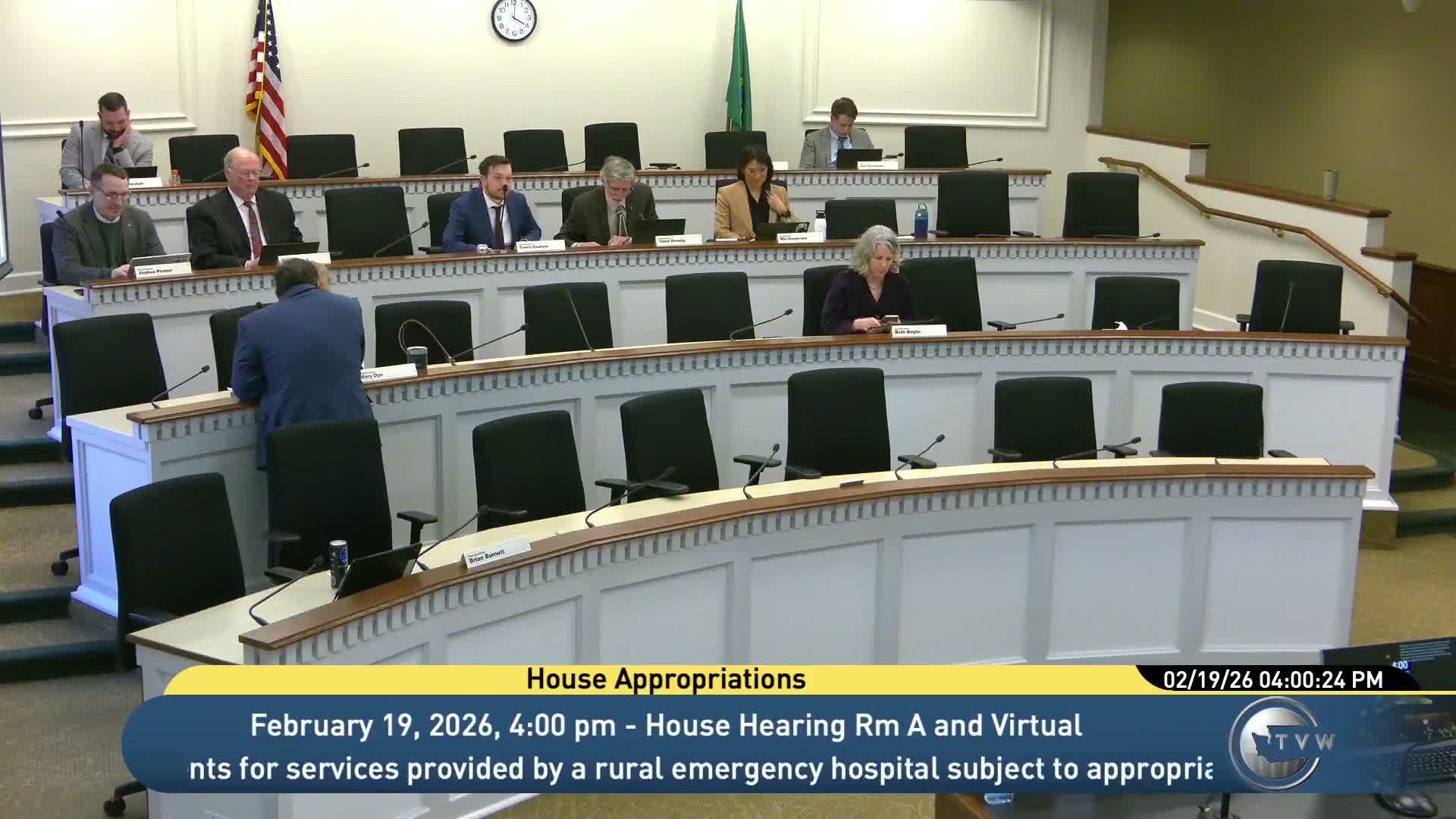
The House Appropriations Committee held a public hearing on Senate Bill 6103, which would allow medical-assistance payments to facilities the federal Centers for Medicare and Medicaid Services designates as rural emergency hospitals (REHs), committee staff and witnesses said.
Megan Morris, staff to the committee, told members that CMS established the REH provider type in 2020 and that certain critical access and rural hospitals certified to participate in Medicare as of Dec. 27, 2020, are eligible to convert. "Senate Bill 6103 relates to payments for rural emergency hospitals," Morris said, summarizing the bill's intent and its statutory placement.
The staff briefing outlined how REHs may provide emergency-department services, observation care and outpatient services but must keep the annual per-patient average length of stay at or below 24 hours. Under federal rules, Morris said Medicare pays REHs at 105% of the outpatient prospective payment system rate, while Medicaid payment policy for REHs is set at the state level.
Lisa Thatcher, representing the Washington State Hospital Association, testified in support, saying the bill would add the federal REH designation into state Medicaid law so these facilities could be treated similarly to critical access hospitals for cost-based reimbursement. "It is a bill that's important and timely," Thatcher said, and she commended staff and agency input on the measure.
Todd Nida, chief executive officer of East Adams Rural Healthcare, said his public hospital district is pursuing conversion to a rural emergency hospital and described the conversion as a survival strategy in the face of rural hospital closures. Nida said federal CMS guidance includes an annual subsidy estimate of about $3,400,000 under the REH model and warned, "Without legislative action, converting to an REH would result in a reduction in reimbursement without the necessary offset to survive."
Committee staff noted the electronic bill book (EBB) fiscal note lists no state fiscal impact for SB 6103. No questions from committee members were recorded during the hearing, and no formal action or vote occurred on the bill at the session.
Chair Ormsby closed the public hearing and provided committee scheduling: a public budget release on Sunday, Feb. 22, at 4 p.m.; a public hearing on Monday, Feb. 23, at 4 p.m.; committee amendment requests to staff due Tuesday, Feb. 24, at 10 a.m.; and anticipated executive action Wednesday, Feb. 25, at 4 p.m. The committee adjourned without taking a vote on SB 6103.
Megan Morris, staff to the committee, told members that CMS established the REH provider type in 2020 and that certain critical access and rural hospitals certified to participate in Medicare as of Dec. 27, 2020, are eligible to convert. "Senate Bill 6103 relates to payments for rural emergency hospitals," Morris said, summarizing the bill's intent and its statutory placement.
The staff briefing outlined how REHs may provide emergency-department services, observation care and outpatient services but must keep the annual per-patient average length of stay at or below 24 hours. Under federal rules, Morris said Medicare pays REHs at 105% of the outpatient prospective payment system rate, while Medicaid payment policy for REHs is set at the state level.
Lisa Thatcher, representing the Washington State Hospital Association, testified in support, saying the bill would add the federal REH designation into state Medicaid law so these facilities could be treated similarly to critical access hospitals for cost-based reimbursement. "It is a bill that's important and timely," Thatcher said, and she commended staff and agency input on the measure.
Todd Nida, chief executive officer of East Adams Rural Healthcare, said his public hospital district is pursuing conversion to a rural emergency hospital and described the conversion as a survival strategy in the face of rural hospital closures. Nida said federal CMS guidance includes an annual subsidy estimate of about $3,400,000 under the REH model and warned, "Without legislative action, converting to an REH would result in a reduction in reimbursement without the necessary offset to survive."
Committee staff noted the electronic bill book (EBB) fiscal note lists no state fiscal impact for SB 6103. No questions from committee members were recorded during the hearing, and no formal action or vote occurred on the bill at the session.
Chair Ormsby closed the public hearing and provided committee scheduling: a public budget release on Sunday, Feb. 22, at 4 p.m.; a public hearing on Monday, Feb. 23, at 4 p.m.; committee amendment requests to staff due Tuesday, Feb. 24, at 10 a.m.; and anticipated executive action Wednesday, Feb. 25, at 4 p.m. The committee adjourned without taking a vote on SB 6103.
View the Full Meeting & All Its Details
This article offers just a summary. Unlock complete video, transcripts, and insights as a Founder Member.
✓
Watch full, unedited meeting videos
✓
Search every word spoken in unlimited transcripts
✓
AI summaries & real-time alerts (all government levels)
✓
Permanent access to expanding government content
30-day money-back guarantee
