Washington bill would create a Heritage Orchard Registry at WSU to preserve rare apple varieties
February 19, 2026 | Legislative Sessions, Washington
This article was created by AI summarizing key points discussed. AI makes mistakes, so for full details and context, please refer to the video of the full meeting. Please report any errors so we can fix them. Report an error »
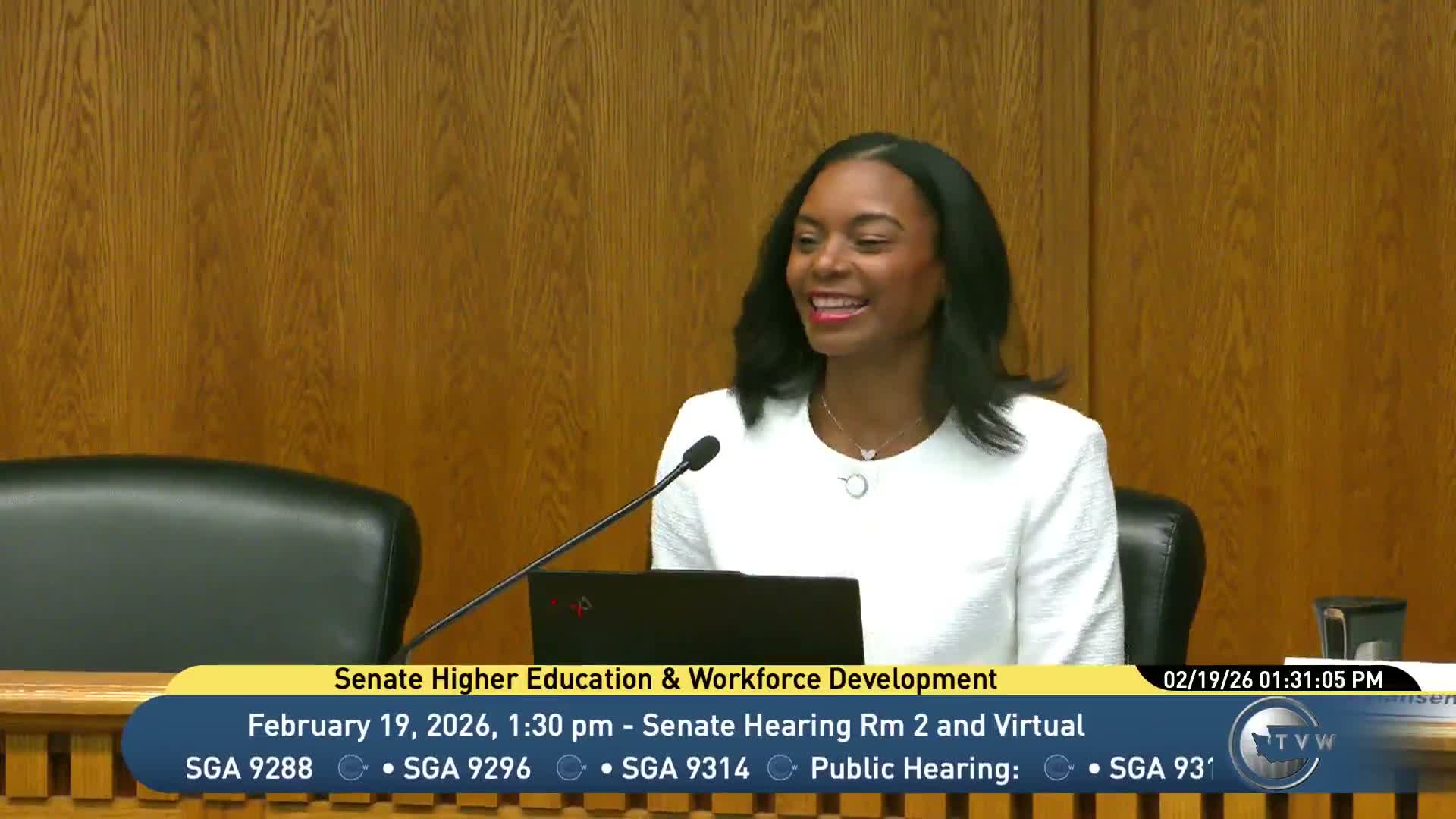
Representative Gloria Mendoza, sponsor of House Bill 2525, told the Senate Higher Education and Workforce Development Committee that the bill would create a Heritage Orchard Program at Washington State University to identify and preserve rare apple varieties growing on small farms across the state.
"Washington is the leading apple producing state in the nation, accounting for more than 60% of U.S. apple production," Representative Gloria Mendoza said, arguing that the measure would protect varieties that once numbered in the tens of thousands but have dwindled under commercial production pressures.
The bill, as briefed by staffer Kelly Gunn, would require Washington State University to maintain a registry of heritage orchards and to develop and maintain a list of rare and lost apple varieties. Gunn told the committee the current substitute reduces several obligations in an earlier draft to two primary duties and includes a null-and-void clause; a fiscal note is available in the EBB.
Mendoza described the measure as both an economic and cultural preservation effort. She said researchers working with Washington State University have already identified dozens of rare and historic apple trees still growing on family farms, some more than 75 years old, and that the program would support preservation efforts and research.
Committee members asked whether the registry would include roadside or "random" trees and how researchers would identify candidates. Mendoza replied that the intent is to capture trees found in the landscape and to register them so that rare varieties are not lost: "That's the idea that there are still apple trees growing in parts of our state that we believe to have been extinct," she said.
The committee waived the five-day notice rule at the start of the session so it could consider the substitute bill. Chair Nobles closed the public hearing after questions and moved the panel on to subsequent items on the agenda.
The bill file includes a fiscal note; the committee did not take a final vote on the measure during this session. If advanced, the program would formalize a partnership with WSU to document and support preservation of heritage orchards across Washington.
"Washington is the leading apple producing state in the nation, accounting for more than 60% of U.S. apple production," Representative Gloria Mendoza said, arguing that the measure would protect varieties that once numbered in the tens of thousands but have dwindled under commercial production pressures.
The bill, as briefed by staffer Kelly Gunn, would require Washington State University to maintain a registry of heritage orchards and to develop and maintain a list of rare and lost apple varieties. Gunn told the committee the current substitute reduces several obligations in an earlier draft to two primary duties and includes a null-and-void clause; a fiscal note is available in the EBB.
Mendoza described the measure as both an economic and cultural preservation effort. She said researchers working with Washington State University have already identified dozens of rare and historic apple trees still growing on family farms, some more than 75 years old, and that the program would support preservation efforts and research.
Committee members asked whether the registry would include roadside or "random" trees and how researchers would identify candidates. Mendoza replied that the intent is to capture trees found in the landscape and to register them so that rare varieties are not lost: "That's the idea that there are still apple trees growing in parts of our state that we believe to have been extinct," she said.
The committee waived the five-day notice rule at the start of the session so it could consider the substitute bill. Chair Nobles closed the public hearing after questions and moved the panel on to subsequent items on the agenda.
The bill file includes a fiscal note; the committee did not take a final vote on the measure during this session. If advanced, the program would formalize a partnership with WSU to document and support preservation of heritage orchards across Washington.
View the Full Meeting & All Its Details
This article offers just a summary. Unlock complete video, transcripts, and insights as a Founder Member.
✓
Watch full, unedited meeting videos
✓
Search every word spoken in unlimited transcripts
✓
AI summaries & real-time alerts (all government levels)
✓
Permanent access to expanding government content
30-day money-back guarantee
