TennCare clarifies 'good cause' review for late appeals after emotional testimony, committee sends mixed recommendations
February 19, 2026 | 2026 Legislature TN, Tennessee
This article was created by AI summarizing key points discussed. AI makes mistakes, so for full details and context, please refer to the video of the full meeting. Please report any errors so we can fix them. Report an error »
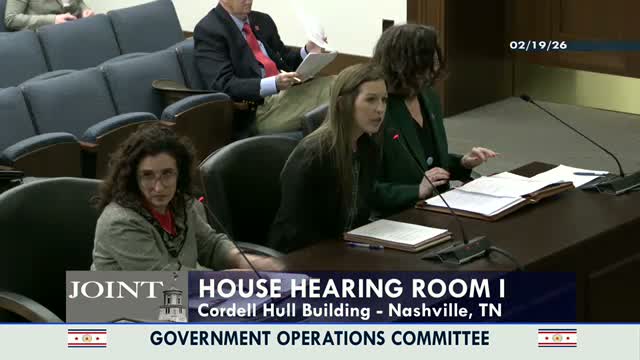
TennCare told the Joint Government Operations Committee it is formalizing a long-standing internal process that permits the agency to accept late eligibility appeals if there is a sufficient justification, a procedure officials call a "good cause" review.
The amendments, presented by Amanda Petri, associate counsel for TennCare, Kim Hagan, director of member services, and Lindsay Wagner (general counsel), do not change the underlying appeals path for timely filings, the agency said. Instead, the rule clarifies when and how TennCare will perform an informal intake review of appeals filed after the 40‑day deadline and lists illustrative examples of acceptable justifications, such as hospitalization or other serious circumstances.
Why it matters: TennCare covers about 1.4 million Tennesseans, and the directive affects how the agency responds when notices are missed or mailed to the wrong address. Committee members raised repeated concerns that relying on internal staff reviews might leave beneficiaries without timely access to care and asked how returned mail, electronic notices, and re‑application pathways were managed.
TennCare officials said good-cause reviews have not historically been sent to an administrative judge and are ‘‘very liberal’’ in practice. "These good cause reviews have never gone to hearing," said Kim Hagan, TennCare director of member services. Lindsey Wagner added that the rule is only an intake step to determine whether a late filing should proceed; if accepted, the appeal moves forward through the same adjudicative processes and, if closed as untimely, remains subject to judicial review under state law.
Public testimony: The hearing included an emotional public comment from Keith Caudill, who described his daughter’s coverage termination in June 2023 and later reinstatement after an eight‑day lapse. "Eight days is important to my daughter," Caudill said, urging the committee to preserve impartial adjudication rather than leave late‑filing screening solely to agency staff. TennCare staff told the committee Mr. Caudill’s case did not go to the appeals judge because no timely appeal was filed; the family instead filed a new application that ultimately led to reinstatement.
What the committee did: After extended questioning and public testimony, the Senate recorded a result that moved the rule out of committee with no recommendation (Senate tally: 4 ayes, 1 no recorded). The House later gave a positive recommendation.
What to watch next: TennCare said it will make notices available via multiple channels (mail, an online portal, email and text prompts), and staff recommended re‑application as a fast path to restoration of coverage while appeals are pending. The committee encouraged the agency to continue improving notice processes and to monitor the rule’s application.
Vote and procedural status: The committee record shows the Senate did not issue a positive recommendation; the House issued a positive recommendation. TennCare highlighted that any agency dismissal of an untimely appeal remains subject to judicial review under TCA 4‑5‑322.
The amendments, presented by Amanda Petri, associate counsel for TennCare, Kim Hagan, director of member services, and Lindsay Wagner (general counsel), do not change the underlying appeals path for timely filings, the agency said. Instead, the rule clarifies when and how TennCare will perform an informal intake review of appeals filed after the 40‑day deadline and lists illustrative examples of acceptable justifications, such as hospitalization or other serious circumstances.
Why it matters: TennCare covers about 1.4 million Tennesseans, and the directive affects how the agency responds when notices are missed or mailed to the wrong address. Committee members raised repeated concerns that relying on internal staff reviews might leave beneficiaries without timely access to care and asked how returned mail, electronic notices, and re‑application pathways were managed.
TennCare officials said good-cause reviews have not historically been sent to an administrative judge and are ‘‘very liberal’’ in practice. "These good cause reviews have never gone to hearing," said Kim Hagan, TennCare director of member services. Lindsey Wagner added that the rule is only an intake step to determine whether a late filing should proceed; if accepted, the appeal moves forward through the same adjudicative processes and, if closed as untimely, remains subject to judicial review under state law.
Public testimony: The hearing included an emotional public comment from Keith Caudill, who described his daughter’s coverage termination in June 2023 and later reinstatement after an eight‑day lapse. "Eight days is important to my daughter," Caudill said, urging the committee to preserve impartial adjudication rather than leave late‑filing screening solely to agency staff. TennCare staff told the committee Mr. Caudill’s case did not go to the appeals judge because no timely appeal was filed; the family instead filed a new application that ultimately led to reinstatement.
What the committee did: After extended questioning and public testimony, the Senate recorded a result that moved the rule out of committee with no recommendation (Senate tally: 4 ayes, 1 no recorded). The House later gave a positive recommendation.
What to watch next: TennCare said it will make notices available via multiple channels (mail, an online portal, email and text prompts), and staff recommended re‑application as a fast path to restoration of coverage while appeals are pending. The committee encouraged the agency to continue improving notice processes and to monitor the rule’s application.
Vote and procedural status: The committee record shows the Senate did not issue a positive recommendation; the House issued a positive recommendation. TennCare highlighted that any agency dismissal of an untimely appeal remains subject to judicial review under TCA 4‑5‑322.
View the Full Meeting & All Its Details
This article offers just a summary. Unlock complete video, transcripts, and insights as a Founder Member.
✓
Watch full, unedited meeting videos
✓
Search every word spoken in unlimited transcripts
✓
AI summaries & real-time alerts (all government levels)
✓
Permanent access to expanding government content
30-day money-back guarantee
