State demographer: Minnesota’s labor‑force growth slowed; migration drove recent gains
February 19, 2026 | 2026 Legislature MN, Minnesota
This article was created by AI summarizing key points discussed. AI makes mistakes, so for full details and context, please refer to the video of the full meeting. Please report any errors so we can fix them. Report an error »
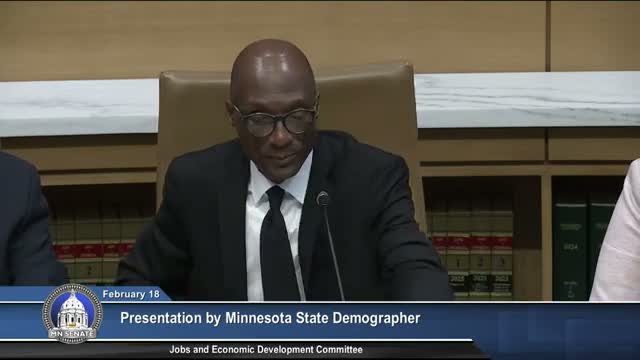
Susan Brower, Minnesota’s state demographer, told the Senate Committee on Jobs and Economic Development on Feb. 18 that long‑term demographic trends — an aging population and lower birth rates — have slowed labor‑force growth and that recent increases were driven largely by immigration.
Brower said participation among people in their prime working years remains high and that future gains will depend less on job creation than on removing barriers that prevent people from working. “The question is less about whether the jobs exist, and more about whether work is accessible to people,” she said.
Using federal and state data, Brower described three age groups (16–24; 25–64; 65+) and showed that the share of prime‑age workers has leveled off as baby boomers have reached retirement. She said Minnesota’s labor‑force growth has moderated from the 1990s peak of about 1.5–2% annual growth to approximately 0.5% in the early 2020s.
Brower highlighted migration as a near‑term source of workforce change. She identified two periods in which international migration meaningfully boosted the labor force — roughly 2014–2016 and 2022–2024 — and said the state gained an estimated 33,000 people from international migration in 2024 compared with about 12,500 in the partial 2025 estimate. She cautioned that if international inflows slow, Minnesota’s labor‑force growth will likely return to the slower rates set by underlying demographics.
Brower also quantified the population not in the labor force and the policy implications. In 2024, about 643,000 working‑age Minnesotans were outside the labor force: roughly 186,000 were enrolled in school, about 104,000 were retired early (ages 55–64), approximately 178,000 reported a disability (about 42,000 of whom receive Supplemental Security Income), and about 64,000 were parents of children ages 0–5. She said these groups face distinct barriers — including childcare availability, transportation, disability accommodations and credential recognition for immigrants — that must be addressed through targeted policy.
Committee members asked for further analysis tying migration trends to economic output and jobs; Brower said she did not have dollar estimates on hand but offered to follow up. Senators also questioned the causes of declining participation among younger age groups; Brower said she had not seen a definitive study but suggested changing work and educational patterns may play a role.
The committee asked Brower to provide follow‑up figures and accepted her overview as context for forthcoming DEED testimony on workforce programs.
Brower said participation among people in their prime working years remains high and that future gains will depend less on job creation than on removing barriers that prevent people from working. “The question is less about whether the jobs exist, and more about whether work is accessible to people,” she said.
Using federal and state data, Brower described three age groups (16–24; 25–64; 65+) and showed that the share of prime‑age workers has leveled off as baby boomers have reached retirement. She said Minnesota’s labor‑force growth has moderated from the 1990s peak of about 1.5–2% annual growth to approximately 0.5% in the early 2020s.
Brower highlighted migration as a near‑term source of workforce change. She identified two periods in which international migration meaningfully boosted the labor force — roughly 2014–2016 and 2022–2024 — and said the state gained an estimated 33,000 people from international migration in 2024 compared with about 12,500 in the partial 2025 estimate. She cautioned that if international inflows slow, Minnesota’s labor‑force growth will likely return to the slower rates set by underlying demographics.
Brower also quantified the population not in the labor force and the policy implications. In 2024, about 643,000 working‑age Minnesotans were outside the labor force: roughly 186,000 were enrolled in school, about 104,000 were retired early (ages 55–64), approximately 178,000 reported a disability (about 42,000 of whom receive Supplemental Security Income), and about 64,000 were parents of children ages 0–5. She said these groups face distinct barriers — including childcare availability, transportation, disability accommodations and credential recognition for immigrants — that must be addressed through targeted policy.
Committee members asked for further analysis tying migration trends to economic output and jobs; Brower said she did not have dollar estimates on hand but offered to follow up. Senators also questioned the causes of declining participation among younger age groups; Brower said she had not seen a definitive study but suggested changing work and educational patterns may play a role.
The committee asked Brower to provide follow‑up figures and accepted her overview as context for forthcoming DEED testimony on workforce programs.
Don't Miss a Word: See the Full Meeting!
Go beyond summaries. Unlock every video, transcript, and key insight with a Founder Membership.
✓
Get instant access to full meeting videos
✓
Search and clip any phrase from complete transcripts
✓
Receive AI-powered summaries & custom alerts
✓
Enjoy lifetime, unrestricted access to government data
30-day money-back guarantee
