PELSB tells Minnesota Senate committee teacher shortages persist; highlights special education demand and five-year attrition
February 19, 2026 | 2026 Legislature MN, Minnesota
This article was created by AI summarizing key points discussed. AI makes mistakes, so for full details and context, please refer to the video of the full meeting. Please report any errors so we can fix them. Report an error »
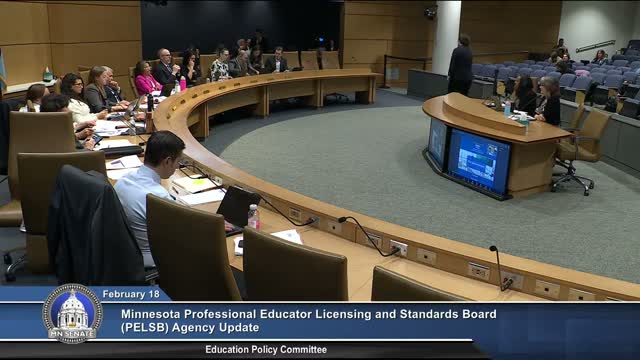
The Professional Educator Licensing and Standards Board (PELSB) presented its supply-and-demand report to the Minnesota Senate Education Policy Committee, reporting persistent gaps in high-demand licensure areas and a concerning attrition rate among newly licensed teachers.
"PELSB is responsible for licensing 110,000 teachers across the state of Minnesota," Executive Director Dr. Elena Bailey told the committee, and the agency licenses about 36,000 teacher actions each year (renewals, new licenses, permissions). Bailey said the state still sees "high need for special education teachers" and noted that special education assignments include academic behavioral strategists and autism spectrum disorder supports.
Bailey summarized key findings: a meaningful share of assignments are being filled with tier 1 or tier 2 licenses (short-term or permission-based authorizations) in areas such as special education, world languages and career and technical education. She said roughly 29% of teachers newly licensed in 2021 did not return after five years — "nearly one third attrition rate" — and that districts report using tier 2→tier 3 internal pathways to recruit and retain teachers.
Dr. Lucy Payne, PELSB board chair, described board priorities including streamlining licensure (reducing complexity across about 80 license types), completing a reading audit and creating a literacy rubric, and finishing rulemaking work on school counseling and computer science licensure requirements. Bailey said the board is pursuing teacher apprenticeships and other "experience-based pathways" to increase access without compromising quality.
Committee members pressed PELSB on equity and pathways. Senator Abler urged the board to consider how credentialing pathways affect teachers of color; Bailey and Payne acknowledged the tension between high licensure standards and access, and pointed to apprenticeship and tiered pathways as potential solutions. Senator Duckworth highlighted district survey results showing that many districts report little change in perceived shortages year over year and asked for deeper data; PELSB said the mnspire survey and website host additional results.
Bailey said PELSB will continue to align retention metrics with the Minnesota Department of Education and will work on both short-term pathways and longer-term preparation to reduce attrition and meet regional needs.
"PELSB is responsible for licensing 110,000 teachers across the state of Minnesota," Executive Director Dr. Elena Bailey told the committee, and the agency licenses about 36,000 teacher actions each year (renewals, new licenses, permissions). Bailey said the state still sees "high need for special education teachers" and noted that special education assignments include academic behavioral strategists and autism spectrum disorder supports.
Bailey summarized key findings: a meaningful share of assignments are being filled with tier 1 or tier 2 licenses (short-term or permission-based authorizations) in areas such as special education, world languages and career and technical education. She said roughly 29% of teachers newly licensed in 2021 did not return after five years — "nearly one third attrition rate" — and that districts report using tier 2→tier 3 internal pathways to recruit and retain teachers.
Dr. Lucy Payne, PELSB board chair, described board priorities including streamlining licensure (reducing complexity across about 80 license types), completing a reading audit and creating a literacy rubric, and finishing rulemaking work on school counseling and computer science licensure requirements. Bailey said the board is pursuing teacher apprenticeships and other "experience-based pathways" to increase access without compromising quality.
Committee members pressed PELSB on equity and pathways. Senator Abler urged the board to consider how credentialing pathways affect teachers of color; Bailey and Payne acknowledged the tension between high licensure standards and access, and pointed to apprenticeship and tiered pathways as potential solutions. Senator Duckworth highlighted district survey results showing that many districts report little change in perceived shortages year over year and asked for deeper data; PELSB said the mnspire survey and website host additional results.
Bailey said PELSB will continue to align retention metrics with the Minnesota Department of Education and will work on both short-term pathways and longer-term preparation to reduce attrition and meet regional needs.
Don't Miss a Word: See the Full Meeting!
Go beyond summaries. Unlock every video, transcript, and key insight with a Founder Membership.
✓
Get instant access to full meeting videos
✓
Search and clip any phrase from complete transcripts
✓
Receive AI-powered summaries & custom alerts
✓
Enjoy lifetime, unrestricted access to government data
30-day money-back guarantee
