House committee advances clean fuel standard, adopts technical amendments
February 14, 2026 | House Committee on Education, House of Representatives, Legislative , Hawaii
This article was created by AI summarizing key points discussed. AI makes mistakes, so for full details and context, please refer to the video of the full meeting. Please report any errors so we can fix them. Report an error »
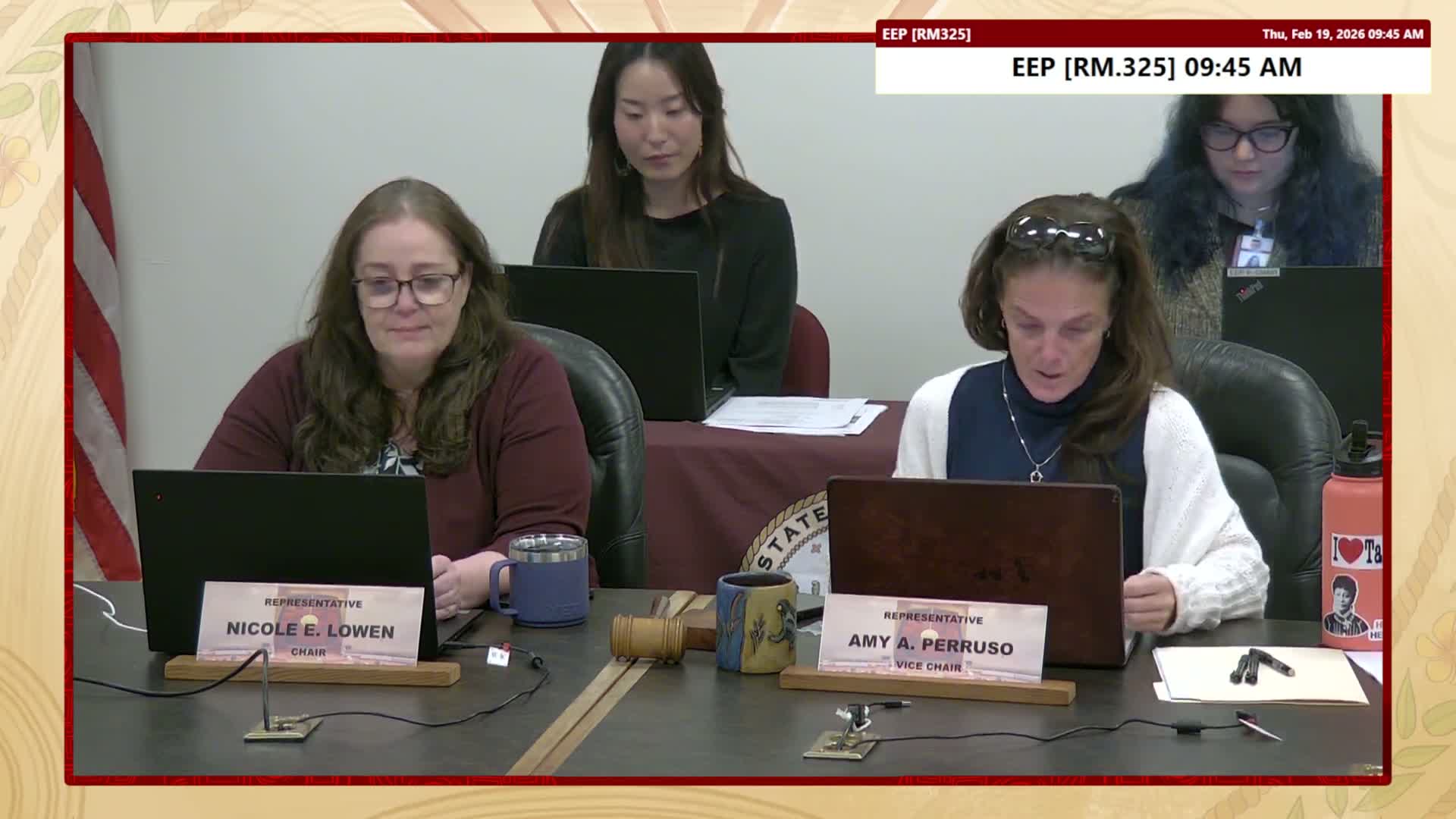
The House Committee on Energy and Environmental Protection on Feb. 19 passed House Bill 19 86 HD1, which directs the Department of Transportation to adopt rules by Jan. 1, 2028, establishing a clean fuel standard for alternative fuels, and requires reporting and public informational sessions.
Supporters at the hearing said the standard is a necessary long-term policy. Leila Lerman of the Climate Change Mitigation and Adaptation Commission said the commission submitted written testimony in support and would be available for questions. Laura Ka'akua of the Hawaii Department of Transportation said the clean fuel standard is a long-term strategy and that short-term tax credits may be needed to jump-start in-state production of sustainable aviation fuels (SAF).
Opponents and some environmental advocates urged caution. Mike Ewell of Energy Justice Network testified that “clean fuels are not clean,” arguing that many so-called sustainable fuels emit greenhouse gases when burned and that Hawaii lacks sufficient land and water to produce large volumes of biofuels locally. Ted Metros warned that credits could create large financial obligations and questioned whether the scale of in-state production could meet demand.
Committee members pressed witnesses on how much fuel could realistically be produced locally and how the clean fuel standard would interact with other incentive programs. DOT and HSEO staff said the tax-credit caps and a staggered implementation are intended to limit short-term fiscal exposure while the standard ramps up.
The committee adopted technical and clarifying amendments and approved the bill with the chair’s recommendation; Representative Matsumoto registered reservations. The committee recorded the passage of HB1986 HD1 and moved it forward for further legislative action.
Supporters at the hearing said the standard is a necessary long-term policy. Leila Lerman of the Climate Change Mitigation and Adaptation Commission said the commission submitted written testimony in support and would be available for questions. Laura Ka'akua of the Hawaii Department of Transportation said the clean fuel standard is a long-term strategy and that short-term tax credits may be needed to jump-start in-state production of sustainable aviation fuels (SAF).
Opponents and some environmental advocates urged caution. Mike Ewell of Energy Justice Network testified that “clean fuels are not clean,” arguing that many so-called sustainable fuels emit greenhouse gases when burned and that Hawaii lacks sufficient land and water to produce large volumes of biofuels locally. Ted Metros warned that credits could create large financial obligations and questioned whether the scale of in-state production could meet demand.
Committee members pressed witnesses on how much fuel could realistically be produced locally and how the clean fuel standard would interact with other incentive programs. DOT and HSEO staff said the tax-credit caps and a staggered implementation are intended to limit short-term fiscal exposure while the standard ramps up.
The committee adopted technical and clarifying amendments and approved the bill with the chair’s recommendation; Representative Matsumoto registered reservations. The committee recorded the passage of HB1986 HD1 and moved it forward for further legislative action.
Don't Miss a Word: See the Full Meeting!
Go beyond summaries. Unlock every video, transcript, and key insight with a Founder Membership.
✓
Get instant access to full meeting videos
✓
Search and clip any phrase from complete transcripts
✓
Receive AI-powered summaries & custom alerts
✓
Enjoy lifetime, unrestricted access to government data
30-day money-back guarantee
