House passes bill giving attorney general limited authority to serve electronic search warrants on businesses
February 16, 2026 | Legislative Sessions, Washington
This article was created by AI summarizing key points discussed. AI makes mistakes, so for full details and context, please refer to the video of the full meeting. Please report any errors so we can fix them. Report an error »
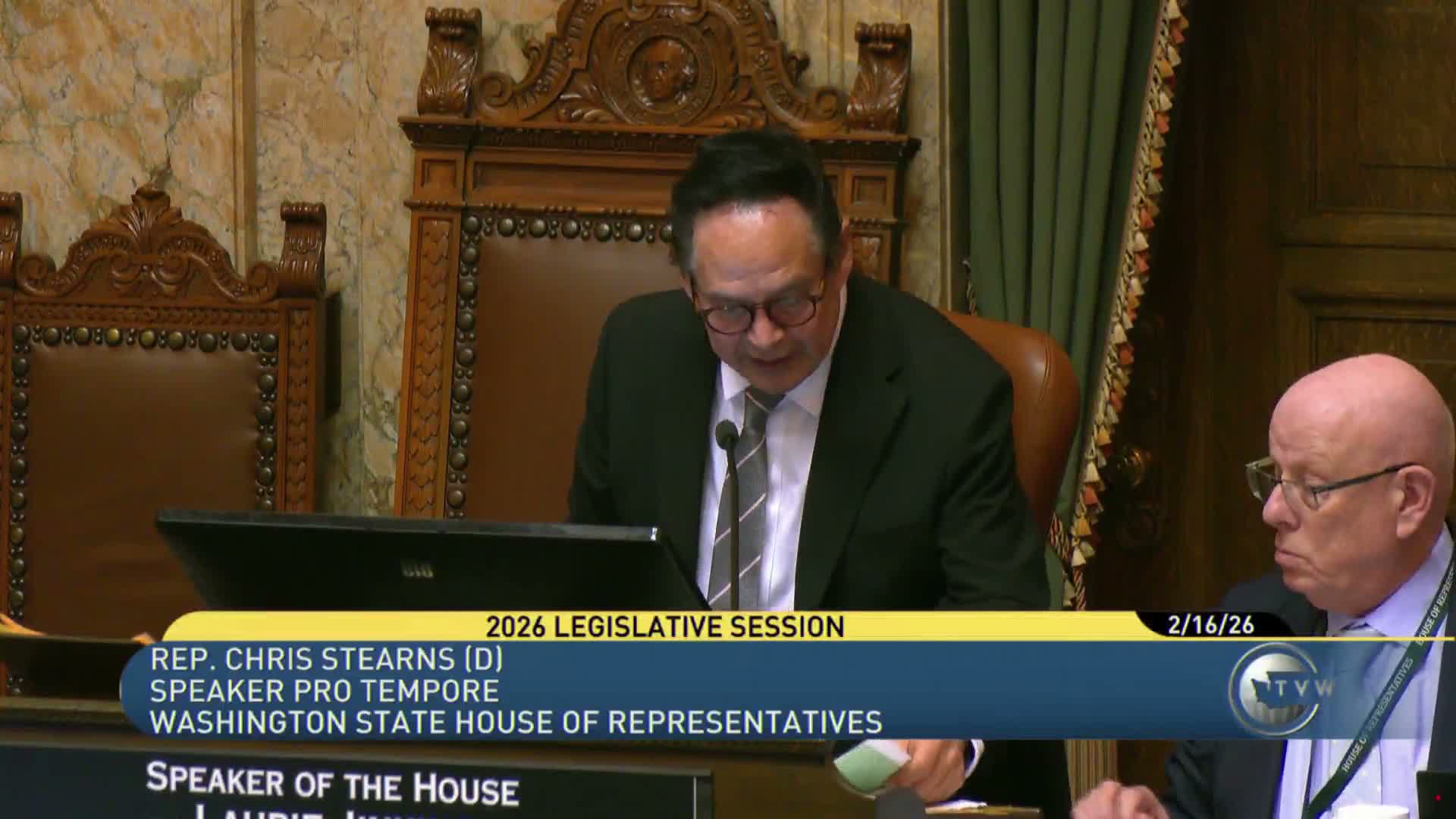
Representative Goodman (45th District) presented a striking amendment that rewrote House Bill 21‑56 to grant the attorney general’s office authority to establish investigators with limited police powers to serve electronically delivered, judicially approved search warrants on businesses, primarily to combat organized retail crime.
The debate centered on scope, oversight and operational limits. Supporters said the tool would help recover records from out‑of‑state and online businesses and assist overwhelmed local law enforcement. "This is a rewrite of the original bill. It's a direct grant of authority to the attorney general's office to establish certain investigators and give them limited police powers to serve, only electronically, not physically, search warrants upon businesses," Goodman said, urging adoption of the striking amendment.
Opponents argued the bill risked centralizing police functions at the state level and expanding the attorney general's role beyond advisory and prosecutorial duties. Representative Graham (6th District) urged caution, saying the change could encroach on local law enforcement and that the right fix is recruiting more frontline officers, not broadening state authority.
Lawmakers adopted several amendments to narrow and clarify the bill before final passage. Among the changes, the House adopted provisions that: restrict electronic service primarily to businesses; require background checks and standards for investigators; clarify that investigators would not arrest, detain, or carry arms; and define the covered investigative targets (economic and financial crimes such as wage theft, construction fraud and organized retail theft).
A scope and object ruling by the Speaker struck one amendment (19‑51) as beyond the bill’s purpose. Other amendments were adopted by voice and roll calls, with several roll calls recorded on the floor during the amendment process. The striking amendment (17‑96 as amended) was adopted and the bill was advanced to third reading. On final passage the clerk reported 54 yays, 43 nays, and 1 excused and the bill was declared passed.
What happens next: House Bill 21‑56 will proceed to the Senate for consideration. The bill’s supporters framed it as an efficiency measure for targeted economic crimes investigations; critics said they will watch for mission creep and seek further oversight provisions in later stages.
The debate centered on scope, oversight and operational limits. Supporters said the tool would help recover records from out‑of‑state and online businesses and assist overwhelmed local law enforcement. "This is a rewrite of the original bill. It's a direct grant of authority to the attorney general's office to establish certain investigators and give them limited police powers to serve, only electronically, not physically, search warrants upon businesses," Goodman said, urging adoption of the striking amendment.
Opponents argued the bill risked centralizing police functions at the state level and expanding the attorney general's role beyond advisory and prosecutorial duties. Representative Graham (6th District) urged caution, saying the change could encroach on local law enforcement and that the right fix is recruiting more frontline officers, not broadening state authority.
Lawmakers adopted several amendments to narrow and clarify the bill before final passage. Among the changes, the House adopted provisions that: restrict electronic service primarily to businesses; require background checks and standards for investigators; clarify that investigators would not arrest, detain, or carry arms; and define the covered investigative targets (economic and financial crimes such as wage theft, construction fraud and organized retail theft).
A scope and object ruling by the Speaker struck one amendment (19‑51) as beyond the bill’s purpose. Other amendments were adopted by voice and roll calls, with several roll calls recorded on the floor during the amendment process. The striking amendment (17‑96 as amended) was adopted and the bill was advanced to third reading. On final passage the clerk reported 54 yays, 43 nays, and 1 excused and the bill was declared passed.
What happens next: House Bill 21‑56 will proceed to the Senate for consideration. The bill’s supporters framed it as an efficiency measure for targeted economic crimes investigations; critics said they will watch for mission creep and seek further oversight provisions in later stages.
Don't Miss a Word: See the Full Meeting!
Go beyond summaries. Unlock every video, transcript, and key insight with a Founder Membership.
✓
Get instant access to full meeting videos
✓
Search and clip any phrase from complete transcripts
✓
Receive AI-powered summaries & custom alerts
✓
Enjoy lifetime, unrestricted access to government data
30-day money-back guarantee
