USA Cares reports results, seeks $2 million renewal from Kentucky legislature
February 20, 2026 | 2026 Legislature KY, Kentucky
This article was created by AI summarizing key points discussed. AI makes mistakes, so for full details and context, please refer to the video of the full meeting. Please report any errors so we can fix them. Report an error »
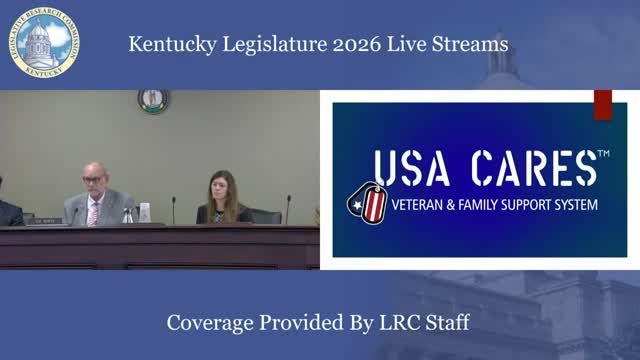
Matt Castor, president and CEO of USA Cares, told the Senate Veterans, Military Affairs and Public Protection Committee on Feb. 19 that the nonprofit has completed a two‑year, $2 million appropriation from the General Assembly and is seeking a renewed $2 million allocation split as $1 million per year in the next biennium.
"We just received our last $500,000 payment, to complete the $2,000,000 from the last cycle," Castor said, and added that the organization had used about 3% of the appropriation for administrative purposes, meaning roughly "97% of the money that you have given us has gone straight to help these families." The presentation was delivered during the committee’s Military Kids Day session in Frankfort.
Castor and USA Cares staff described the group’s core programs, including the Military Assistance Response Program (MARP) for emergency financial stabilization and a career‑transition program coordinated with Fort Knox. Jim Locke, vice president for government and corporate relations, told senators the organization receives 150–200 calls a week nationally and that the VA and local community providers are among the steady referral sources to USA Cares.
Program manager Angela Chateau summarized recent service metrics: USA Cares reported serving 364 families in the prior 18 months, covering more than 500 dependents, and identified housing, vehicles and utilities as the top categories for payouts. Castor said the organization projects it will have spent the $2 million appropriation plus additional donated funds to meet client needs.
Lawmakers pressed for operational detail. Senator Smith asked for a ZIP‑code breakdown of referrals so members could see regional impacts; Castor said USA Cares tracks referrals by ZIP code and offered to provide that data to staff. Senator Craig Richardson questioned whether "Internet search" referrals represent qualified contacts; Chateau said referral source data come from applicant self‑report on intake and that the VA, homeless crisis lines and local HUD/VASH programs are major referral partners.
Several senators asked about connections to health and behavioral‑health services. Senator Berg asked whether veterans helped by USA Cares are using VA medical benefits and how many have substance‑use problems; presenters said they do not require applicants to use VA care and conceded substance‑use is frequently underreported. Castor described a new initiative, "Operation Follow‑up," developed with the University of Louisville to perform mental‑health assessments after financial stabilization and to arrange warm handoffs to VA counselors or other treatment as appropriate.
Chair Dennehy thanked the presenters for accountability and said he would support continued funding: "We want to do everything we can to support our veterans," he said, praising USA Cares’ documentation and oversight practices. The organization formally requested $2,000,000 for the next budget cycle; committee action on that request was not recorded in this session.
The presentation and questions illustrate lawmakers’ focus on geographic reach, referral quality, and how short‑term financial assistance connects to longer‑term treatment and employment supports for veterans.
"We just received our last $500,000 payment, to complete the $2,000,000 from the last cycle," Castor said, and added that the organization had used about 3% of the appropriation for administrative purposes, meaning roughly "97% of the money that you have given us has gone straight to help these families." The presentation was delivered during the committee’s Military Kids Day session in Frankfort.
Castor and USA Cares staff described the group’s core programs, including the Military Assistance Response Program (MARP) for emergency financial stabilization and a career‑transition program coordinated with Fort Knox. Jim Locke, vice president for government and corporate relations, told senators the organization receives 150–200 calls a week nationally and that the VA and local community providers are among the steady referral sources to USA Cares.
Program manager Angela Chateau summarized recent service metrics: USA Cares reported serving 364 families in the prior 18 months, covering more than 500 dependents, and identified housing, vehicles and utilities as the top categories for payouts. Castor said the organization projects it will have spent the $2 million appropriation plus additional donated funds to meet client needs.
Lawmakers pressed for operational detail. Senator Smith asked for a ZIP‑code breakdown of referrals so members could see regional impacts; Castor said USA Cares tracks referrals by ZIP code and offered to provide that data to staff. Senator Craig Richardson questioned whether "Internet search" referrals represent qualified contacts; Chateau said referral source data come from applicant self‑report on intake and that the VA, homeless crisis lines and local HUD/VASH programs are major referral partners.
Several senators asked about connections to health and behavioral‑health services. Senator Berg asked whether veterans helped by USA Cares are using VA medical benefits and how many have substance‑use problems; presenters said they do not require applicants to use VA care and conceded substance‑use is frequently underreported. Castor described a new initiative, "Operation Follow‑up," developed with the University of Louisville to perform mental‑health assessments after financial stabilization and to arrange warm handoffs to VA counselors or other treatment as appropriate.
Chair Dennehy thanked the presenters for accountability and said he would support continued funding: "We want to do everything we can to support our veterans," he said, praising USA Cares’ documentation and oversight practices. The organization formally requested $2,000,000 for the next budget cycle; committee action on that request was not recorded in this session.
The presentation and questions illustrate lawmakers’ focus on geographic reach, referral quality, and how short‑term financial assistance connects to longer‑term treatment and employment supports for veterans.
Don't Miss a Word: See the Full Meeting!
Go beyond summaries. Unlock every video, transcript, and key insight with a Founder Membership.
✓
Get instant access to full meeting videos
✓
Search and clip any phrase from complete transcripts
✓
Receive AI-powered summaries & custom alerts
✓
Enjoy lifetime, unrestricted access to government data
30-day money-back guarantee
