Senate committee reviews S.327; testimony urges state match to draw down federal SBDC dollars and funds to shore up nonprofits
February 19, 2026 | Economic Development, Housing & General Affairs, SENATE, Committees, Legislative , Vermont
This article was created by AI summarizing key points discussed. AI makes mistakes, so for full details and context, please refer to the video of the full meeting. Please report any errors so we can fix them. Report an error »
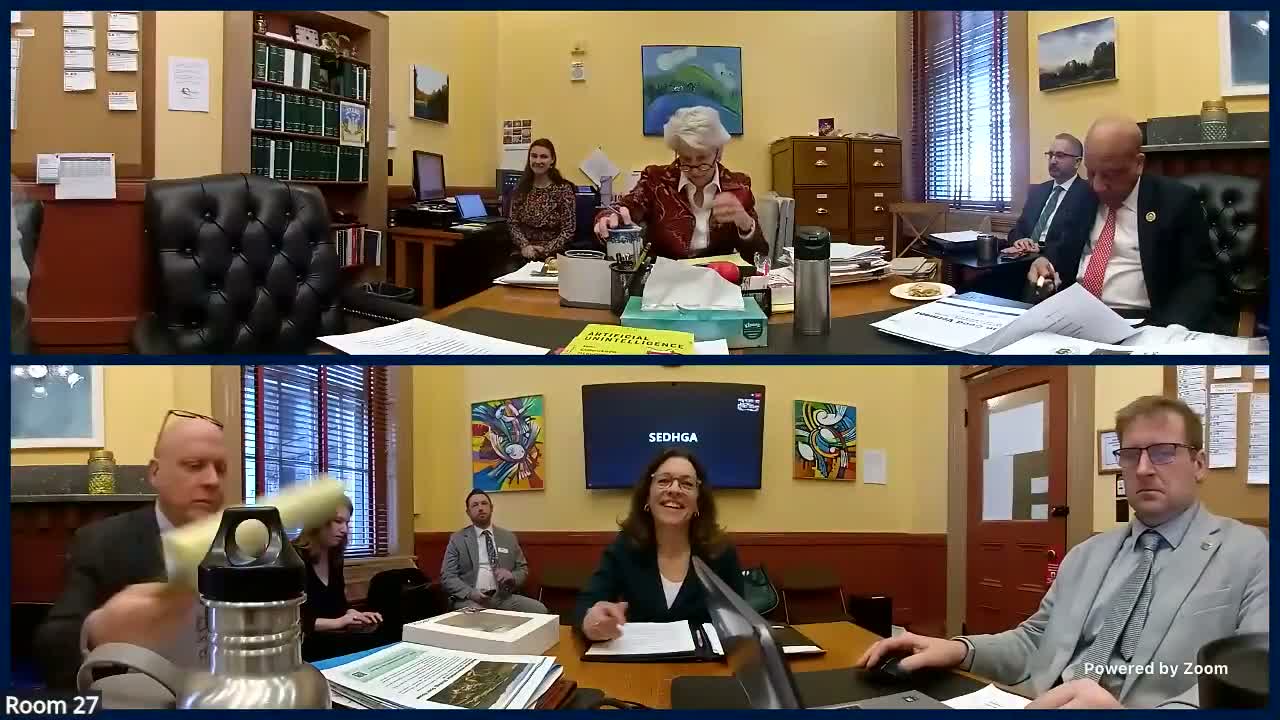
The Senate Economic Development, Housing and General Affairs Committee on S.327 heard testimony and technical briefings on proposed expansions to small‑business and nonprofit supports and debated several substantive rewrites of the bill.
Linda Rossi, state director of the Vermont Small Business Development Center (Vermont SBDC), told the committee the SBDC could not accept the full 2026 federal award without an increased state match. "The federal amount that has been confirmed is $833,000," Rossi said, explaining that the SBDC program is a federal–nonfederal cooperative model that requires a 1:1 nonfederal match with at least 50% of the match in cash. Rossi said Vermont has historically provided the cash match and that without additional state funds "we would be leaving federal dollars not able to be drawn down." She told members the SBDC operated on about a $1.2 million budget last year, served 445 individual Vermont business owners who reported securing roughly $9.7 million in new capital, helped start 24 businesses and created or retained more than 200 jobs across 148 towns.
"We are not allowed to charge for our services," Rossi said, noting SBDC advising is confidential and that the center is accredited nationally every five years. She urged the committee to consider the proposed increase in S.327 so Vermont can continue to draw down federal SBDC funds and maintain statewide advising capacity (the SBDC said it employs roughly 7.5 full‑time equivalent advisers across all 14 counties).
Emma Paradis, co‑director of Common Good Vermont (a statewide program of United Way of Northwest), asked the committee to consider a separate proposal to strengthen the nonprofit sector. Paradis described a two‑part request: $295,000 in one‑time funding for immediate technical assistance to help nonprofits navigate federal policy changes, and $267,000 in base funding to build long‑term capacity in financial management and compliance. "This proposal is about preparedness," Paradis said, arguing that federal funding uncertainty already is causing nonprofits to delay hiring and pause initiatives. She said Vermont has about 6,400 nonprofits (4,500 of them public charities) and estimated nonprofits employ about 63,000 Vermonters — roughly one in five workers in the state.
Paradis described program elements that would be supported by the requested funds: a nonprofit legal hub to skill up lawyers in nonprofit law, a shared‑services initiative to explore cost savings and collaboration, and a one‑stop help desk to triage organizations and connect them to consultants and training. She said more than 50 organizations had signed on to the proposal and confirmed Common Good has not previously received state appropriations; Common Good said its operating budget is about $450,000 with a staff of three plus one AmeriCorps member.
Committee staff then presented draft 1.1 of S.327 and walked members through numerous edits. Highlights include restoring or adding funding for the Vermont Professionals of Color Network; an unchanged allocation for Brownfields; an increase in the International Business Office Montreal allocation to fund representation focused on Taiwan market engagement (described as contracting for a Taiwan representative rather than opening a full office); and consolidation of a previously proposed business growth task force and a resources inventory into a department‑led business growth and development study to identify resources, succession planning supports and capital access options, with a report due by Dec. 15.
Members also discussed changes to the Veggie program: the draft would remove Veggie's sunset so the program can continue accepting applications indefinitely and would create an enhanced Veggie incentive for employee‑owned companies. That definitional change prompted extended debate: committee members and staff raised concerns that the proposed language could treat entities where voting power is weighted by seniority (for example, giving longer‑serving members more votes) as employee‑owned and asked for precedent and legal review. One member said proportional voting based on years of service "seems a little bit... anti‑democratic," and members requested additional testimony from subject‑matter witnesses and legal counsel before finalizing the language.
No votes were taken. Members asked staff and witnesses for additional materials and agreed to continue discussion next week, scheduling follow‑up testimony from experts referenced during the hearing.
The committee is expected to reconvene in the coming week to continue markup of S.327 and review the requested supplemental materials and expert testimony.
Linda Rossi, state director of the Vermont Small Business Development Center (Vermont SBDC), told the committee the SBDC could not accept the full 2026 federal award without an increased state match. "The federal amount that has been confirmed is $833,000," Rossi said, explaining that the SBDC program is a federal–nonfederal cooperative model that requires a 1:1 nonfederal match with at least 50% of the match in cash. Rossi said Vermont has historically provided the cash match and that without additional state funds "we would be leaving federal dollars not able to be drawn down." She told members the SBDC operated on about a $1.2 million budget last year, served 445 individual Vermont business owners who reported securing roughly $9.7 million in new capital, helped start 24 businesses and created or retained more than 200 jobs across 148 towns.
"We are not allowed to charge for our services," Rossi said, noting SBDC advising is confidential and that the center is accredited nationally every five years. She urged the committee to consider the proposed increase in S.327 so Vermont can continue to draw down federal SBDC funds and maintain statewide advising capacity (the SBDC said it employs roughly 7.5 full‑time equivalent advisers across all 14 counties).
Emma Paradis, co‑director of Common Good Vermont (a statewide program of United Way of Northwest), asked the committee to consider a separate proposal to strengthen the nonprofit sector. Paradis described a two‑part request: $295,000 in one‑time funding for immediate technical assistance to help nonprofits navigate federal policy changes, and $267,000 in base funding to build long‑term capacity in financial management and compliance. "This proposal is about preparedness," Paradis said, arguing that federal funding uncertainty already is causing nonprofits to delay hiring and pause initiatives. She said Vermont has about 6,400 nonprofits (4,500 of them public charities) and estimated nonprofits employ about 63,000 Vermonters — roughly one in five workers in the state.
Paradis described program elements that would be supported by the requested funds: a nonprofit legal hub to skill up lawyers in nonprofit law, a shared‑services initiative to explore cost savings and collaboration, and a one‑stop help desk to triage organizations and connect them to consultants and training. She said more than 50 organizations had signed on to the proposal and confirmed Common Good has not previously received state appropriations; Common Good said its operating budget is about $450,000 with a staff of three plus one AmeriCorps member.
Committee staff then presented draft 1.1 of S.327 and walked members through numerous edits. Highlights include restoring or adding funding for the Vermont Professionals of Color Network; an unchanged allocation for Brownfields; an increase in the International Business Office Montreal allocation to fund representation focused on Taiwan market engagement (described as contracting for a Taiwan representative rather than opening a full office); and consolidation of a previously proposed business growth task force and a resources inventory into a department‑led business growth and development study to identify resources, succession planning supports and capital access options, with a report due by Dec. 15.
Members also discussed changes to the Veggie program: the draft would remove Veggie's sunset so the program can continue accepting applications indefinitely and would create an enhanced Veggie incentive for employee‑owned companies. That definitional change prompted extended debate: committee members and staff raised concerns that the proposed language could treat entities where voting power is weighted by seniority (for example, giving longer‑serving members more votes) as employee‑owned and asked for precedent and legal review. One member said proportional voting based on years of service "seems a little bit... anti‑democratic," and members requested additional testimony from subject‑matter witnesses and legal counsel before finalizing the language.
No votes were taken. Members asked staff and witnesses for additional materials and agreed to continue discussion next week, scheduling follow‑up testimony from experts referenced during the hearing.
The committee is expected to reconvene in the coming week to continue markup of S.327 and review the requested supplemental materials and expert testimony.
Don't Miss a Word: See the Full Meeting!
Go beyond summaries. Unlock every video, transcript, and key insight with a Founder Membership.
✓
Get instant access to full meeting videos
✓
Search and clip any phrase from complete transcripts
✓
Receive AI-powered summaries & custom alerts
✓
Enjoy lifetime, unrestricted access to government data
30-day money-back guarantee
