Haralson County planning commission debates rezoning request for 2.25‑acre parcel; no vote taken
February 16, 2026 | Haralson County, Georgia
This article was created by AI summarizing key points discussed. AI makes mistakes, so for full details and context, please refer to the video of the full meeting. Please report any errors so we can fix them. Report an error »
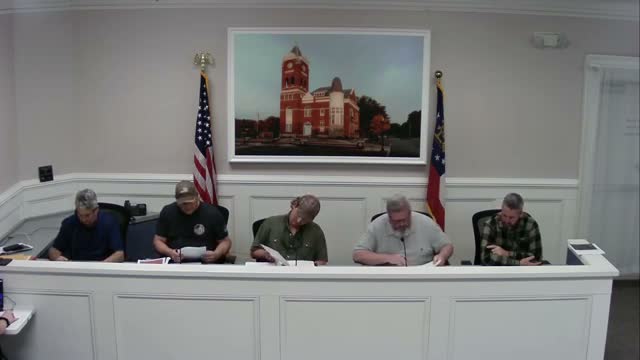
Haralson County planning commissioners spent their February meeting debating a request to rezone Map 111A, Parcel 5 — a roughly 2.25‑acre parcel — from A1 (agriculture) to R2 (residential). The panel did not take a vote on the rezoning; members instead asked staff to seek guidance from the county attorney.
The issue arose after an attendee asked whether the 2.25‑acre parcel could be split into two 1‑acre lots. Unidentified Speaker 2, an unidentified meeting participant, said the plat submitted with the application shows a split and that supporting materials indicate portions of the larger original tract were divided as early as 1987, before the county’s zoning map was adopted in 1998. "It was split prior to the zoning map adoption," Speaker 2 said, presenting the 1987 survey and subsequent split history as the factual basis for the applicant’s request.
Other commissioners raised concerns about creating an island of residential zoning surrounded by agricultural parcels. Unidentified Speaker 1 said rezoning the parcel to R2 "would be spot zoning," and warned that neighbors could be upset if one lot were singled out for a lower‑acreage residential designation amid A1 zoning. Unidentified Speaker 3 emphasized precedent and ongoing work on the county’s zoning ordinance, stating they could not vote to rezone agricultural land down to 1 acre.
Several commissioners signaled support instead for an administrative remedy. Unidentified Speaker 2 said they did not propose a zoning map change but would support allowing the zoning office to split the parcel administratively to match the existing pattern of smaller tracts in the area. Speaker 4 cautioned that even if the lots were corrected administratively, an "island" of different zoning might remain on the map.
The record includes two brief procedural actions earlier in the meeting: a motion (mover: Speaker 3) to amend the agenda to add approval of old minutes, which was seconded and approved by voice, and a subsequent motion (mover: Speaker 3; second not clearly identified in the transcript) to approve the prior meeting’s minutes as written, which the chair indicated were approved. The rezoning application itself received detailed discussion but no formal motion or vote on rezoning is recorded in the transcript.
Next steps, as recorded in the meeting, are procedural: commissioners agreed to ask the county attorney whether an administrative correction to the zoning map is possible in this case and to report back; the transcript records no final decision on rezoning.
The transcript identifies an applicant phrase rendered as "Abner is Pamela Famille" in the record; the spelling and phrasing in that line are unclear, and the commission minutes or applicant materials should be checked to confirm the applicant’s proper name and contact information.
The issue arose after an attendee asked whether the 2.25‑acre parcel could be split into two 1‑acre lots. Unidentified Speaker 2, an unidentified meeting participant, said the plat submitted with the application shows a split and that supporting materials indicate portions of the larger original tract were divided as early as 1987, before the county’s zoning map was adopted in 1998. "It was split prior to the zoning map adoption," Speaker 2 said, presenting the 1987 survey and subsequent split history as the factual basis for the applicant’s request.
Other commissioners raised concerns about creating an island of residential zoning surrounded by agricultural parcels. Unidentified Speaker 1 said rezoning the parcel to R2 "would be spot zoning," and warned that neighbors could be upset if one lot were singled out for a lower‑acreage residential designation amid A1 zoning. Unidentified Speaker 3 emphasized precedent and ongoing work on the county’s zoning ordinance, stating they could not vote to rezone agricultural land down to 1 acre.
Several commissioners signaled support instead for an administrative remedy. Unidentified Speaker 2 said they did not propose a zoning map change but would support allowing the zoning office to split the parcel administratively to match the existing pattern of smaller tracts in the area. Speaker 4 cautioned that even if the lots were corrected administratively, an "island" of different zoning might remain on the map.
The record includes two brief procedural actions earlier in the meeting: a motion (mover: Speaker 3) to amend the agenda to add approval of old minutes, which was seconded and approved by voice, and a subsequent motion (mover: Speaker 3; second not clearly identified in the transcript) to approve the prior meeting’s minutes as written, which the chair indicated were approved. The rezoning application itself received detailed discussion but no formal motion or vote on rezoning is recorded in the transcript.
Next steps, as recorded in the meeting, are procedural: commissioners agreed to ask the county attorney whether an administrative correction to the zoning map is possible in this case and to report back; the transcript records no final decision on rezoning.
The transcript identifies an applicant phrase rendered as "Abner is Pamela Famille" in the record; the spelling and phrasing in that line are unclear, and the commission minutes or applicant materials should be checked to confirm the applicant’s proper name and contact information.
View the Full Meeting & All Its Details
This article offers just a summary. Unlock complete video, transcripts, and insights as a Founder Member.
✓
Watch full, unedited meeting videos
✓
Search every word spoken in unlimited transcripts
✓
AI summaries & real-time alerts (all government levels)
✓
Permanent access to expanding government content
30-day money-back guarantee
