Haralson County planning panel reviews draft subdivision ordinance, debates lot definitions and enforcement
February 16, 2026 | Haralson County, Georgia
This article was created by AI summarizing key points discussed. AI makes mistakes, so for full details and context, please refer to the video of the full meeting. Please report any errors so we can fix them. Report an error »
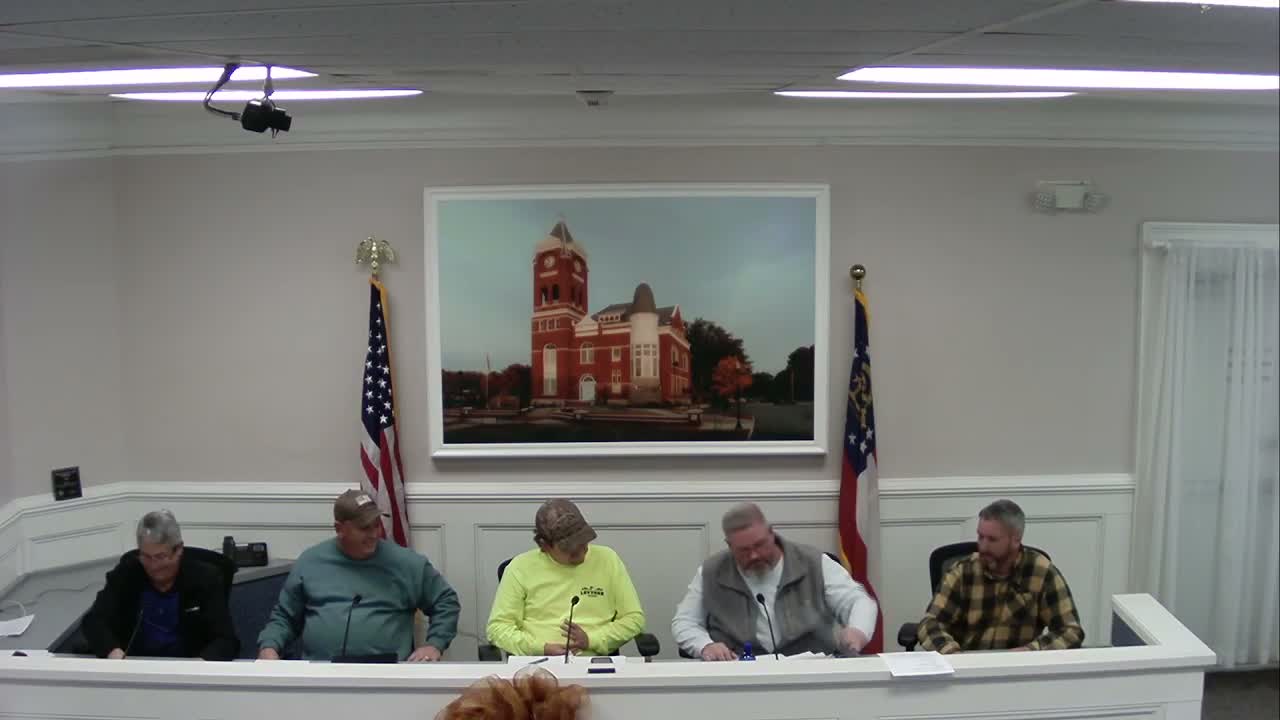
At a Haralson County planning meeting, commissioners began a detailed review of a proposed rewrite of the county subdivision ordinance, focusing on definitions, numeric thresholds for minor subdivisions and the county's ability to enforce recording and platting requirements.
The review opened with Speaker 2 (role/title: Unknown) noting confusion over document versions and effective dates, saying, "This would be effective January 2024," and pointing to a different copy dated 05/30/2025. That discrepancy prompted discussion about which text should govern and what prior zoning rights would continue to apply.
Why it matters: the definitions and thresholds in this ordinance determine whether landowners can subdivide property administratively or must seek public review and rezoning. Commissioners flagged several areas that could change how many lots can be created without a board hearing, how lot area is measured, and whether banking-driven "mortgage lots" can be used to circumvent minimum‑lot requirements.
Key points from the meeting:
- Lot-area wording: Speaker 2 raised that the ordinance's phrase "exclusive of public road right of ways or private road or access easements" could wrongly exclude internal access easements from a lot's area. Commissioners suggested either moving the clause or removing the access‑easement language to avoid ambiguity.
- Lot depth and graphics: Commissioners said the draft's average-depth method can misstate depth on angled or flag lots and asked for clearer illustrations and a perpendicular or nearest-distance standard.
- Mortgage lots: The commission discussed "mortgage lots"—parcels created at a lender's request that may later be sold or used to circumvent zoning minima. Speaker 2 asked how the county should treat those lots; commissioners agreed this needs legal research and suggested striking or clarifying the term if it cannot be regulated locally.
- Thresholds for minor subdivisions: Staff recommended lowering the administrative cap from 20 lots to 10 lots; several commissioners supported aligning minor-subdivision rules with current zoning or capping minor subdivisions at 10 lots so larger developments come before the board.
- Delegation to zoning director: The draft vests authority in the director of zoning and permits to approve minor subdivision final plats. Commissioners said the numeric limit (for example, "up to 10 lots") must be mirrored in the delegation language so the director’s authority and the definition match.
- Plat recording and clerk-of-court processes: Commissioners reported plats have occasionally been recorded without county signatures or the required plat-act notation. Speaker 2 said staff had found plats that "slip right on through, and they've went on and stamped it and never checked for our signature," and asked for better checklist procedures and communication with the clerk's office.
- Enforcement and remedies: Speaker 6 asked how the county would enforce an ordinance provision that declares certain sales or subdivisions "unlawful," asking specifically, "Are we pressing charges? Are we citing?" Commissioners agreed legal counsel should identify available remedies and how enforcement would be carried out in practice.
What the commission directed: staff and legal counsel will research and return with clarifications on (1) which document/version is controlling, (2) how prior zoning and recorded plats interact with new rules, (3) treatment of mortgage lots, (4) appropriate lot-count thresholds for administrative approval, and (5) practical enforcement steps and clerk-of-court coordination. The commission scheduled continued review for its next meeting.
Next steps: Commissioners set a follow-up meeting and assigned homework to staff and legal counsel to bring findings and proposed redlines for the ordinance sections covering final plats and delegation.
The review opened with Speaker 2 (role/title: Unknown) noting confusion over document versions and effective dates, saying, "This would be effective January 2024," and pointing to a different copy dated 05/30/2025. That discrepancy prompted discussion about which text should govern and what prior zoning rights would continue to apply.
Why it matters: the definitions and thresholds in this ordinance determine whether landowners can subdivide property administratively or must seek public review and rezoning. Commissioners flagged several areas that could change how many lots can be created without a board hearing, how lot area is measured, and whether banking-driven "mortgage lots" can be used to circumvent minimum‑lot requirements.
Key points from the meeting:
- Lot-area wording: Speaker 2 raised that the ordinance's phrase "exclusive of public road right of ways or private road or access easements" could wrongly exclude internal access easements from a lot's area. Commissioners suggested either moving the clause or removing the access‑easement language to avoid ambiguity.
- Lot depth and graphics: Commissioners said the draft's average-depth method can misstate depth on angled or flag lots and asked for clearer illustrations and a perpendicular or nearest-distance standard.
- Mortgage lots: The commission discussed "mortgage lots"—parcels created at a lender's request that may later be sold or used to circumvent zoning minima. Speaker 2 asked how the county should treat those lots; commissioners agreed this needs legal research and suggested striking or clarifying the term if it cannot be regulated locally.
- Thresholds for minor subdivisions: Staff recommended lowering the administrative cap from 20 lots to 10 lots; several commissioners supported aligning minor-subdivision rules with current zoning or capping minor subdivisions at 10 lots so larger developments come before the board.
- Delegation to zoning director: The draft vests authority in the director of zoning and permits to approve minor subdivision final plats. Commissioners said the numeric limit (for example, "up to 10 lots") must be mirrored in the delegation language so the director’s authority and the definition match.
- Plat recording and clerk-of-court processes: Commissioners reported plats have occasionally been recorded without county signatures or the required plat-act notation. Speaker 2 said staff had found plats that "slip right on through, and they've went on and stamped it and never checked for our signature," and asked for better checklist procedures and communication with the clerk's office.
- Enforcement and remedies: Speaker 6 asked how the county would enforce an ordinance provision that declares certain sales or subdivisions "unlawful," asking specifically, "Are we pressing charges? Are we citing?" Commissioners agreed legal counsel should identify available remedies and how enforcement would be carried out in practice.
What the commission directed: staff and legal counsel will research and return with clarifications on (1) which document/version is controlling, (2) how prior zoning and recorded plats interact with new rules, (3) treatment of mortgage lots, (4) appropriate lot-count thresholds for administrative approval, and (5) practical enforcement steps and clerk-of-court coordination. The commission scheduled continued review for its next meeting.
Next steps: Commissioners set a follow-up meeting and assigned homework to staff and legal counsel to bring findings and proposed redlines for the ordinance sections covering final plats and delegation.
Don't Miss a Word: See the Full Meeting!
Go beyond summaries. Unlock every video, transcript, and key insight with a Founder Membership.
✓
Get instant access to full meeting videos
✓
Search and clip any phrase from complete transcripts
✓
Receive AI-powered summaries & custom alerts
✓
Enjoy lifetime, unrestricted access to government data
30-day money-back guarantee
