City committee hears plans for King Street, Snoqualmie Parkway railroad crossing safety upgrades
February 19, 2026 | Snoqualmie, King County, Washington
This article was created by AI summarizing key points discussed. AI makes mistakes, so for full details and context, please refer to the video of the full meeting. Please report any errors so we can fix them. Report an error »
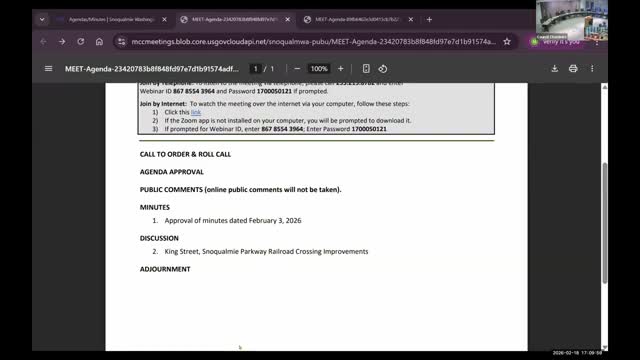
Chairman Cotton and the Parks and Public Works Committee on Feb. 18 heard a detailed presentation on planned safety upgrades at the King Street and Snoqualmie Parkway railroad crossings intended to reduce collisions and improve pedestrian access.
Philip Bennett, deputy director of Public Works, introduced the project and Richard Anderson, executive director of the Northwest Railway Museum, described the local context. Anderson said the museum operates six miles of track from Snoqualmie Falls to North Bend and that the King Street crossing has existed since about 1891. "This is a public safety project and it's funded with, with, gas tax dollars," Anderson said, framing the work as a benefit to both residents and visitors.
Andrew Vining, project engineer, summarized scope and schedule: new sidewalks and ADA crossings on King Street (along State Route 202), sidewalk widening and upgraded train detection on Snoqualmie Parkway, and replacement of a 12-inch water main that currently runs under the railroad. Vining said the project was approaching 90% design and that construction is being targeted for May 2026, subject to final design, bidding and contractor scheduling.
The estimated construction cost range is between $3 million and $3.5 million, Vining said; the project has a $2 million federal grant. He told the committee the grant requires no local match "as long as the work is completed prior to September 2026," and staff said they expect state partners to cover any delta that appears after bids are received.
Vining described the planned traffic impacts: "a full closure at the King Street crossing, 7 to 14 days," plus a three-day closure of Snoqualmie Parkway over a long weekend (7 p.m. Thursday to 5 a.m. Monday) and single-lane closures at other times. Emergency vehicle access would be maintained through Gateway Park while public traffic would detour via other routes, including Interstate 90.
Council members and staff pressed for clarity about timing and community impacts. Members noted the potential overlap with summer events — including the Boeing Classic and Snoqualmie Days — and asked whether the grant deadline requires authorization or completion by September. Vining and Anderson said they would confirm the precise grant conditions and return with refined dates and mitigation plans.
Anderson and Vining described alternatives and trade-offs considered during planning. Staff said full closures reduce total construction time, improve track alignment and enhance crew safety; by contrast, staggered partial closures would increase daily costs and prolong disruption. Vining cited an estimate that partial closures could raise costs by about $30,000 per added workday.
Committee members emphasized the need for a robust outreach plan to notify residents, truckers and navigation services, and to manage detours so large vehicles avoid unsafe U-turns or turnarounds. Staff said they would incorporate those operational lessons into final bid documents and communications.
No formal committee vote on the crossing project was taken during the meeting. The committee approved routine agenda items (amended agenda and Feb. 3 minutes) and adjourned at 5:33 p.m. Staff said they will return with final grant/deadline clarifications, detailed closure dates and a communications plan before construction begins.
Philip Bennett, deputy director of Public Works, introduced the project and Richard Anderson, executive director of the Northwest Railway Museum, described the local context. Anderson said the museum operates six miles of track from Snoqualmie Falls to North Bend and that the King Street crossing has existed since about 1891. "This is a public safety project and it's funded with, with, gas tax dollars," Anderson said, framing the work as a benefit to both residents and visitors.
Andrew Vining, project engineer, summarized scope and schedule: new sidewalks and ADA crossings on King Street (along State Route 202), sidewalk widening and upgraded train detection on Snoqualmie Parkway, and replacement of a 12-inch water main that currently runs under the railroad. Vining said the project was approaching 90% design and that construction is being targeted for May 2026, subject to final design, bidding and contractor scheduling.
The estimated construction cost range is between $3 million and $3.5 million, Vining said; the project has a $2 million federal grant. He told the committee the grant requires no local match "as long as the work is completed prior to September 2026," and staff said they expect state partners to cover any delta that appears after bids are received.
Vining described the planned traffic impacts: "a full closure at the King Street crossing, 7 to 14 days," plus a three-day closure of Snoqualmie Parkway over a long weekend (7 p.m. Thursday to 5 a.m. Monday) and single-lane closures at other times. Emergency vehicle access would be maintained through Gateway Park while public traffic would detour via other routes, including Interstate 90.
Council members and staff pressed for clarity about timing and community impacts. Members noted the potential overlap with summer events — including the Boeing Classic and Snoqualmie Days — and asked whether the grant deadline requires authorization or completion by September. Vining and Anderson said they would confirm the precise grant conditions and return with refined dates and mitigation plans.
Anderson and Vining described alternatives and trade-offs considered during planning. Staff said full closures reduce total construction time, improve track alignment and enhance crew safety; by contrast, staggered partial closures would increase daily costs and prolong disruption. Vining cited an estimate that partial closures could raise costs by about $30,000 per added workday.
Committee members emphasized the need for a robust outreach plan to notify residents, truckers and navigation services, and to manage detours so large vehicles avoid unsafe U-turns or turnarounds. Staff said they would incorporate those operational lessons into final bid documents and communications.
No formal committee vote on the crossing project was taken during the meeting. The committee approved routine agenda items (amended agenda and Feb. 3 minutes) and adjourned at 5:33 p.m. Staff said they will return with final grant/deadline clarifications, detailed closure dates and a communications plan before construction begins.
View the Full Meeting & All Its Details
This article offers just a summary. Unlock complete video, transcripts, and insights as a Founder Member.
✓
Watch full, unedited meeting videos
✓
Search every word spoken in unlimited transcripts
✓
AI summaries & real-time alerts (all government levels)
✓
Permanent access to expanding government content
30-day money-back guarantee
