Washington committee hears plan to prioritize removal of fish‑passage barriers, with culverts front and center
February 19, 2026 | Legislative Sessions, Washington
This article was created by AI summarizing key points discussed. AI makes mistakes, so for full details and context, please refer to the video of the full meeting. Please report any errors so we can fix them. Report an error »
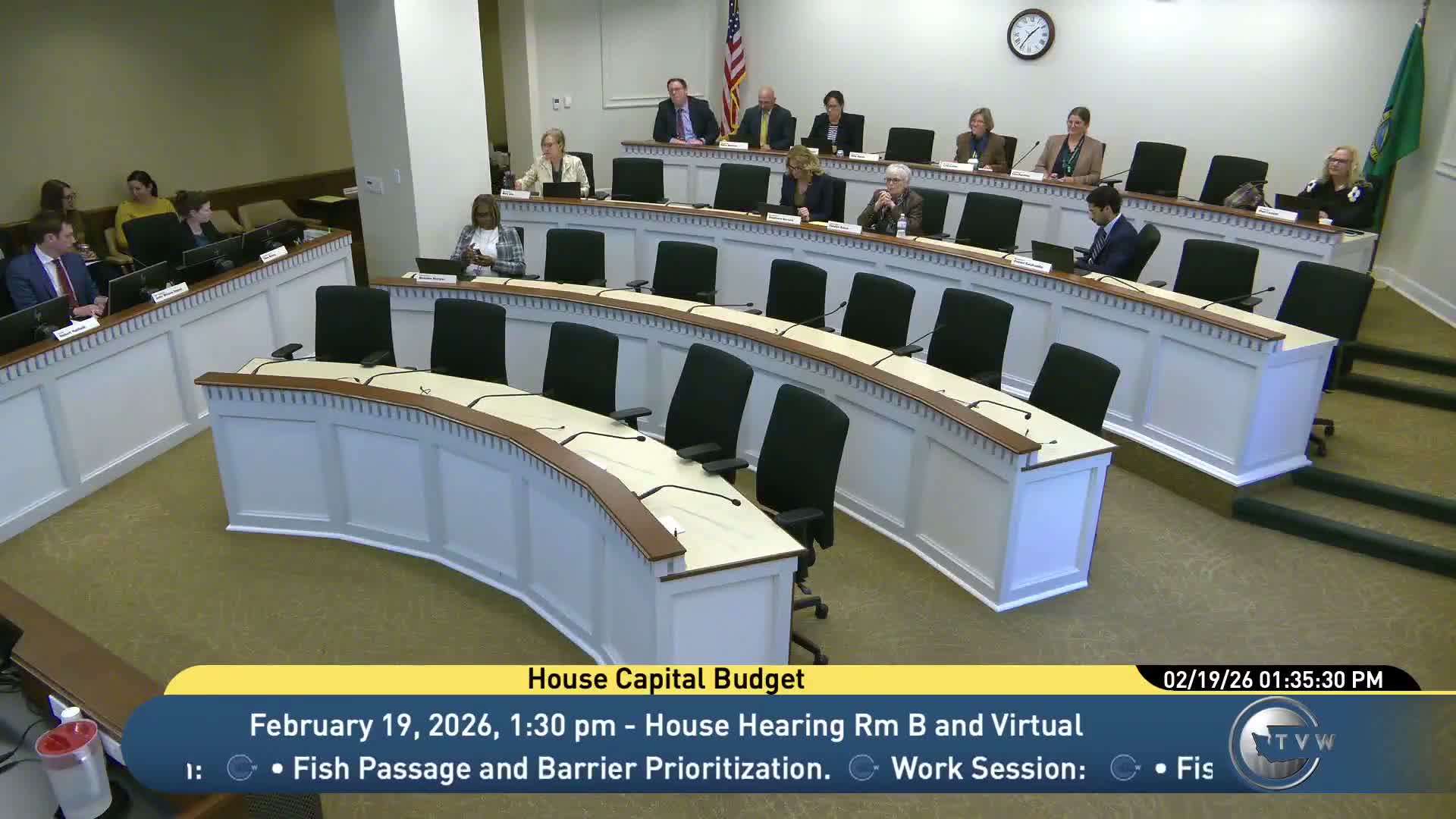
Tom Jamieson, Fish Passage and Screening Division Manager at the Washington Department of Fish and Wildlife and chair of the Brian Abbott Fish Barrier Removal Board, told the Capital Budget Committee the state will use a watershed‑level prioritization strategy and an optimization model to target the most beneficial fish‑passage removals.
Jamieson said culverts are the most numerous fish‑passage structures and account for about 84% of barriers in the state database. He told lawmakers the state assesses culverts against three technical criteria: an excessive downstream drop (he said anything over 9 inches is treated as a barrier), water velocity that exceeds about 2 feet per second, or insufficient depth (less than about 6 inches) for larger salmon to pass.
The prioritization work responds to a 2020 legislative direction that asked Fish and Wildlife, the Department of Transportation (DOT) and the Fish Barrier Removal Board to develop a statewide strategy so publicly funded corrections deliver the greatest benefit to listed salmon and southern resident orcas. Jamieson said the board will produce prioritized lists by watershed rather than a single statewide 1–20,000 ranking because funding can support only a few dozen projects per biennium.
Jamieson described two analytical elements the science panel recommended: an optimization model to locate bottlenecks that most benefit fish when removed, and a subsequent scoring and ranking step. He cautioned that the optimization step depends on accurate stream connectivity, but the federal National Hydrologic Dataset (NHD) mapping is outdated in places; staff are advancing a manual ‘‘snapping’’ process to move streamlines so barriers align with the stream network used by the model.
Jamieson gave recent program and funding figures: the board has sent five biennial project lists to the committee and, across those submittals, the committee has funded 199 projects totaling nearly $225 million. For the most recent biennium he said the board received about $122.6 million, including roughly $52 million in federal Infrastructure Investment and Jobs Act (IIJA) PROTECT funds. He added that the board received 102 proposals this cycle and funded 100 of them or their alternates.
Lawmakers pressed on costs and timelines. Jamieson said an average driveway culvert replacement on a fish‑bearing stream can run about $250,000; he noted the board typically removes roughly 30 barriers every two years and that full remediation of all barriers is not currently affordable. On timelines he said staff began snapping streamlines with $400,000 from the committee this summer, that optimization should run on all watersheds with salmon by 2026, and that a request for proposals is expected in 2027 with projects competing for the 2029–31 biennium.
Jamieson also summarized the federal culvert injunction tied to the Stevens Treaty case area. He said the injunction applies to state‑owned culverts in the case area and set an earlier benchmark for DOT to open about 90% of potential upstream area by 2030. He reported DOT had an initial inventory of roughly 1,000 culverts for that effort, had completed 176 as of last June with about $3.8 billion spent, and that federal mediation between the governor’s office and tribal attorneys is ongoing because limited funding may prevent meeting the 2030 benchmark.
Jamieson and members agreed that prioritization will prompt debate: different regions and tribes consider local barriers most important, and Jamieson acknowledged the lists will likely produce pushback when published. He emphasized the strategy aims to guide public investments across multiple programs so state funding is applied where it achieves the greatest benefit for threatened and endangered salmon and related goals for harvest and orca recovery.
The hearing ended with committee thanks to Jamieson and no formal votes or motions recorded.
Jamieson said culverts are the most numerous fish‑passage structures and account for about 84% of barriers in the state database. He told lawmakers the state assesses culverts against three technical criteria: an excessive downstream drop (he said anything over 9 inches is treated as a barrier), water velocity that exceeds about 2 feet per second, or insufficient depth (less than about 6 inches) for larger salmon to pass.
The prioritization work responds to a 2020 legislative direction that asked Fish and Wildlife, the Department of Transportation (DOT) and the Fish Barrier Removal Board to develop a statewide strategy so publicly funded corrections deliver the greatest benefit to listed salmon and southern resident orcas. Jamieson said the board will produce prioritized lists by watershed rather than a single statewide 1–20,000 ranking because funding can support only a few dozen projects per biennium.
Jamieson described two analytical elements the science panel recommended: an optimization model to locate bottlenecks that most benefit fish when removed, and a subsequent scoring and ranking step. He cautioned that the optimization step depends on accurate stream connectivity, but the federal National Hydrologic Dataset (NHD) mapping is outdated in places; staff are advancing a manual ‘‘snapping’’ process to move streamlines so barriers align with the stream network used by the model.
Jamieson gave recent program and funding figures: the board has sent five biennial project lists to the committee and, across those submittals, the committee has funded 199 projects totaling nearly $225 million. For the most recent biennium he said the board received about $122.6 million, including roughly $52 million in federal Infrastructure Investment and Jobs Act (IIJA) PROTECT funds. He added that the board received 102 proposals this cycle and funded 100 of them or their alternates.
Lawmakers pressed on costs and timelines. Jamieson said an average driveway culvert replacement on a fish‑bearing stream can run about $250,000; he noted the board typically removes roughly 30 barriers every two years and that full remediation of all barriers is not currently affordable. On timelines he said staff began snapping streamlines with $400,000 from the committee this summer, that optimization should run on all watersheds with salmon by 2026, and that a request for proposals is expected in 2027 with projects competing for the 2029–31 biennium.
Jamieson also summarized the federal culvert injunction tied to the Stevens Treaty case area. He said the injunction applies to state‑owned culverts in the case area and set an earlier benchmark for DOT to open about 90% of potential upstream area by 2030. He reported DOT had an initial inventory of roughly 1,000 culverts for that effort, had completed 176 as of last June with about $3.8 billion spent, and that federal mediation between the governor’s office and tribal attorneys is ongoing because limited funding may prevent meeting the 2030 benchmark.
Jamieson and members agreed that prioritization will prompt debate: different regions and tribes consider local barriers most important, and Jamieson acknowledged the lists will likely produce pushback when published. He emphasized the strategy aims to guide public investments across multiple programs so state funding is applied where it achieves the greatest benefit for threatened and endangered salmon and related goals for harvest and orca recovery.
The hearing ended with committee thanks to Jamieson and no formal votes or motions recorded.
View the Full Meeting & All Its Details
This article offers just a summary. Unlock complete video, transcripts, and insights as a Founder Member.
✓
Watch full, unedited meeting videos
✓
Search every word spoken in unlimited transcripts
✓
AI summaries & real-time alerts (all government levels)
✓
Permanent access to expanding government content
30-day money-back guarantee
