Panel hears proposal to create state supply-chain competitiveness program for ports
February 18, 2026 | Legislative Sessions, Washington
This article was created by AI summarizing key points discussed. AI makes mistakes, so for full details and context, please refer to the video of the full meeting. Please report any errors so we can fix them. Report an error »
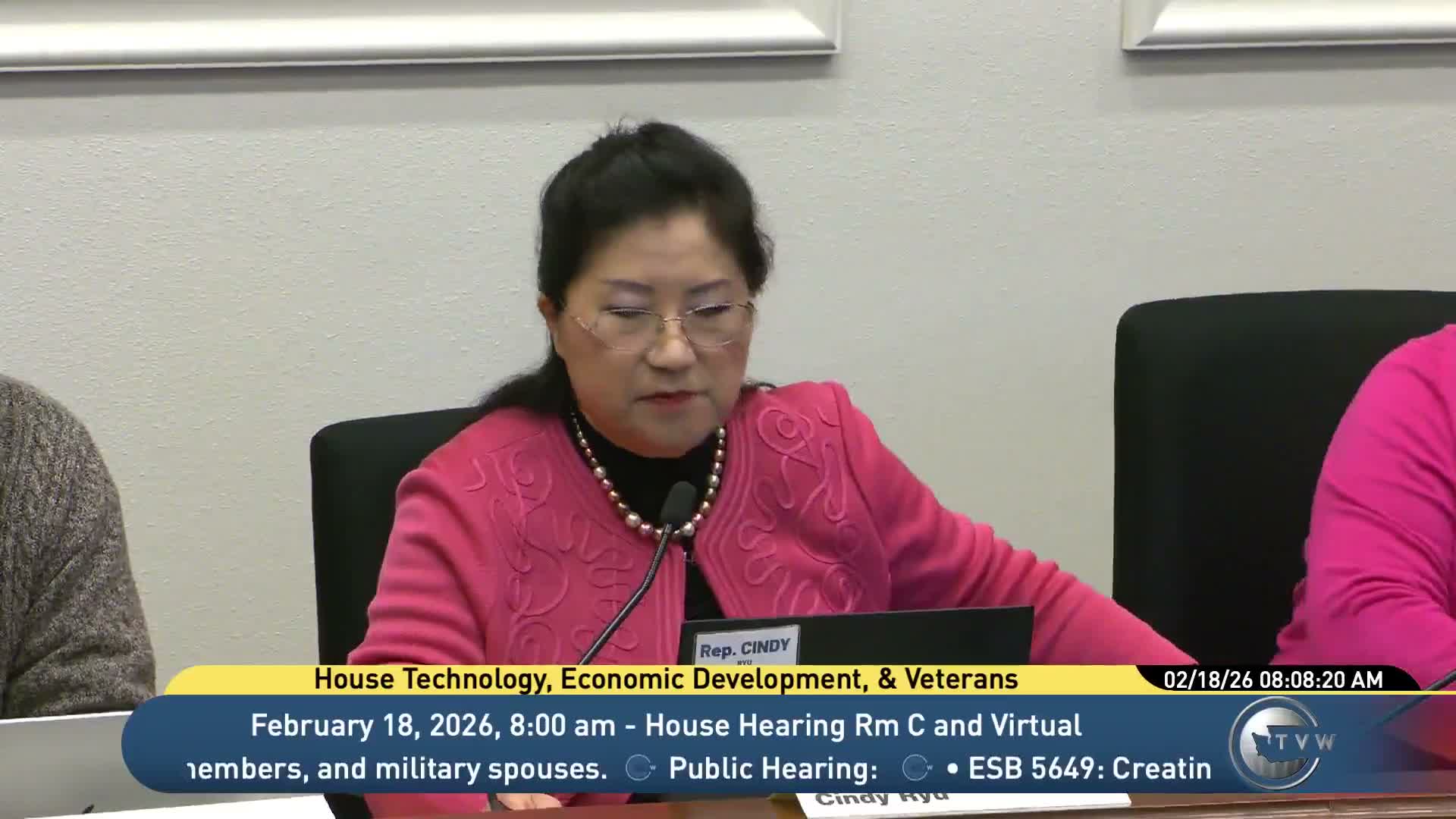
The Technology, Economic Development, and Veterans Committee heard testimony Feb. 18 on engrossed Senate Bill 5649, which would authorize the Washington Department of Transportation to establish a state supply-chain competitiveness infrastructure program providing grants and loans to public and tribal ports.
Senator Marco Elias (D-21st), the bill's prime sponsor, told the committee the measure would set program parameters so the Legislature could later fund it through the budget process. "Ports affect our daily lives from the smartphones we use to the groceries we buy," Elias said, arguing the pandemic showed how brittle supply chains can be and that a targeted state program would help ports maintain critical infrastructure and preserve good-paying jobs.
Martha Whaling, staff to the committee, summarized the bill's mechanics: the Department of Transportation would set program priorities, collaborate with identified stakeholders, develop performance metrics and an eligible project list, and create a state treasury account for the program. Projects must be included in a port's freight development plan and align with six programmatic goals that include operations, efficiency, market access and mitigation for impacted communities. Whaling also described an amendment (WALE 392) sponsored by Representative Ryu that would limit program eligibility to projects that are not eligible for funding from the Freight Mobility Strategic Investment Board (FMSIB).
Eric Fitch, executive director of the Washington Public Ports Association, said the measure is a bipartisan attempt to address freight congestion and efficiency problems that are harming growers, shippers and manufacturers. "We undertook that work with valuable partners — truckers, rail operators, apple and wheat growers, dock workers," Fitch said, urging collaboration on any committee concerns.
Port officials offered concrete examples of need. Cassie Lohse, director of government affairs for the Port of Benton, said the port owns about 16 miles of rail that is largely in disrepair; recent federal funding improved line speeds "from about 5 miles, 5 to 7 miles an hour" closer to 10 mph, and additional state support could further improve rail service and attract businesses. Catherine Fraser, grants and government affairs manager for the Port of Port Angeles, said the port's cargo terminal has reached the end of its useful life and needs more than $10,000,000 in renovations; she said the project was not eligible for FMSIB funding and that state matching funds could make federal grants accessible to small and rural ports.
Committee members pressed testifiers on whether large projects (such as infrastructure at Port of Longview to support potash shipments) would use this program and on whether the new grant source would duplicate existing programs. Fitch said the amendment was designed to avoid duplication with FMSIB while recognizing that some complex projects have components eligible for different funding streams. He added that the program could be "stacked" with federal grants where state matching is required.
The committee closed the hearing on SB 5649 without taking a vote. The bill sets program parameters but would require budget allocation in a separate appropriations process for grants and loans to be available.
Senator Marco Elias (D-21st), the bill's prime sponsor, told the committee the measure would set program parameters so the Legislature could later fund it through the budget process. "Ports affect our daily lives from the smartphones we use to the groceries we buy," Elias said, arguing the pandemic showed how brittle supply chains can be and that a targeted state program would help ports maintain critical infrastructure and preserve good-paying jobs.
Martha Whaling, staff to the committee, summarized the bill's mechanics: the Department of Transportation would set program priorities, collaborate with identified stakeholders, develop performance metrics and an eligible project list, and create a state treasury account for the program. Projects must be included in a port's freight development plan and align with six programmatic goals that include operations, efficiency, market access and mitigation for impacted communities. Whaling also described an amendment (WALE 392) sponsored by Representative Ryu that would limit program eligibility to projects that are not eligible for funding from the Freight Mobility Strategic Investment Board (FMSIB).
Eric Fitch, executive director of the Washington Public Ports Association, said the measure is a bipartisan attempt to address freight congestion and efficiency problems that are harming growers, shippers and manufacturers. "We undertook that work with valuable partners — truckers, rail operators, apple and wheat growers, dock workers," Fitch said, urging collaboration on any committee concerns.
Port officials offered concrete examples of need. Cassie Lohse, director of government affairs for the Port of Benton, said the port owns about 16 miles of rail that is largely in disrepair; recent federal funding improved line speeds "from about 5 miles, 5 to 7 miles an hour" closer to 10 mph, and additional state support could further improve rail service and attract businesses. Catherine Fraser, grants and government affairs manager for the Port of Port Angeles, said the port's cargo terminal has reached the end of its useful life and needs more than $10,000,000 in renovations; she said the project was not eligible for FMSIB funding and that state matching funds could make federal grants accessible to small and rural ports.
Committee members pressed testifiers on whether large projects (such as infrastructure at Port of Longview to support potash shipments) would use this program and on whether the new grant source would duplicate existing programs. Fitch said the amendment was designed to avoid duplication with FMSIB while recognizing that some complex projects have components eligible for different funding streams. He added that the program could be "stacked" with federal grants where state matching is required.
The committee closed the hearing on SB 5649 without taking a vote. The bill sets program parameters but would require budget allocation in a separate appropriations process for grants and loans to be available.
Don't Miss a Word: See the Full Meeting!
Go beyond summaries. Unlock every video, transcript, and key insight with a Founder Membership.
✓
Get instant access to full meeting videos
✓
Search and clip any phrase from complete transcripts
✓
Receive AI-powered summaries & custom alerts
✓
Enjoy lifetime, unrestricted access to government data
30-day money-back guarantee
