Massachusetts presenters outline state and federal tax credits that can boost refunds for low- and moderate-income families
February 18, 2026 | Department of Early Education and Care, Executive , Massachusetts
This article was created by AI summarizing key points discussed. AI makes mistakes, so for full details and context, please refer to the video of the full meeting. Please report any errors so we can fix them. Report an error »
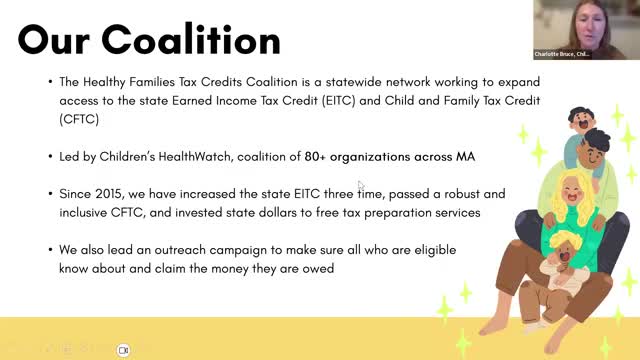
Presenters at an outreach webinar explained how Massachusetts and federal tax credits can reduce taxes owed and increase refunds for low‑ and moderate‑income households, and how to access free help to claim them. Carly Romly, a presenter who introduced the session, said the credits "pode ser centenas a milhares de dólares" for eligible families.
The webinar described two main credits: the federal earned-income tax credit (EITC) and a Massachusetts child-and-family tax credit. The presenters said the EITC is for workers with moderate or low earnings and that Massachusetts covers roughly 40% of the federal amount. Slides and remarks mentioned workers earning under about $69,000 as a reference point for some options, while a later slide referenced a $79,000 threshold for 2025 filings; presenters directed attendees to the materials for exact eligibility rules.
Angela do Varson, an attorney with a clinic serving low‑income taxpayers, explained the state child-and-family credit is narrower in dollar amount but broader in who it covers: she said a new state credit provides about $440 per child under 13 and can also apply to older dependents with disabilities or elderly dependents in a household. Presenters emphasized that the Massachusetts child-and-family credit may be claimable even when a taxpayer has little or no earned income.
The webinar used three household examples to show how the credits interact: a single worker without children who could receive a modest state credit, a single-parent household with older children that might not qualify for the child credit but would for the EITC, and a married household where federal and state credits together produced a much larger combined benefit in the presenter’s example (one example cited nearly $10,000).
Presenters said taxpayers may file returns for prior years to claim missed credits — generally up to three years after the original due date — and they stressed that claiming credits does not automatically affect eligibility for other public-benefit programs. For immigrants, presenters said that people without Social Security numbers can apply for an ITIN to file taxes but should weigh any immigration-specific legal risks and may wish to consult immigration counsel.
The session closed with instructions for finding free, IRS-certified VITA tax-preparation sites and a reminder that printed and translated outreach materials are available for community partners. Presenters posted contact emails in chat and offered follow-up help for complicated individual situations.
The next practical step for interested households is to consult the resource page linked by presenters and, if eligible, schedule assistance at a local VITA site or contact the legal clinic for more complex immigration or revenue disputes.
The webinar described two main credits: the federal earned-income tax credit (EITC) and a Massachusetts child-and-family tax credit. The presenters said the EITC is for workers with moderate or low earnings and that Massachusetts covers roughly 40% of the federal amount. Slides and remarks mentioned workers earning under about $69,000 as a reference point for some options, while a later slide referenced a $79,000 threshold for 2025 filings; presenters directed attendees to the materials for exact eligibility rules.
Angela do Varson, an attorney with a clinic serving low‑income taxpayers, explained the state child-and-family credit is narrower in dollar amount but broader in who it covers: she said a new state credit provides about $440 per child under 13 and can also apply to older dependents with disabilities or elderly dependents in a household. Presenters emphasized that the Massachusetts child-and-family credit may be claimable even when a taxpayer has little or no earned income.
The webinar used three household examples to show how the credits interact: a single worker without children who could receive a modest state credit, a single-parent household with older children that might not qualify for the child credit but would for the EITC, and a married household where federal and state credits together produced a much larger combined benefit in the presenter’s example (one example cited nearly $10,000).
Presenters said taxpayers may file returns for prior years to claim missed credits — generally up to three years after the original due date — and they stressed that claiming credits does not automatically affect eligibility for other public-benefit programs. For immigrants, presenters said that people without Social Security numbers can apply for an ITIN to file taxes but should weigh any immigration-specific legal risks and may wish to consult immigration counsel.
The session closed with instructions for finding free, IRS-certified VITA tax-preparation sites and a reminder that printed and translated outreach materials are available for community partners. Presenters posted contact emails in chat and offered follow-up help for complicated individual situations.
The next practical step for interested households is to consult the resource page linked by presenters and, if eligible, schedule assistance at a local VITA site or contact the legal clinic for more complex immigration or revenue disputes.
Don't Miss a Word: See the Full Meeting!
Go beyond summaries. Unlock every video, transcript, and key insight with a Founder Membership.
✓
Get instant access to full meeting videos
✓
Search and clip any phrase from complete transcripts
✓
Receive AI-powered summaries & custom alerts
✓
Enjoy lifetime, unrestricted access to government data
30-day money-back guarantee
