Community session outlines tax-credit eligibility and low-cost filing help for immigrants and low-income residents
February 18, 2026 | Department of Early Education and Care, Executive , Massachusetts
This article was created by AI summarizing key points discussed. AI makes mistakes, so for full details and context, please refer to the video of the full meeting. Please report any errors so we can fix them. Report an error »
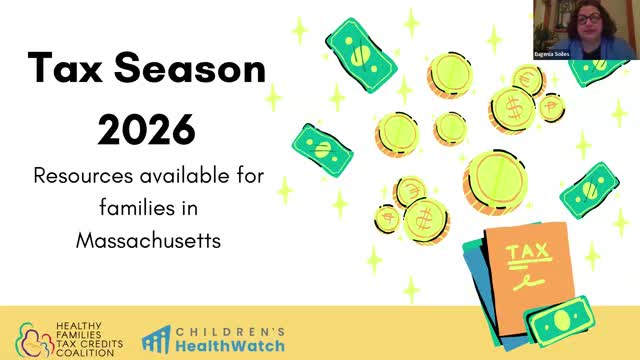
Two presenters at a community information session provided attendees with practical guidance on claiming tax credits and finding low-cost tax-preparation services.
The session focused on who is eligible for certain refundable credits, how household income and banking status affect qualification, and what documents are commonly requested. Speaker 2 repeated that some credits can reach “jusqu'à 1000 euros” (up to 1,000 euros), though the transcript did not fully specify currency context or program name. Speaker 2 also told the audience that low-cost or free tax-preparation options are widely available and that such services “généralement touche soixante-neuf dollars ou bien moins” (generally cost $69 or less).
Why it matters: For low-income families and immigrant residents, claiming eligible credits and using low-cost filing assistance can increase household income. The presenters emphasized outreach and multiple-language supports and encouraged those with complex immigration or income situations to seek additional legal advice.
Details from the session
Eligibility and filing options: Speaker 2 explained that qualification for the credit depends on income, filing status and whether a household has a qualifying bank account or taxpayer identification. The presenter described example households where family composition affects eligibility and said claims can be made at state or federal levels depending on the program.
Immigrant taxpayers and documentation: On immigrant eligibility, Speaker 2 stated that a Social Security number is “pas besoin” (not always required) in some situations and discussed use of alternate documentation. The transcript does not specify which alternate identifiers or what exact procedures apply; the presenters recommended consulting an immigration attorney for cases with legal complexity.
Costs and services: The presenters said community tax-preparation services are available across the state, often in multiple languages, and that attendees commonly see a price point around $69 for paid services. Printed materials and online resources were made available, and attendees were encouraged to reach out for help.
Follow-up and contacts: Attendees were directed to contact Angela or Charlotte (roles not specified in the transcript) for appointments and assistance. The presenters said materials would be shared online and via social media, and that flyers could be printed for distribution.
The session concluded with an invitation to follow up by phone or online and with presenters offering to share additional resources by email or through community partners.
The session focused on who is eligible for certain refundable credits, how household income and banking status affect qualification, and what documents are commonly requested. Speaker 2 repeated that some credits can reach “jusqu'à 1000 euros” (up to 1,000 euros), though the transcript did not fully specify currency context or program name. Speaker 2 also told the audience that low-cost or free tax-preparation options are widely available and that such services “généralement touche soixante-neuf dollars ou bien moins” (generally cost $69 or less).
Why it matters: For low-income families and immigrant residents, claiming eligible credits and using low-cost filing assistance can increase household income. The presenters emphasized outreach and multiple-language supports and encouraged those with complex immigration or income situations to seek additional legal advice.
Details from the session
Eligibility and filing options: Speaker 2 explained that qualification for the credit depends on income, filing status and whether a household has a qualifying bank account or taxpayer identification. The presenter described example households where family composition affects eligibility and said claims can be made at state or federal levels depending on the program.
Immigrant taxpayers and documentation: On immigrant eligibility, Speaker 2 stated that a Social Security number is “pas besoin” (not always required) in some situations and discussed use of alternate documentation. The transcript does not specify which alternate identifiers or what exact procedures apply; the presenters recommended consulting an immigration attorney for cases with legal complexity.
Costs and services: The presenters said community tax-preparation services are available across the state, often in multiple languages, and that attendees commonly see a price point around $69 for paid services. Printed materials and online resources were made available, and attendees were encouraged to reach out for help.
Follow-up and contacts: Attendees were directed to contact Angela or Charlotte (roles not specified in the transcript) for appointments and assistance. The presenters said materials would be shared online and via social media, and that flyers could be printed for distribution.
The session concluded with an invitation to follow up by phone or online and with presenters offering to share additional resources by email or through community partners.
View the Full Meeting & All Its Details
This article offers just a summary. Unlock complete video, transcripts, and insights as a Founder Member.
✓
Watch full, unedited meeting videos
✓
Search every word spoken in unlimited transcripts
✓
AI summaries & real-time alerts (all government levels)
✓
Permanent access to expanding government content
30-day money-back guarantee
