Committee hears competing fixes for toxicology backlog as Seattle cites 22‑month turnaround
February 19, 2026 | Legislative Sessions, Washington
This article was created by AI summarizing key points discussed. AI makes mistakes, so for full details and context, please refer to the video of the full meeting. Please report any errors so we can fix them. Report an error »
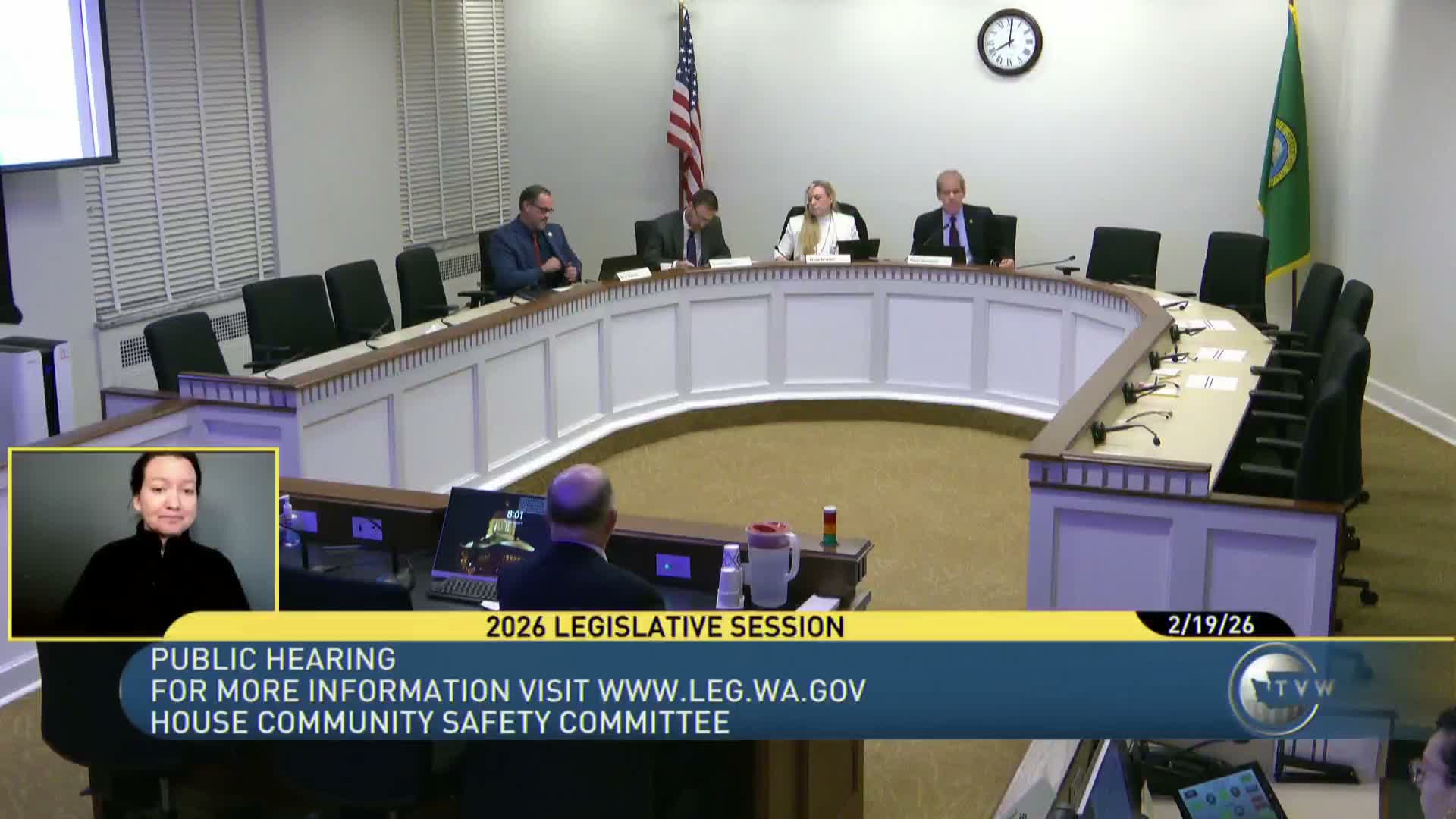
The House Community Safety Committee heard rapid testimony on second substitute Senate Bill 5,880 on Feb. 19, a proposal that would allow ISO/IEC‑accredited private laboratories to perform blood and breath analyses used in impaired‑driving cases and let local governments accept private funding to use those labs.
Martha Whaling, staff to the committee, told members the bill would permit private labs' test results to be admissible so long as testing follows approved methods and, if a city or county opts to use outside testing, it must contract with the Washington State Patrol to reimburse the patrol’s costs for moving evidence.
Senator Keith Wagoner and multiple law‑enforcement witnesses said the proposal is designed as a stopgap while the state toxicology lab is strengthened. Russell Brown of the Washington Association of Prosecuting Attorneys said the bill “does not fix our tox backlog” and estimated that clearing it by outsourcing could cost tens of millions: “If you run some rough math … it could be close to $40,000,000 to clear the backlog under this dynamic,” he said.
Seattle City Attorney Erica Evans, whose office cited a 22‑month turnaround for toxicology reports, urged passage “as is” and said prolonged delays let suspects remain without court‑imposed restrictions. At the same time, Bradley Lane, a state traffic safety prosecutor, and defense representatives warned that outsourcing raises practical discovery and confrontation issues: Carly Valdez of the Washington Association of Criminal Defense Lawyers asked the committee to require contracting language that obligates outside labs and clinics to cooperate with reasonable interview and discovery requests as a condition of procurement contracts.
Veteran prosecutor Amy Friedheim, who has worked blood‑alcohol testing for decades, told the committee that every analyst who touches a forensic blood sample must come to testify in person unless defendants agree otherwise — a reality that makes outsourcing expensive and does not eliminate the need for more state capacity. Friedheim recommended lowering the per‑se blood‑alcohol concentration as a complementary policy to reduce crash volume and lab demand.
Several witnesses urged pairing any expansion to private lab use with state funding increases, statutory timelines and contract protections for defense discovery. Committee members signaled openness to amendments that preserve flexibility for in‑state and out‑of‑state labs while protecting due process. The bill remains pending for executive action next week.
The committee suspended SSB 5,880 to hear other bills but did not take final action on the measure during the Feb. 19 session.
Martha Whaling, staff to the committee, told members the bill would permit private labs' test results to be admissible so long as testing follows approved methods and, if a city or county opts to use outside testing, it must contract with the Washington State Patrol to reimburse the patrol’s costs for moving evidence.
Senator Keith Wagoner and multiple law‑enforcement witnesses said the proposal is designed as a stopgap while the state toxicology lab is strengthened. Russell Brown of the Washington Association of Prosecuting Attorneys said the bill “does not fix our tox backlog” and estimated that clearing it by outsourcing could cost tens of millions: “If you run some rough math … it could be close to $40,000,000 to clear the backlog under this dynamic,” he said.
Seattle City Attorney Erica Evans, whose office cited a 22‑month turnaround for toxicology reports, urged passage “as is” and said prolonged delays let suspects remain without court‑imposed restrictions. At the same time, Bradley Lane, a state traffic safety prosecutor, and defense representatives warned that outsourcing raises practical discovery and confrontation issues: Carly Valdez of the Washington Association of Criminal Defense Lawyers asked the committee to require contracting language that obligates outside labs and clinics to cooperate with reasonable interview and discovery requests as a condition of procurement contracts.
Veteran prosecutor Amy Friedheim, who has worked blood‑alcohol testing for decades, told the committee that every analyst who touches a forensic blood sample must come to testify in person unless defendants agree otherwise — a reality that makes outsourcing expensive and does not eliminate the need for more state capacity. Friedheim recommended lowering the per‑se blood‑alcohol concentration as a complementary policy to reduce crash volume and lab demand.
Several witnesses urged pairing any expansion to private lab use with state funding increases, statutory timelines and contract protections for defense discovery. Committee members signaled openness to amendments that preserve flexibility for in‑state and out‑of‑state labs while protecting due process. The bill remains pending for executive action next week.
The committee suspended SSB 5,880 to hear other bills but did not take final action on the measure during the Feb. 19 session.
View the Full Meeting & All Its Details
This article offers just a summary. Unlock complete video, transcripts, and insights as a Founder Member.
✓
Watch full, unedited meeting videos
✓
Search every word spoken in unlimited transcripts
✓
AI summaries & real-time alerts (all government levels)
✓
Permanent access to expanding government content
30-day money-back guarantee
