Bill would bar HOAs from banning fire‑hardened building materials for qualifying homes
February 19, 2026 | Legislative Sessions, Washington
This article was created by AI summarizing key points discussed. AI makes mistakes, so for full details and context, please refer to the video of the full meeting. Please report any errors so we can fix them. Report an error »
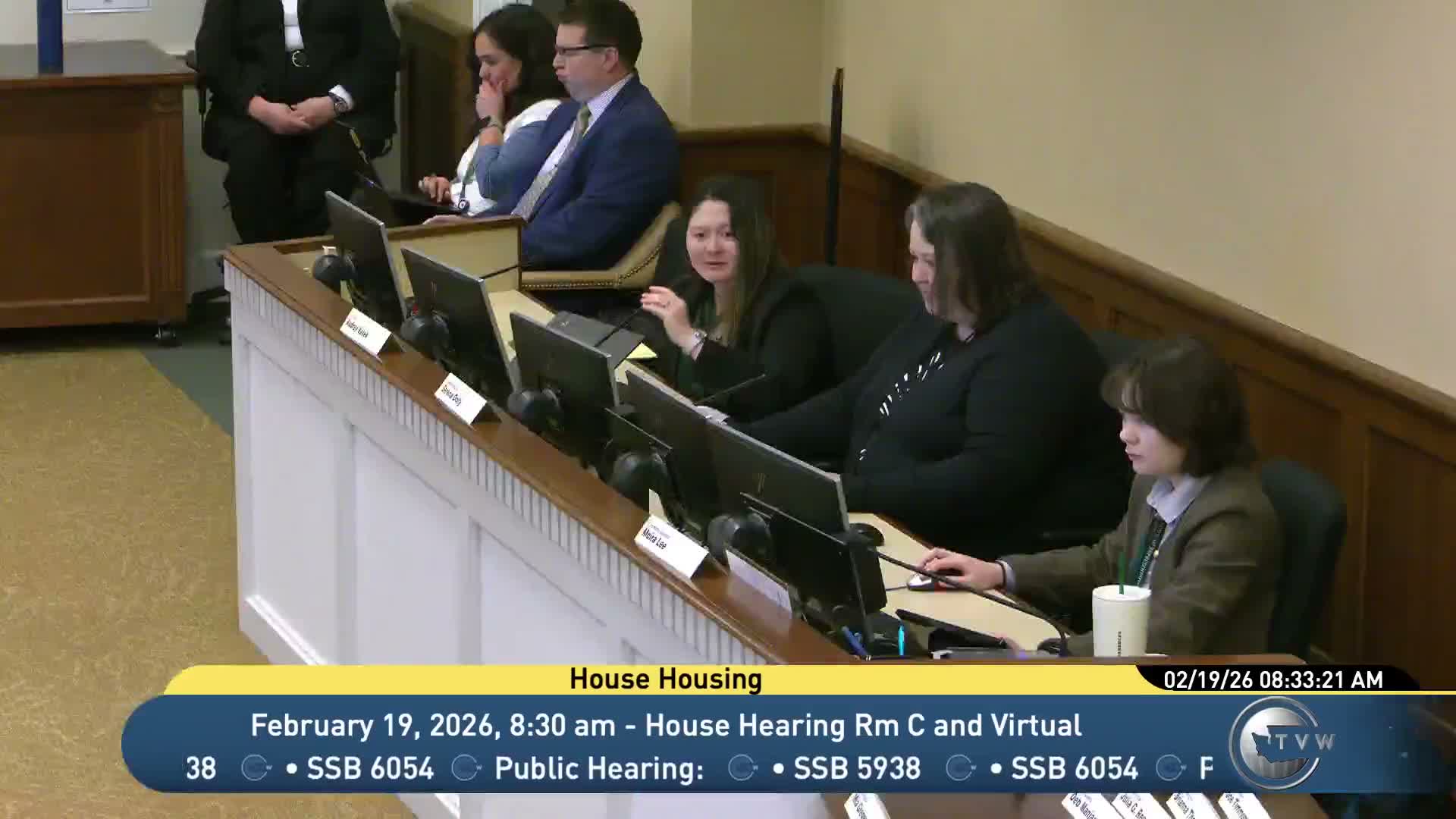
Senate Bill 6,054 would stop common‑interest communities (such as homeowners associations and condominiums) from banning homeowners who want to install fire‑hardened building materials that meet applicable permitting and health‑and‑safety standards.
Senator Victoria Hunt (5th Legislative District), sponsor of the bill, told the House Housing Committee that she encountered communities where governing documents require shake roofs and prevent homeowners from replacing them with safer, fire‑resistant materials. "This is a bill that prevents HOAs from having unreasonable restrictions on folks in terms of what they can use to keep their homes and the homes of their neighbors safe against wildfire," Hunt said.
The substitute bill, as summarized by committee staff Audrey Vaisik, would add a new limitation on the authority of CIC governing documents under the Washington Uniform Common Interest Ownership Act, the Homeowners Association Act, and the Washington Condominium Act. Governing documents "would not be allowed to prohibit the installation, use, or maintenance of fire‑hardened building materials that meet applicable health and safety standards imposed by permitting authorities," Vaisik said. The bill preserves an HOA's ability to adopt "reasonable rules regarding the design, dimensions, placement, or exterior appearance" so long as those rules do not render the use of qualifying materials infeasible or "significantly increase" their cost. The substitute also states the change applies retroactively, voiding any inconsistent governing‑document provisions on the bill's effective date.
Supporters at the hearing framed the bill as a public‑safety measure. David Fort, senior policy adviser for property and casualty insurance at the Office of the Insurance Commissioner, testified the number of homeowners policies nonrenewed by insurers has doubled in Washington over the past five years and said the bill gives homeowners "some additional tools to become insurable." Hillary Boblitz, chair of the Washington State Community Association Institute Legislative Action Committee, said the measure "strikes an appropriate balance" between resilience and preserving community character.
Stakeholders suggested technical changes. Brandon Huskeeper of the American Wood Council said some definitions in the substitute are "a bit restrictive" and could exclude wood products that meet other standards; he offered written amendments and asked to work with the sponsor. Steve Horvath of HOA United supported the bill but warned that words such as "reasonable" and "significantly" may invite litigation; he suggested adding a numeric threshold (for example, 10%–20%) to define when an HOA's architectural requirement would be considered to "significantly increase" costs.
Committee staff and the sponsor did not take a vote in the public hearing. The committee closed the public hearing on SB 6,054 and indicated the bill may be scheduled for executive action next week.
The committee did not adopt amendments during the hearing; stakeholders asked sponsors to work on definition and cost‑threshold language before potential executive action.
Senator Victoria Hunt (5th Legislative District), sponsor of the bill, told the House Housing Committee that she encountered communities where governing documents require shake roofs and prevent homeowners from replacing them with safer, fire‑resistant materials. "This is a bill that prevents HOAs from having unreasonable restrictions on folks in terms of what they can use to keep their homes and the homes of their neighbors safe against wildfire," Hunt said.
The substitute bill, as summarized by committee staff Audrey Vaisik, would add a new limitation on the authority of CIC governing documents under the Washington Uniform Common Interest Ownership Act, the Homeowners Association Act, and the Washington Condominium Act. Governing documents "would not be allowed to prohibit the installation, use, or maintenance of fire‑hardened building materials that meet applicable health and safety standards imposed by permitting authorities," Vaisik said. The bill preserves an HOA's ability to adopt "reasonable rules regarding the design, dimensions, placement, or exterior appearance" so long as those rules do not render the use of qualifying materials infeasible or "significantly increase" their cost. The substitute also states the change applies retroactively, voiding any inconsistent governing‑document provisions on the bill's effective date.
Supporters at the hearing framed the bill as a public‑safety measure. David Fort, senior policy adviser for property and casualty insurance at the Office of the Insurance Commissioner, testified the number of homeowners policies nonrenewed by insurers has doubled in Washington over the past five years and said the bill gives homeowners "some additional tools to become insurable." Hillary Boblitz, chair of the Washington State Community Association Institute Legislative Action Committee, said the measure "strikes an appropriate balance" between resilience and preserving community character.
Stakeholders suggested technical changes. Brandon Huskeeper of the American Wood Council said some definitions in the substitute are "a bit restrictive" and could exclude wood products that meet other standards; he offered written amendments and asked to work with the sponsor. Steve Horvath of HOA United supported the bill but warned that words such as "reasonable" and "significantly" may invite litigation; he suggested adding a numeric threshold (for example, 10%–20%) to define when an HOA's architectural requirement would be considered to "significantly increase" costs.
Committee staff and the sponsor did not take a vote in the public hearing. The committee closed the public hearing on SB 6,054 and indicated the bill may be scheduled for executive action next week.
The committee did not adopt amendments during the hearing; stakeholders asked sponsors to work on definition and cost‑threshold language before potential executive action.
Don't Miss a Word: See the Full Meeting!
Go beyond summaries. Unlock every video, transcript, and key insight with a Founder Membership.
✓
Get instant access to full meeting videos
✓
Search and clip any phrase from complete transcripts
✓
Receive AI-powered summaries & custom alerts
✓
Enjoy lifetime, unrestricted access to government data
30-day money-back guarantee
