Supporters press for 0.05 BAC while hospitality and defense warn of consequences
February 19, 2026 | Legislative Sessions, Washington
This article was created by AI summarizing key points discussed. AI makes mistakes, so for full details and context, please refer to the video of the full meeting. Please report any errors so we can fix them. Report an error »
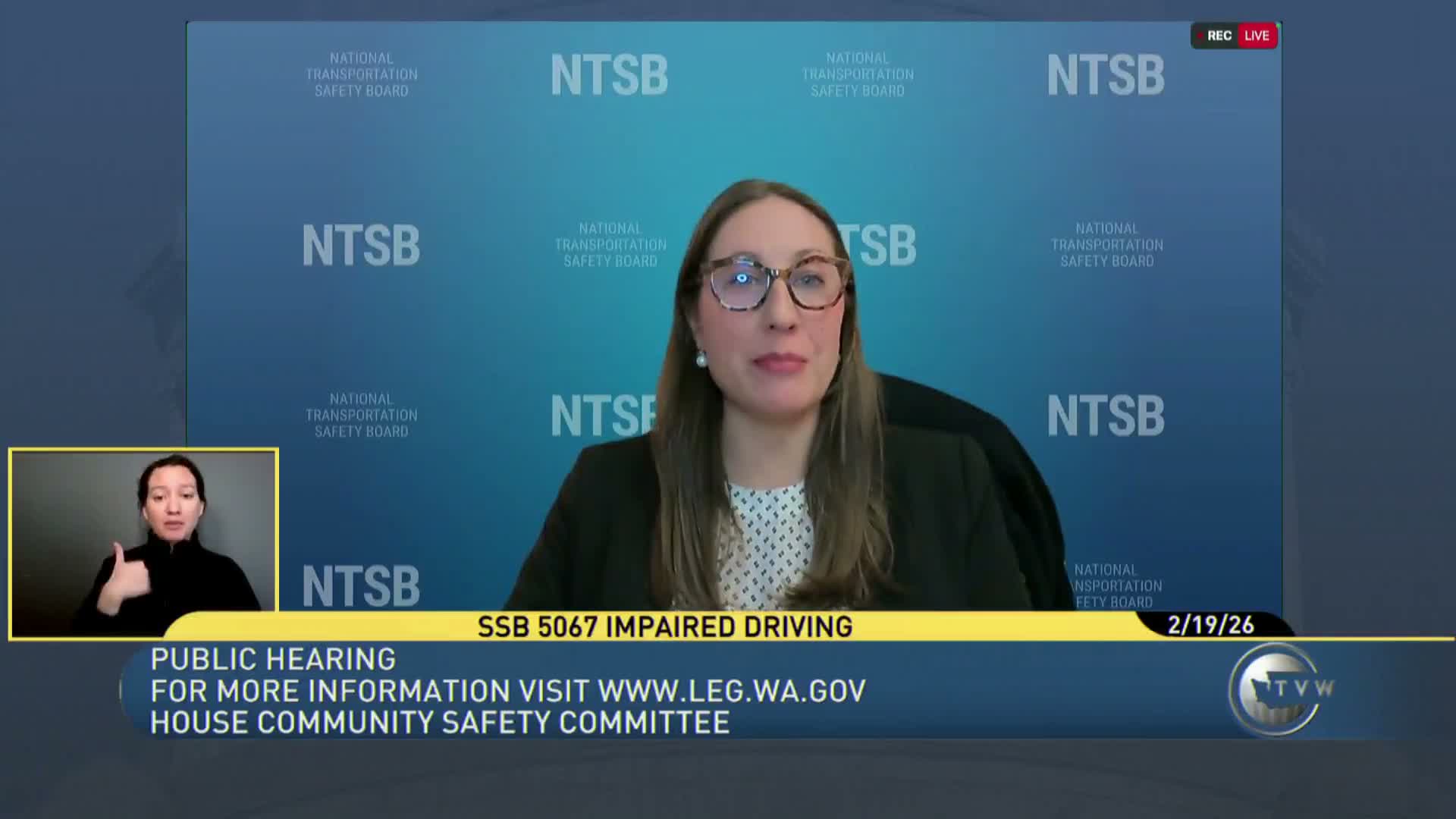
The committee heard compressed public testimony on substitute Senate Bill 50 67, which would lower Washington’s per‑se blood‑alcohol concentration limit from 0.08 to 0.05, require a public information campaign and mandate an evaluation of the policy’s impacts.
Leah Walton of the National Transportation Safety Board said the NTSB has recommended a 0.05 per‑se standard and cited research estimating an 11% reduction in fatal alcohol‑related crashes if states adopt the lower limit. Multiple victims' family members and advocates told personal stories of lives lost and urged the committee to pass the measure to prevent future deaths.
The Washington State Patrol and the state Traffic Safety Commission supported the bill as evidence‑based deterrence and not a change in enforcement authority — officers still require reasonable suspicion or probable cause to stop drivers. Captain Dion Glover said the bill is designed to prevent deaths and encourage planning for sober transport rather than to increase arrests.
Opponents included the Washington Hospitality Association, which urged focus on enforcement and prevention rather than expanding liability, and defense‑oriented witnesses who argued a 0.05 per‑se standard reduces protections and shifts the evidentiary burden from impairment to a numeric threshold that can have life‑altering consequences for accused people.
Committee members acknowledged the stark testimony from victims and the NTSB’s data but also asked technical questions about arrest rates, lab capacity and how lowering the per‑se level would change case processing. The committee did not take a final vote on Feb. 19 and will consider the measure further.
Leah Walton of the National Transportation Safety Board said the NTSB has recommended a 0.05 per‑se standard and cited research estimating an 11% reduction in fatal alcohol‑related crashes if states adopt the lower limit. Multiple victims' family members and advocates told personal stories of lives lost and urged the committee to pass the measure to prevent future deaths.
The Washington State Patrol and the state Traffic Safety Commission supported the bill as evidence‑based deterrence and not a change in enforcement authority — officers still require reasonable suspicion or probable cause to stop drivers. Captain Dion Glover said the bill is designed to prevent deaths and encourage planning for sober transport rather than to increase arrests.
Opponents included the Washington Hospitality Association, which urged focus on enforcement and prevention rather than expanding liability, and defense‑oriented witnesses who argued a 0.05 per‑se standard reduces protections and shifts the evidentiary burden from impairment to a numeric threshold that can have life‑altering consequences for accused people.
Committee members acknowledged the stark testimony from victims and the NTSB’s data but also asked technical questions about arrest rates, lab capacity and how lowering the per‑se level would change case processing. The committee did not take a final vote on Feb. 19 and will consider the measure further.
Don't Miss a Word: See the Full Meeting!
Go beyond summaries. Unlock every video, transcript, and key insight with a Founder Membership.
✓
Get instant access to full meeting videos
✓
Search and clip any phrase from complete transcripts
✓
Receive AI-powered summaries & custom alerts
✓
Enjoy lifetime, unrestricted access to government data
30-day money-back guarantee
