Committee hears bill to align state hiring rules with federal work‑authorization
February 18, 2026 | Legislative Sessions, Washington
This article was created by AI summarizing key points discussed. AI makes mistakes, so for full details and context, please refer to the video of the full meeting. Please report any errors so we can fix them. Report an error »
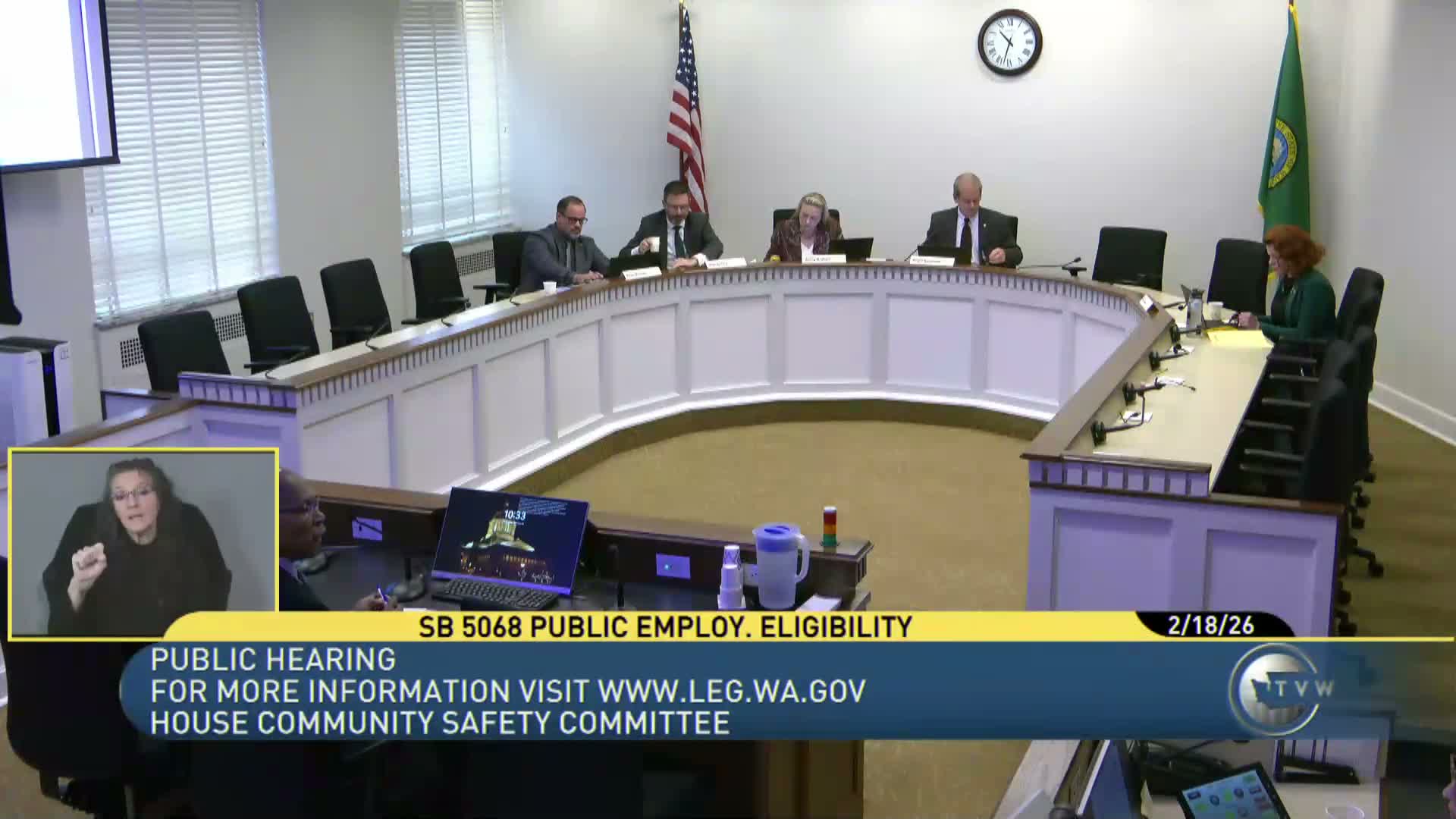
Martha Whaling, staff to the House Community Safety Committee, told members that "the bill before you, engrossed Senate Bill 50 68, removes references to applicants who are lawful permanent residents or in DACA status, and instead specifies that an individual who is legally authorized to work in the United States under federal law can apply for and be employed" in law enforcement and other public safety positions. The bill also includes a retroactivity provision for those employed on or after the effective date and an emergency clause to make its provisions effective immediately.
Senator John Lubbock (44th District), who sponsored the measure in the Senate, said the change will enlarge the pool of candidates at a time the state is expanding training capacity and urged a yes vote. "I would just encourage a yes vote," he said, adding the legislation should help agencies recruit qualified applicants.
Ranking Member (speaker 5) and other members pressed staff and the sponsor on background‑check mechanics and potential gaps when foreign records are involved. The ranking member said she remained concerned that "when we talk about somebody that has legal status to be able to work, that there is a problem with the investigation that goes into the person" if an applicant lied on their visa. Witnesses and agency representatives said existing safeguards permit termination or decertification if dishonesty is discovered, and several supporters recommended restoring an amendment from last year clarifying certification and timing issues for visas.
Joe McDermott, state relations director for the King County executive, testified King County "supports Senate Bill 50 68" because it brings state statute into alignment with the federal work‑authorization framework and helps clear inconsistent eligibility language that complicates hiring. James McMahon (Association of Sheriffs and Police Chiefs) asked the committee to reapply a prior amendment addressing certification and timing of visa authorization so agencies are protected from discrimination claims.
Opposition testimony included Steven Shutt of Gig Harbor, who argued from a labor perspective that the bill could be "anti‑worker" and urged lawmakers to consider wages and labor market policies rather than expanding visa‑based hiring as the primary response to workforce shortages.
The committee did not take final action. Chair Goodman told members that the committee will take executive action on recently heard bills the following day and encouraged sponsors and stakeholders to work with staff on technical amendments and clarifications.
The hearing record includes staff briefings, sponsor remarks, county and law‑enforcement association support, individual immigrant testimony in favor, and at least one labor‑market objection. The committee indicated it will continue to refine amendment language before executive action.
Senator John Lubbock (44th District), who sponsored the measure in the Senate, said the change will enlarge the pool of candidates at a time the state is expanding training capacity and urged a yes vote. "I would just encourage a yes vote," he said, adding the legislation should help agencies recruit qualified applicants.
Ranking Member (speaker 5) and other members pressed staff and the sponsor on background‑check mechanics and potential gaps when foreign records are involved. The ranking member said she remained concerned that "when we talk about somebody that has legal status to be able to work, that there is a problem with the investigation that goes into the person" if an applicant lied on their visa. Witnesses and agency representatives said existing safeguards permit termination or decertification if dishonesty is discovered, and several supporters recommended restoring an amendment from last year clarifying certification and timing issues for visas.
Joe McDermott, state relations director for the King County executive, testified King County "supports Senate Bill 50 68" because it brings state statute into alignment with the federal work‑authorization framework and helps clear inconsistent eligibility language that complicates hiring. James McMahon (Association of Sheriffs and Police Chiefs) asked the committee to reapply a prior amendment addressing certification and timing of visa authorization so agencies are protected from discrimination claims.
Opposition testimony included Steven Shutt of Gig Harbor, who argued from a labor perspective that the bill could be "anti‑worker" and urged lawmakers to consider wages and labor market policies rather than expanding visa‑based hiring as the primary response to workforce shortages.
The committee did not take final action. Chair Goodman told members that the committee will take executive action on recently heard bills the following day and encouraged sponsors and stakeholders to work with staff on technical amendments and clarifications.
The hearing record includes staff briefings, sponsor remarks, county and law‑enforcement association support, individual immigrant testimony in favor, and at least one labor‑market objection. The committee indicated it will continue to refine amendment language before executive action.
Don't Miss a Word: See the Full Meeting!
Go beyond summaries. Unlock every video, transcript, and key insight with a Founder Membership.
✓
Get instant access to full meeting videos
✓
Search and clip any phrase from complete transcripts
✓
Receive AI-powered summaries & custom alerts
✓
Enjoy lifetime, unrestricted access to government data
30-day money-back guarantee
