Bill would create state grant program to shore up port supply‑chain projects
February 18, 2026 | Legislative Sessions, Washington
This article was created by AI summarizing key points discussed. AI makes mistakes, so for full details and context, please refer to the video of the full meeting. Please report any errors so we can fix them. Report an error »
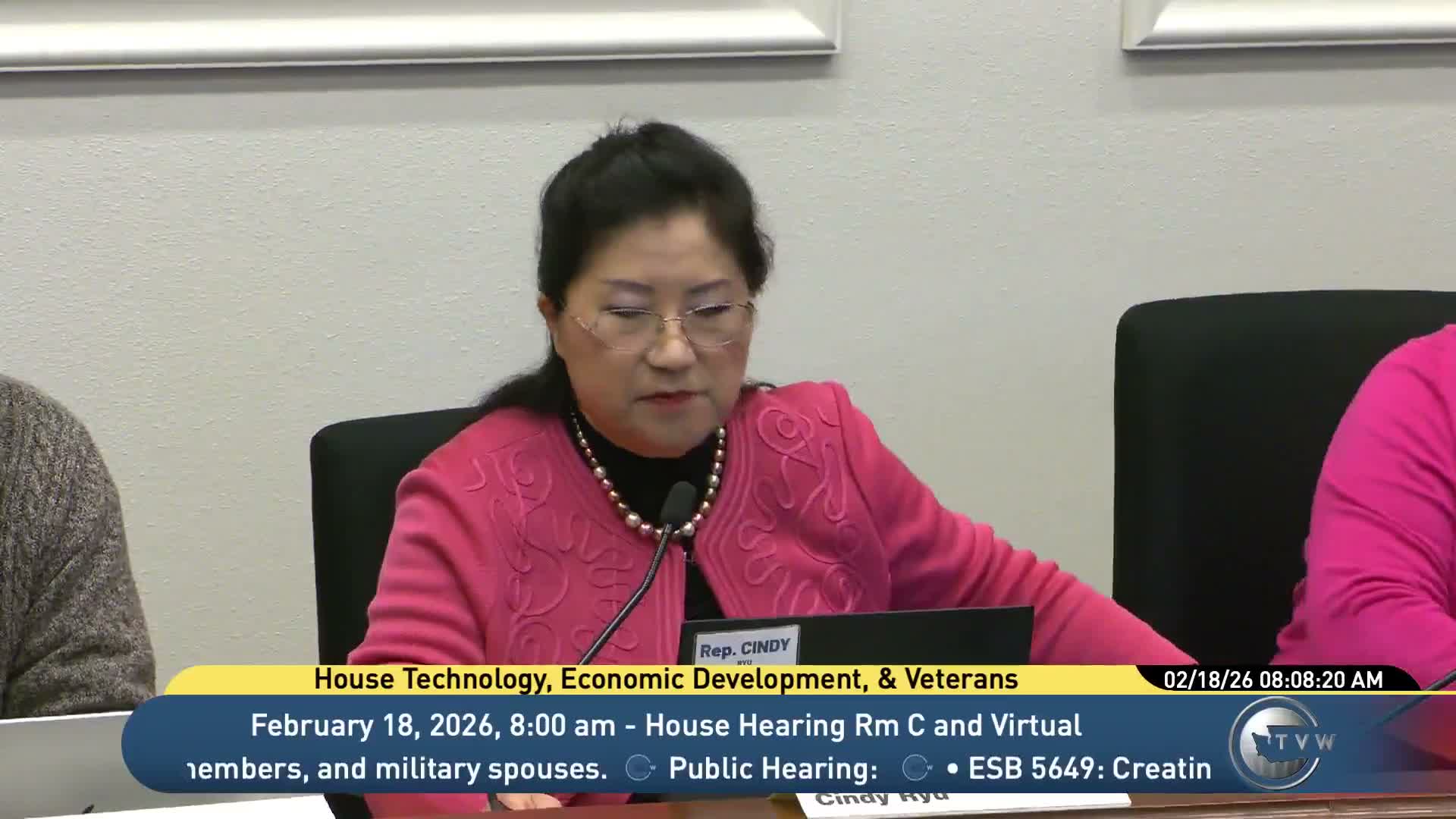
Senate Bill 5649 would authorize the Washington State Department of Transportation to set priorities and administer grants and loans to public and tribal ports for projects included in freight development plans, supporters told the Technology, Economic Development and Veterans Committee on Feb. 18.
Sen. Marco Elias (21st District), the bill’s prime sponsor and chair of the Senate Transportation Committee, said the measure is intended to help ports protect Washington’s trade-driven economy and to address supply‑chain weaknesses revealed during the pandemic. “Ports affect our daily lives from the smartphones we use to the groceries we buy,” Elias said.
Martha Whaling, staff to the committee, said the engrossed bill creates a dedicated account in the state treasury for the program, requires the Department of Transportation to collaborate with supply‑chain stakeholders to develop performance metrics and a list of eligible project types, and requires that projects be included in a port’s freight development plan. The bill includes an amendment (WALE 392) sponsored by Rep. Ryu that limits program eligibility to projects that are not eligible for funding from the Freight Mobility Strategic Investment Board (FMSIB), Whaling said.
Port officials who testified described infrastructure needs they say existing state and federal programs do not cover. Eric Fitch, executive director of the Washington Public Ports Association, said ports and their partners face freight congestion and that some important, transportation‑oriented projects are not eligible for other grant programs. “We undertook that work with valuable partners — truckers, rail operators, apple and wheat growers, dock workers, maritime labor partners,” Fitch said, describing stakeholder input used to shape the bill.
Cassie Lohse, director of government affairs for the Port of Benton, said her port owns 16 miles of rail that is “in disrepair” and cited examples such as damaged crossings and ties. She said federal funding has improved speeds modestly but state matching tools would help bring service up to levels that attract businesses and create family‑wage jobs.
Catherine Fraser, grants and government affairs manager for the Port of Port Angeles, told the committee her port’s cargo terminal has reached the end of its useful life and needs “major renovations” estimated at more than $10,000,000. Fraser said the project had been screened and found ineligible for FMSIB funding, and she urged the state to provide matching funds to help rural and disadvantaged communities compete for federal grants.
Committee members asked whether projects funded by the proposed program could be combined with federal grants. Fitch said the program could be used as state match for federal funds in some cases and that the amendment limiting overlap with FMSIB was intended to avoid duplication with existing state funding streams. No formal action or vote was taken in the committee during the hearing.
The bill’s fiscal implementation would be subject to appropriation by the Legislature. The committee closed the SB 5649 hearing and returned to consider Senate Bill 5420.
Sen. Marco Elias (21st District), the bill’s prime sponsor and chair of the Senate Transportation Committee, said the measure is intended to help ports protect Washington’s trade-driven economy and to address supply‑chain weaknesses revealed during the pandemic. “Ports affect our daily lives from the smartphones we use to the groceries we buy,” Elias said.
Martha Whaling, staff to the committee, said the engrossed bill creates a dedicated account in the state treasury for the program, requires the Department of Transportation to collaborate with supply‑chain stakeholders to develop performance metrics and a list of eligible project types, and requires that projects be included in a port’s freight development plan. The bill includes an amendment (WALE 392) sponsored by Rep. Ryu that limits program eligibility to projects that are not eligible for funding from the Freight Mobility Strategic Investment Board (FMSIB), Whaling said.
Port officials who testified described infrastructure needs they say existing state and federal programs do not cover. Eric Fitch, executive director of the Washington Public Ports Association, said ports and their partners face freight congestion and that some important, transportation‑oriented projects are not eligible for other grant programs. “We undertook that work with valuable partners — truckers, rail operators, apple and wheat growers, dock workers, maritime labor partners,” Fitch said, describing stakeholder input used to shape the bill.
Cassie Lohse, director of government affairs for the Port of Benton, said her port owns 16 miles of rail that is “in disrepair” and cited examples such as damaged crossings and ties. She said federal funding has improved speeds modestly but state matching tools would help bring service up to levels that attract businesses and create family‑wage jobs.
Catherine Fraser, grants and government affairs manager for the Port of Port Angeles, told the committee her port’s cargo terminal has reached the end of its useful life and needs “major renovations” estimated at more than $10,000,000. Fraser said the project had been screened and found ineligible for FMSIB funding, and she urged the state to provide matching funds to help rural and disadvantaged communities compete for federal grants.
Committee members asked whether projects funded by the proposed program could be combined with federal grants. Fitch said the program could be used as state match for federal funds in some cases and that the amendment limiting overlap with FMSIB was intended to avoid duplication with existing state funding streams. No formal action or vote was taken in the committee during the hearing.
The bill’s fiscal implementation would be subject to appropriation by the Legislature. The committee closed the SB 5649 hearing and returned to consider Senate Bill 5420.
Don't Miss a Word: See the Full Meeting!
Go beyond summaries. Unlock every video, transcript, and key insight with a Founder Membership.
✓
Get instant access to full meeting videos
✓
Search and clip any phrase from complete transcripts
✓
Receive AI-powered summaries & custom alerts
✓
Enjoy lifetime, unrestricted access to government data
30-day money-back guarantee
