House committee reviews H.529 strike‑all to reshape Vermont pretrial supervision program
February 19, 2026 | Corrections & Institutions, HOUSE OF REPRESENTATIVES, Committees, Legislative , Vermont
This article was created by AI summarizing key points discussed. AI makes mistakes, so for full details and context, please refer to the video of the full meeting. Please report any errors so we can fix them. Report an error »
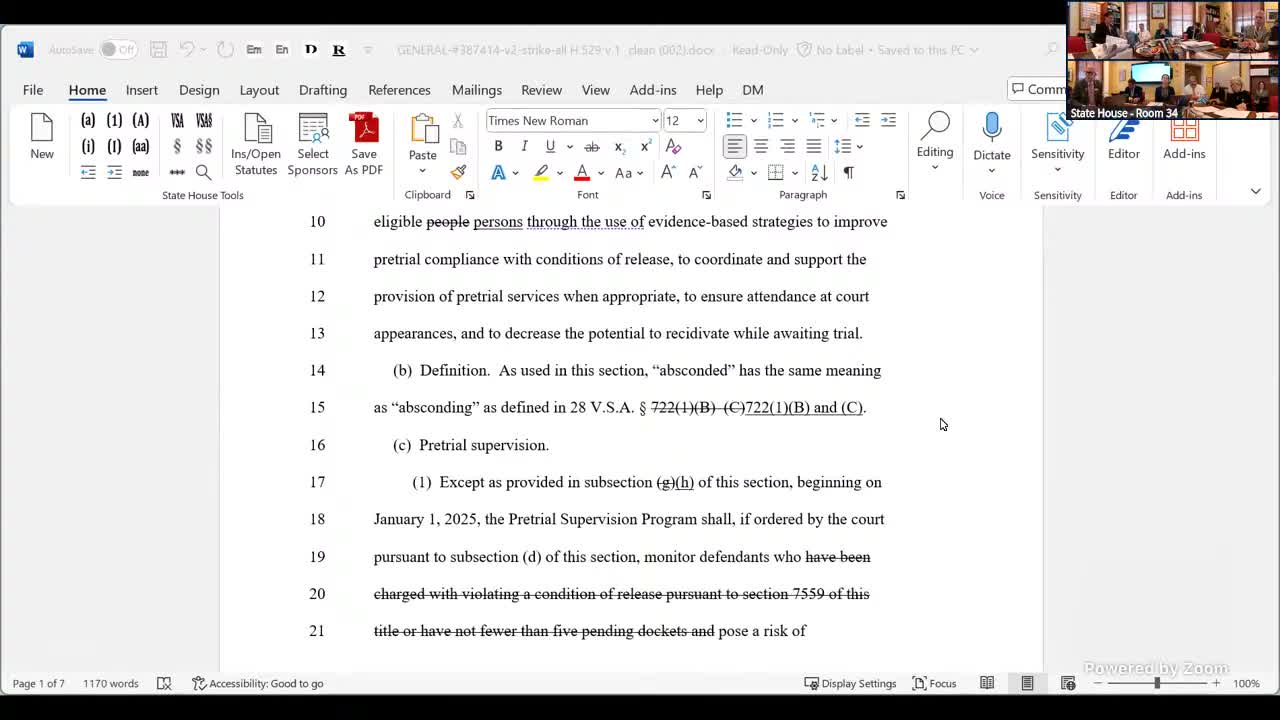
Legislative counsel introduced draft 1.1 of a strike‑all amendment to H.529 on Feb. 18 before the House Corrections & Institutions committee, proposing two substantive statutory changes and several procedural rewrites. The amendment would remove existing statutory eligibility requirements (including the 5‑pending‑dockets threshold) and alter the arrest‑warrant trigger from ‘multiple violations’ of supervision requirements to ‘one or more.’
Hillary Tredder Ames, counsel for the Legislative Council, told the committee the amendment also reorders referral and assessment steps for readability and proposes a nonbinding caseload target of 20 defendants per pretrial supervision officer. "The first is to remove the statutory eligibility requirements," Ames said, and she flagged two policy questions that remain for the committee: whether to include a statutory caseload target and whether to require interagency coordination for behavioral health referrals.
Committee members repeatedly pressed the Department of Corrections and other witnesses for operational detail. DOC staff and witnesses said the statutory change would not remove DOC's role: courts would still order supervision as a condition of release and DOC would use evidence‑based screening to recommend a supervision level. DOC witnesses also warned the proposed change to 'one or more' violations could broaden the category of violations that prompt arrest warrants because 'violations of supervision requirements' may differ from 'conditions of release.'
The Department of Corrections witness described the Burlington/Chittenden accountability docket pilot as a model that relied on sustained, rapid review — five days a week at peak — and close local coordination. The witness said 79 people passed through the pilot representing roughly 702 dockets; 61 of those individuals subsequently fell under some form of DOC oversight, about 27% were held in a facility at some point, and roughly 77% of the group entered DOC supervision in some form. "What made Burlington work so well was the fact that it was 5 days a week, that it was a consistent and, rapid churn," the witness said.
Prosecutors raised concerns about how robust supervision would be statewide. Kim McManus of the Department of State's Attorneys and Sheriffs told the committee that counties differ in capacity and that the Burlington model will not copy easily to all jurisdictions. "Each county is gonna be a little bit different in what it needs," McManus said, urging the committee to consider how often officers would check defendants, response times, and what supervision actually entails before expanding eligibility.
Funding and staffing questions framed much of the debate. Committee members reviewed prior appropriations: approximately $660,000 in FY25 and $650,000 in FY26 (about $1.3 million total) were previously allocated for rollout in a limited way; the governor's FY27 budget proposal would add $200,000 intended to create seven additional permanent positions. DOC staff told the committee five position numbers were initially created, two are filled and three remain vacant, and that a fully funded ongoing position costs in the order of $100,000 per year. DOC representatives said the additional positions would be distributed across field offices and used flexibly depending on local need, not limited strictly to pretrial duties.
Members also debated whether the accountability docket and pretrial supervision serve the same policy ends. Several legislators said a properly resourced accountability docket — concentrated days of rapid processing — reduces the inflow that otherwise might require intensive pretrial supervision; others said pretrial supervision can be valuable for people who would otherwise be detained. Committee counsel noted the amendment sets an effective date of July 1, 2026.
No formal votes were taken. Members asked DOC, House Judiciary and behavioral‑health agencies for follow‑up — including the remaining balances of prior appropriations, clarity on position funding and vacancy mechanics, the operational definition of supervision levels, and more testimony from the pretrial officers who worked on the pilot — before deciding whether to adopt the amendment or to reconcile the bill with House Judiciary's approach.
The committee scheduled further follow up and signaled that more precise implementation details would be needed before the legislature commits to expanded statewide operations.
Hillary Tredder Ames, counsel for the Legislative Council, told the committee the amendment also reorders referral and assessment steps for readability and proposes a nonbinding caseload target of 20 defendants per pretrial supervision officer. "The first is to remove the statutory eligibility requirements," Ames said, and she flagged two policy questions that remain for the committee: whether to include a statutory caseload target and whether to require interagency coordination for behavioral health referrals.
Committee members repeatedly pressed the Department of Corrections and other witnesses for operational detail. DOC staff and witnesses said the statutory change would not remove DOC's role: courts would still order supervision as a condition of release and DOC would use evidence‑based screening to recommend a supervision level. DOC witnesses also warned the proposed change to 'one or more' violations could broaden the category of violations that prompt arrest warrants because 'violations of supervision requirements' may differ from 'conditions of release.'
The Department of Corrections witness described the Burlington/Chittenden accountability docket pilot as a model that relied on sustained, rapid review — five days a week at peak — and close local coordination. The witness said 79 people passed through the pilot representing roughly 702 dockets; 61 of those individuals subsequently fell under some form of DOC oversight, about 27% were held in a facility at some point, and roughly 77% of the group entered DOC supervision in some form. "What made Burlington work so well was the fact that it was 5 days a week, that it was a consistent and, rapid churn," the witness said.
Prosecutors raised concerns about how robust supervision would be statewide. Kim McManus of the Department of State's Attorneys and Sheriffs told the committee that counties differ in capacity and that the Burlington model will not copy easily to all jurisdictions. "Each county is gonna be a little bit different in what it needs," McManus said, urging the committee to consider how often officers would check defendants, response times, and what supervision actually entails before expanding eligibility.
Funding and staffing questions framed much of the debate. Committee members reviewed prior appropriations: approximately $660,000 in FY25 and $650,000 in FY26 (about $1.3 million total) were previously allocated for rollout in a limited way; the governor's FY27 budget proposal would add $200,000 intended to create seven additional permanent positions. DOC staff told the committee five position numbers were initially created, two are filled and three remain vacant, and that a fully funded ongoing position costs in the order of $100,000 per year. DOC representatives said the additional positions would be distributed across field offices and used flexibly depending on local need, not limited strictly to pretrial duties.
Members also debated whether the accountability docket and pretrial supervision serve the same policy ends. Several legislators said a properly resourced accountability docket — concentrated days of rapid processing — reduces the inflow that otherwise might require intensive pretrial supervision; others said pretrial supervision can be valuable for people who would otherwise be detained. Committee counsel noted the amendment sets an effective date of July 1, 2026.
No formal votes were taken. Members asked DOC, House Judiciary and behavioral‑health agencies for follow‑up — including the remaining balances of prior appropriations, clarity on position funding and vacancy mechanics, the operational definition of supervision levels, and more testimony from the pretrial officers who worked on the pilot — before deciding whether to adopt the amendment or to reconcile the bill with House Judiciary's approach.
The committee scheduled further follow up and signaled that more precise implementation details would be needed before the legislature commits to expanded statewide operations.
Don't Miss a Word: See the Full Meeting!
Go beyond summaries. Unlock every video, transcript, and key insight with a Founder Membership.
✓
Get instant access to full meeting videos
✓
Search and clip any phrase from complete transcripts
✓
Receive AI-powered summaries & custom alerts
✓
Enjoy lifetime, unrestricted access to government data
30-day money-back guarantee
