DORA holds stakeholder meeting on mortuary rules; refrigeration, advertising and chain-of-custody draw questions
November 01, 2024 | Regulatory Agencies, Governor's Cabinet, Organizations, Executive, Colorado
This article was created by AI summarizing key points discussed. AI makes mistakes, so for full details and context, please refer to the video of the full meeting. Please report any errors so we can fix them. Report an error »
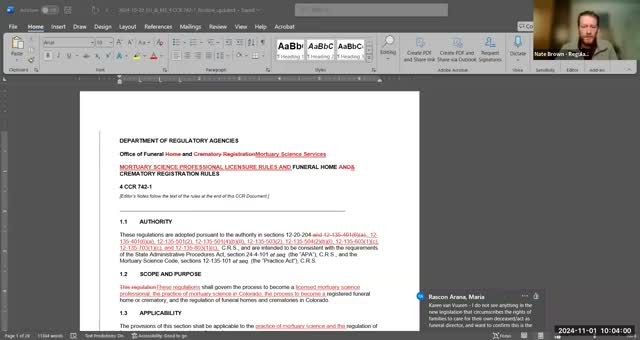
The State Office of Funeral Home and Mortuary Science Services hosted a stakeholder webinar on Nov. 1 to gather public input on proposed rules to implement recently enacted mortuary legislation. Regulatory staff said the rules will revise and renumber existing sections and add new provisions (proposed rules 1.5–1.27) to clarify refrigeration, capacity, off-site storage, natural reduction and advertising requirements.
Nate Brown, a regulatory analyst who opened the meeting, told attendees the goal is to craft rules that "clarify and explain legislation, ensure minimum competency to enter and continue practice in the profession, and provide only what is absolutely necessary for consumer protection without creating unnecessary barriers to the marketplace." He reminded participants that comments will be sent to the director for consideration.
Stakeholders raised several recurring concerns. Lenny Griffin, who identified himself as owner of Griffin Funeral Companies, pressed staff on fee changes he described as a more-than-500% increase in establishment registration fees and asked whether businesses would be expected to pass the costs to consumers. Program staff said establishment and individual licensing fees were included in the bill fiscal notes and that individual licensing fees have not yet been finalized; staff pointed stakeholders to the fiscal note and offered to share the specific citation.
Refrigeration and capacity were prominent topics. Multiple mortuary practitioners urged rules that focus on practical outcomes—consistent, documented refrigeration—rather than mandating a single equipment type. One owner suggested a refrigeration log that records the deceased’s name, date of death, location in the unit and dates of removal and re-entry, retained for three years and subject to inspection. Staff said the draft language was updated to reflect industry feedback (for example, replacing the term "floor drain" with "functional drain") and reported a technical change lowering a proposed maximum refrigeration temperature from 44 degrees to a target of about 39 degrees based on stakeholder input.
Questions about off-site storage and chain-of-custody surfaced after a family member and other commenters described gaps in how crematoria and facilities document transfers. Program staff pointed to proposed rule 1.22 governing chain-of-custody and said the agency is coordinating with the Colorado Department of Public Health and Environment (CDPHE), which regulates permits for disposition, to address gaps in permitting and closure processes.
Consumer advocates asked whether advertising and signage rules are within the director’s authority and urged required owner disclosure in marketing materials. Program staff said the statute gives the director broad rulemaking authority to implement the act, but any advertising rules would be reviewed by agency attorneys and removed if they exceed statutory authority.
Stakeholders also sought clarity on enforcement and inspections. Staff described routine periodic inspections set in rule to align with renewal periods (no less than annually), and noted facilities may also be inspected at initial application, after lapsed registrations, on complaint or at the director’s initiative. Continuing education requirements were discussed; staff referenced a six-hour requirement with an in-person component in the proposed text.
On disqualifying criminal convictions, staff said proposed rule 1.16 reflects statutory provisions and omits duplicative language where specific offenses (for example, abuse of a corpse) are already listed in statute. Staff added an express provision that "Every funeral establishment that performs embalming must maintain a clean and sanitary appropriation room" to address stakeholder concerns that facilities not offering embalming should not be required to have an embalming room.
Program staff said the redline of the most recent draft will be posted on the program’s website and reminded stakeholders that written comments may be submitted to the agency email provided. The director will review all comments and proposed revisions will be published for additional comment before the formal rulemaking hearing, which staff said is scheduled for Nov. 7, 2024.
What’s next: DORA will publish the updated redline and accept written comments; the agency plans to present a rulemaking notice and hold the scheduled hearing on Nov. 7, 2024. Stakeholders asked staff to provide the fiscal-note citation for fee changes and to continue coordination with CDPHE on permit and chain-of-custody issues.
Nate Brown, a regulatory analyst who opened the meeting, told attendees the goal is to craft rules that "clarify and explain legislation, ensure minimum competency to enter and continue practice in the profession, and provide only what is absolutely necessary for consumer protection without creating unnecessary barriers to the marketplace." He reminded participants that comments will be sent to the director for consideration.
Stakeholders raised several recurring concerns. Lenny Griffin, who identified himself as owner of Griffin Funeral Companies, pressed staff on fee changes he described as a more-than-500% increase in establishment registration fees and asked whether businesses would be expected to pass the costs to consumers. Program staff said establishment and individual licensing fees were included in the bill fiscal notes and that individual licensing fees have not yet been finalized; staff pointed stakeholders to the fiscal note and offered to share the specific citation.
Refrigeration and capacity were prominent topics. Multiple mortuary practitioners urged rules that focus on practical outcomes—consistent, documented refrigeration—rather than mandating a single equipment type. One owner suggested a refrigeration log that records the deceased’s name, date of death, location in the unit and dates of removal and re-entry, retained for three years and subject to inspection. Staff said the draft language was updated to reflect industry feedback (for example, replacing the term "floor drain" with "functional drain") and reported a technical change lowering a proposed maximum refrigeration temperature from 44 degrees to a target of about 39 degrees based on stakeholder input.
Questions about off-site storage and chain-of-custody surfaced after a family member and other commenters described gaps in how crematoria and facilities document transfers. Program staff pointed to proposed rule 1.22 governing chain-of-custody and said the agency is coordinating with the Colorado Department of Public Health and Environment (CDPHE), which regulates permits for disposition, to address gaps in permitting and closure processes.
Consumer advocates asked whether advertising and signage rules are within the director’s authority and urged required owner disclosure in marketing materials. Program staff said the statute gives the director broad rulemaking authority to implement the act, but any advertising rules would be reviewed by agency attorneys and removed if they exceed statutory authority.
Stakeholders also sought clarity on enforcement and inspections. Staff described routine periodic inspections set in rule to align with renewal periods (no less than annually), and noted facilities may also be inspected at initial application, after lapsed registrations, on complaint or at the director’s initiative. Continuing education requirements were discussed; staff referenced a six-hour requirement with an in-person component in the proposed text.
On disqualifying criminal convictions, staff said proposed rule 1.16 reflects statutory provisions and omits duplicative language where specific offenses (for example, abuse of a corpse) are already listed in statute. Staff added an express provision that "Every funeral establishment that performs embalming must maintain a clean and sanitary appropriation room" to address stakeholder concerns that facilities not offering embalming should not be required to have an embalming room.
Program staff said the redline of the most recent draft will be posted on the program’s website and reminded stakeholders that written comments may be submitted to the agency email provided. The director will review all comments and proposed revisions will be published for additional comment before the formal rulemaking hearing, which staff said is scheduled for Nov. 7, 2024.
What’s next: DORA will publish the updated redline and accept written comments; the agency plans to present a rulemaking notice and hold the scheduled hearing on Nov. 7, 2024. Stakeholders asked staff to provide the fiscal-note citation for fee changes and to continue coordination with CDPHE on permit and chain-of-custody issues.
Don't Miss a Word: See the Full Meeting!
Go beyond summaries. Unlock every video, transcript, and key insight with a Founder Membership.
✓
Get instant access to full meeting videos
✓
Search and clip any phrase from complete transcripts
✓
Receive AI-powered summaries & custom alerts
✓
Enjoy lifetime, unrestricted access to government data
30-day money-back guarantee
