Central Ohio forum highlights maternal-care gaps, racial disparities and growing community solutions
February 18, 2026 | Columbus City Council, Columbus, Franklin County, Ohio
This article was created by AI summarizing key points discussed. AI makes mistakes, so for full details and context, please refer to the video of the full meeting. Please report any errors so we can fix them. Report an error »
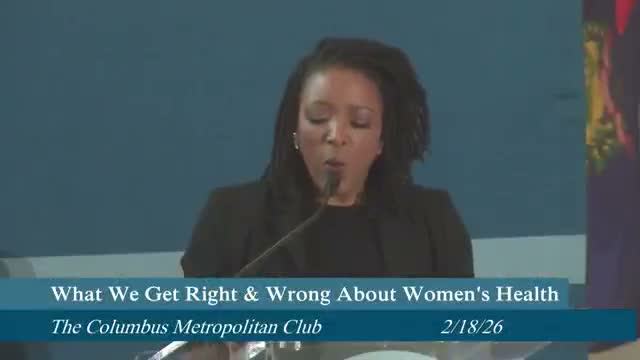
Columbus — Local clinicians, community organizers and family members at a Columbus Metropolitan Club forum on women’s health described persistent gaps in maternal and reproductive care in Ohio and urged expanded community-based supports and policy changes to improve outcomes.
Sofia Pfiffner, president and CEO of the Columbus Metropolitan Club, opened the March forum by noting county-level shortages in obstetric care and framing the conversation around racial disparities and rising maternal risk. “13 Ohio counties lack OB providers completely,” she said, calling attention to access problems outside urban centers.
Panelists said that improving outcomes will require acknowledging a broader definition of women’s health — one that extends beyond pregnancy to include mental health, chronic disease prevention and care across the lifespan. “The second leading cause of maternal mortality is actually related to mental health issues,” said Dr. Mona Prasad, system chief for maternal fetal medicine at OhioHealth Physicians Group, urging early identification and treatment of perinatal mental illness.
Jatubu Bekwai Stallings, founder and CEO of Central Ohio Postpartum Extended Respite Care, described how gaps in postpartum follow-up shaped her nonprofit’s work after losing a client. “What I realized is that 65 percent of…what we consider pregnancy-related deaths happen after that six-week mark,” Stallings said, arguing that many new mothers lack a primary-care connection and mental-health services once routine obstetric visits end.
Speakers pointed to several practical and policy approaches that could reduce risk in maternity 'deserts': bolstering telehealth and mobile units for prenatal care, expanding doula and midwifery services, and aligning funding and reimbursement to make practice in underserved areas sustainable. A panelist noted that Medicaid reimbursement for doulas now exists in Ohio, widening potential access for families who cannot pay out of pocket.
Community organizations and quality collaboratives were presented as existing levers for change. Panelists described cross-system coordination in Central Ohio that links doulas, lactation support and clinical teams, and highlighted the Ohio Perinatal Quality Collaborative’s CARE Project as an example of a statewide effort to improve respectful, data-driven care.
Speakers also urged that stillbirth and infant loss be part of the maternal-health conversation. Michael Bullock, president of Miles’ Mission, said Ohio ranks among the states with high numbers of fetal and infant losses and advocated for bereavement programs and prevention efforts such as the Count the Kicks initiative. “We developed a bereavement care package,” he said, describing collaboration across local hospitals and community partners.
Panelists repeatedly linked racial disparities to structural factors, historic mistrust and resource allocation. Several said the work cannot fall only on the relatively small number of Black obstetric providers in Columbus; it requires systemwide changes in training, respectful-care practices and accountability.
The forum closed with action-oriented suggestions: improve data collection to identify disparities, use telehealth and Project ECHO–style consult models to support regional clinicians, expand certified menopause and perinatal training, and press state and national payers to sustain services in low-volume regions. No formal policy vote or official action resulted from the event; speakers presented ideas and community experiences for policymakers and health systems to consider.
The Columbus Metropolitan Club plans related future discussions and provided local reading recommendations and resources for attendees seeking further information.
Sofia Pfiffner, president and CEO of the Columbus Metropolitan Club, opened the March forum by noting county-level shortages in obstetric care and framing the conversation around racial disparities and rising maternal risk. “13 Ohio counties lack OB providers completely,” she said, calling attention to access problems outside urban centers.
Panelists said that improving outcomes will require acknowledging a broader definition of women’s health — one that extends beyond pregnancy to include mental health, chronic disease prevention and care across the lifespan. “The second leading cause of maternal mortality is actually related to mental health issues,” said Dr. Mona Prasad, system chief for maternal fetal medicine at OhioHealth Physicians Group, urging early identification and treatment of perinatal mental illness.
Jatubu Bekwai Stallings, founder and CEO of Central Ohio Postpartum Extended Respite Care, described how gaps in postpartum follow-up shaped her nonprofit’s work after losing a client. “What I realized is that 65 percent of…what we consider pregnancy-related deaths happen after that six-week mark,” Stallings said, arguing that many new mothers lack a primary-care connection and mental-health services once routine obstetric visits end.
Speakers pointed to several practical and policy approaches that could reduce risk in maternity 'deserts': bolstering telehealth and mobile units for prenatal care, expanding doula and midwifery services, and aligning funding and reimbursement to make practice in underserved areas sustainable. A panelist noted that Medicaid reimbursement for doulas now exists in Ohio, widening potential access for families who cannot pay out of pocket.
Community organizations and quality collaboratives were presented as existing levers for change. Panelists described cross-system coordination in Central Ohio that links doulas, lactation support and clinical teams, and highlighted the Ohio Perinatal Quality Collaborative’s CARE Project as an example of a statewide effort to improve respectful, data-driven care.
Speakers also urged that stillbirth and infant loss be part of the maternal-health conversation. Michael Bullock, president of Miles’ Mission, said Ohio ranks among the states with high numbers of fetal and infant losses and advocated for bereavement programs and prevention efforts such as the Count the Kicks initiative. “We developed a bereavement care package,” he said, describing collaboration across local hospitals and community partners.
Panelists repeatedly linked racial disparities to structural factors, historic mistrust and resource allocation. Several said the work cannot fall only on the relatively small number of Black obstetric providers in Columbus; it requires systemwide changes in training, respectful-care practices and accountability.
The forum closed with action-oriented suggestions: improve data collection to identify disparities, use telehealth and Project ECHO–style consult models to support regional clinicians, expand certified menopause and perinatal training, and press state and national payers to sustain services in low-volume regions. No formal policy vote or official action resulted from the event; speakers presented ideas and community experiences for policymakers and health systems to consider.
The Columbus Metropolitan Club plans related future discussions and provided local reading recommendations and resources for attendees seeking further information.
Don't Miss a Word: See the Full Meeting!
Go beyond summaries. Unlock every video, transcript, and key insight with a Founder Membership.
✓
Get instant access to full meeting videos
✓
Search and clip any phrase from complete transcripts
✓
Receive AI-powered summaries & custom alerts
✓
Enjoy lifetime, unrestricted access to government data
30-day money-back guarantee
