FBI, Google analysts warn AI will speed cyber attacks as White House EO seeks federal alignment
February 18, 2026 | Federal Bureau of Investigation (FBI), Department of Justice (DOJ), Executive, Federal
This article was created by AI summarizing key points discussed. AI makes mistakes, so for full details and context, please refer to the video of the full meeting. Please report any errors so we can fix them. Report an error »
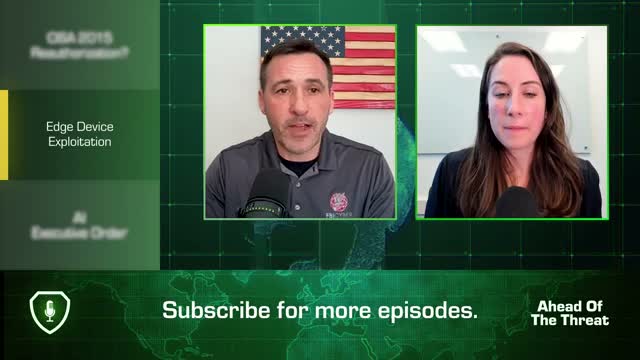
A recent presidential executive order on artificial intelligence aims to knit together federal action to reduce conflicting state rules and accelerate a national AI strategy, Kristen Grimes of the FBI’s cyber law unit said. The order establishes interagency work and a Justice Department task force charged with identifying and addressing regulatory conflicts.
"This is meant to really centralize what that approach is to AI and make sure that the handcuffs are off, right, to be able to to innovate," Grimes said, framing the EO as part of three pillars the administration set out in 2025 to accelerate innovation, build infrastructure and lead internationally.
John Holtquist, chief analyst at Google Threat Intelligence Group, said the technological trend the EO addresses has operational consequences: agentic AI — systems that can perform multi‑step operations autonomously — can speed attacks from days to minutes and change defenders’ operating model.
"The area that we're pushing towards though is . . . the agentic capability. It's essentially automation," Holtquist said, citing an Anthropic report that observed a China‑linked campaign where AI executed 80–90% of tactical operations across reconnaissance, exploitation, lateral movement and exfiltration.
Practical implications: Holtquist urged defenders to automate vulnerability discovery and patching cycles, saying many current incident‑response plans assume human‑speed adversaries and will not scale against AI‑speed campaigns. He noted Google’s internal tools (an agent called "Big Sleep") and VirusTotal’s early AI integration as defensive examples.
Policy context: Grimes described the EO’s mechanisms — a DOJ task force to challenge conflicting state laws, tying federal broadband funding to regulatory alignment, and prompting agencies such as the FCC and FTC to consider preemptive federal standards — as intended to provide a single, coherent framework for innovation and national security.
Next steps: Both the FBI and industry speakers urged organizations to evaluate automation and defensive AI for high‑value assets while policy teams monitor the EO’s interagency work and potential changes to state‑federal regulatory dynamics.
"This is meant to really centralize what that approach is to AI and make sure that the handcuffs are off, right, to be able to to innovate," Grimes said, framing the EO as part of three pillars the administration set out in 2025 to accelerate innovation, build infrastructure and lead internationally.
John Holtquist, chief analyst at Google Threat Intelligence Group, said the technological trend the EO addresses has operational consequences: agentic AI — systems that can perform multi‑step operations autonomously — can speed attacks from days to minutes and change defenders’ operating model.
"The area that we're pushing towards though is . . . the agentic capability. It's essentially automation," Holtquist said, citing an Anthropic report that observed a China‑linked campaign where AI executed 80–90% of tactical operations across reconnaissance, exploitation, lateral movement and exfiltration.
Practical implications: Holtquist urged defenders to automate vulnerability discovery and patching cycles, saying many current incident‑response plans assume human‑speed adversaries and will not scale against AI‑speed campaigns. He noted Google’s internal tools (an agent called "Big Sleep") and VirusTotal’s early AI integration as defensive examples.
Policy context: Grimes described the EO’s mechanisms — a DOJ task force to challenge conflicting state laws, tying federal broadband funding to regulatory alignment, and prompting agencies such as the FCC and FTC to consider preemptive federal standards — as intended to provide a single, coherent framework for innovation and national security.
Next steps: Both the FBI and industry speakers urged organizations to evaluate automation and defensive AI for high‑value assets while policy teams monitor the EO’s interagency work and potential changes to state‑federal regulatory dynamics.
Don't Miss a Word: See the Full Meeting!
Go beyond summaries. Unlock every video, transcript, and key insight with a Founder Membership.
✓
Get instant access to full meeting videos
✓
Search and clip any phrase from complete transcripts
✓
Receive AI-powered summaries & custom alerts
✓
Enjoy lifetime, unrestricted access to government data
30-day money-back guarantee
