Titusville planning panel recommends denial of Tranquility development amendment
February 19, 2026 | Titusville, Brevard County, Florida
This article was created by AI summarizing key points discussed. AI makes mistakes, so for full details and context, please refer to the video of the full meeting. Please report any errors so we can fix them. Report an error »
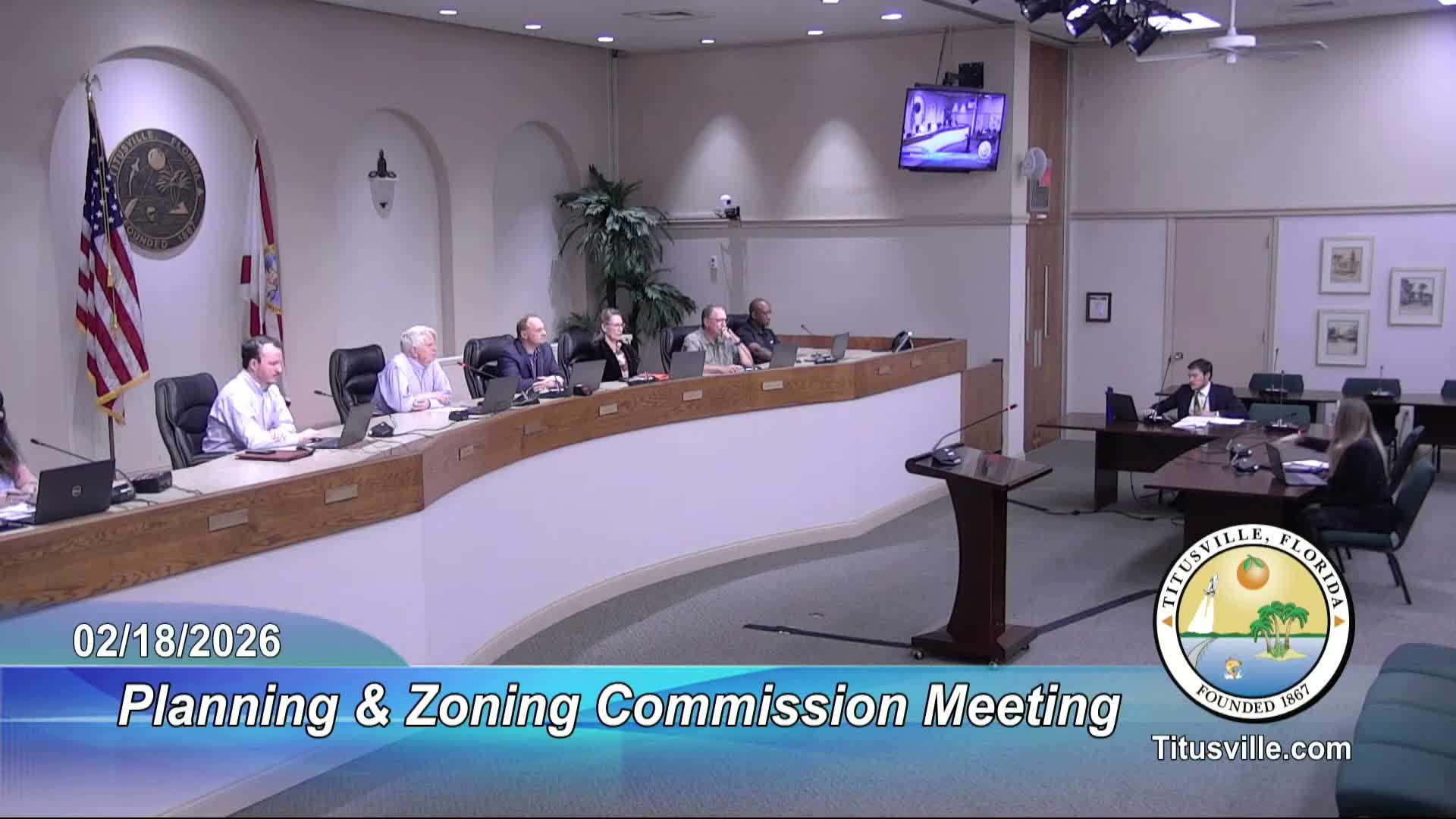
TITUSVILLE, Fla. — The Titusville Planning and Zoning Commission on Feb. 18 recommended denial of the fifth amendment to the Tranquility Development Agreement, sending the proposal to the City Council with a list of unresolved issues and requests for clearer documentation.
Senior planner Christy Anderson told the commission the Tranquility project (formerly Antigua Bay) is a planned, mixed‑use community of about 340 acres with 2,404 residential units and a mix of single‑family, multifamily, commercial, preservation areas and parkland. The applicant is asking the city to clarify and amend the agreement to allow, among other changes, building heights of up to 150 feet, use of the small‑scale plat process for some land divisions, reduced landscape buffers with a proposed "125%" enhancement, accessory‑structure encroachments into the 50‑foot arterial setback, and phased land clearing and on‑site stockpiling of fill.
"The Tranquility Development is a mixed use planned community with 2,404 residential units," Anderson told the commission, and staff outlined numerous gaps in the amendment: unspecified locations and intended uses for buildings that might claim the 150‑foot height incentive, missing exhibits to show compliance with small‑scale plat rules, unclear utility and stormwater plans, and an insufficiently defined approach to the proposed 125% landscape enhancement.
That definitional issue — whether the overlay’s 150‑foot allowance requires two uses within the same building or could be met by multiple uses across the entire development — became the meeting’s focal point.
Cole Oliver, representing the applicant, said the 150‑foot height already appears in the agreement and urged a looser reading of the mixed‑use requirement. "We are not asking for an increase in height," Oliver said; "we're asking for a clarification that we already meet mixed use determination." He sought flexibility to use private mains in some small‑scale plats, to permit joint stormwater solutions among lots, and to stage excavated fill on‑site for up to two years with a bonding mechanism.
Staff and several commissioners pressed for concrete exhibits and limits. Anderson said staff needs maps and parcel‑level detail showing the number, location and intended uses of buildings that would claim the height bonus, documented compliance with the small‑scale plat criteria (including how water and sewer would be provided), a clarified calculation for the 125% landscape enhancement (quantity, size or caliper of plant materials), and a firm phasing and bonding plan to prevent indefinite long‑term storage of excavated material.
Commissioners also raised public‑safety and nuisance concerns tied to the proposal to permit accessory structures inside the 50‑foot arterial setback along U.S. 1. One commissioner urged that, if the commission were to permit reduced setbacks for a subset of lots, the approval should require a concrete safety measure such as a barrier wall or other defined protection before allowing pools or other backyard uses within 25 feet of the highway.
Rodney Henicott, the applicant’s engineer, described the spine roads and said the spine infrastructure will include public water and sewer connections and that private mains would be limited to internal site systems typical to apartment complexes. He confirmed the applicant would seek Saint Johns River Water Management District permits for stormwater and said the application contemplates bonding and a two‑year limit on storage with extensions available if necessary.
Despite the applicant’s assurances, members repeatedly returned to the mixed‑use definition and the risk that unclear language in an agreement could create problematic precedent. City counsel advised that ambiguous contracts are permitted but carry litigation risk and that clarifying language is recommended to avoid downstream disputes.
After extended deliberation, Member Garrod moved to recommend denial; the motion was seconded and the commission recorded a roll call in which all present members voted yes. The commission’s stated reasons include the unresolved mixed‑use interpretation, insufficient exhibits on utilities and stormwater, unclear implementation language for the 125% landscape enhancement, and inadequate limits and mitigation for proposed clearing and stockpiling.
Votes at a glance: The commission voted (roll call) to recommend denial to the City Council. Motion: deny the fifth amendment to the Tranquility Development Agreement. Mover: Member Garrod. Second: (recorded). Vote: unanimous among present commissioners (Garrod, Scully, Seidler, Childs, Fason, Chairman Eton). Outcome: recommendation of denial forwarded to City Council.
What happens next: The commission’s recommendation and its recorded concerns will travel with the file to the City Council for final action. Staff and the applicant told the commission they can continue to negotiate language and exhibits; staff specifically requested parcel‑level exhibits, a clearer method to show the 125% landscape enhancement, stormwater and utility plans sufficient to determine small‑scale plat eligibility, and precise phasing and bonding terms for any stockpiling.
— Reporting in this article is based on the public hearing transcript of the Feb. 18 Titusville Planning and Zoning Commission meeting and statements made on the record by staff (Christy Anderson), the applicant’s representatives (Cole Oliver, Rodney Henicott), and commissioners.
Senior planner Christy Anderson told the commission the Tranquility project (formerly Antigua Bay) is a planned, mixed‑use community of about 340 acres with 2,404 residential units and a mix of single‑family, multifamily, commercial, preservation areas and parkland. The applicant is asking the city to clarify and amend the agreement to allow, among other changes, building heights of up to 150 feet, use of the small‑scale plat process for some land divisions, reduced landscape buffers with a proposed "125%" enhancement, accessory‑structure encroachments into the 50‑foot arterial setback, and phased land clearing and on‑site stockpiling of fill.
"The Tranquility Development is a mixed use planned community with 2,404 residential units," Anderson told the commission, and staff outlined numerous gaps in the amendment: unspecified locations and intended uses for buildings that might claim the 150‑foot height incentive, missing exhibits to show compliance with small‑scale plat rules, unclear utility and stormwater plans, and an insufficiently defined approach to the proposed 125% landscape enhancement.
That definitional issue — whether the overlay’s 150‑foot allowance requires two uses within the same building or could be met by multiple uses across the entire development — became the meeting’s focal point.
Cole Oliver, representing the applicant, said the 150‑foot height already appears in the agreement and urged a looser reading of the mixed‑use requirement. "We are not asking for an increase in height," Oliver said; "we're asking for a clarification that we already meet mixed use determination." He sought flexibility to use private mains in some small‑scale plats, to permit joint stormwater solutions among lots, and to stage excavated fill on‑site for up to two years with a bonding mechanism.
Staff and several commissioners pressed for concrete exhibits and limits. Anderson said staff needs maps and parcel‑level detail showing the number, location and intended uses of buildings that would claim the height bonus, documented compliance with the small‑scale plat criteria (including how water and sewer would be provided), a clarified calculation for the 125% landscape enhancement (quantity, size or caliper of plant materials), and a firm phasing and bonding plan to prevent indefinite long‑term storage of excavated material.
Commissioners also raised public‑safety and nuisance concerns tied to the proposal to permit accessory structures inside the 50‑foot arterial setback along U.S. 1. One commissioner urged that, if the commission were to permit reduced setbacks for a subset of lots, the approval should require a concrete safety measure such as a barrier wall or other defined protection before allowing pools or other backyard uses within 25 feet of the highway.
Rodney Henicott, the applicant’s engineer, described the spine roads and said the spine infrastructure will include public water and sewer connections and that private mains would be limited to internal site systems typical to apartment complexes. He confirmed the applicant would seek Saint Johns River Water Management District permits for stormwater and said the application contemplates bonding and a two‑year limit on storage with extensions available if necessary.
Despite the applicant’s assurances, members repeatedly returned to the mixed‑use definition and the risk that unclear language in an agreement could create problematic precedent. City counsel advised that ambiguous contracts are permitted but carry litigation risk and that clarifying language is recommended to avoid downstream disputes.
After extended deliberation, Member Garrod moved to recommend denial; the motion was seconded and the commission recorded a roll call in which all present members voted yes. The commission’s stated reasons include the unresolved mixed‑use interpretation, insufficient exhibits on utilities and stormwater, unclear implementation language for the 125% landscape enhancement, and inadequate limits and mitigation for proposed clearing and stockpiling.
Votes at a glance: The commission voted (roll call) to recommend denial to the City Council. Motion: deny the fifth amendment to the Tranquility Development Agreement. Mover: Member Garrod. Second: (recorded). Vote: unanimous among present commissioners (Garrod, Scully, Seidler, Childs, Fason, Chairman Eton). Outcome: recommendation of denial forwarded to City Council.
What happens next: The commission’s recommendation and its recorded concerns will travel with the file to the City Council for final action. Staff and the applicant told the commission they can continue to negotiate language and exhibits; staff specifically requested parcel‑level exhibits, a clearer method to show the 125% landscape enhancement, stormwater and utility plans sufficient to determine small‑scale plat eligibility, and precise phasing and bonding terms for any stockpiling.
— Reporting in this article is based on the public hearing transcript of the Feb. 18 Titusville Planning and Zoning Commission meeting and statements made on the record by staff (Christy Anderson), the applicant’s representatives (Cole Oliver, Rodney Henicott), and commissioners.
Don't Miss a Word: See the Full Meeting!
Go beyond summaries. Unlock every video, transcript, and key insight with a Founder Membership.
✓
Get instant access to full meeting videos
✓
Search and clip any phrase from complete transcripts
✓
Receive AI-powered summaries & custom alerts
✓
Enjoy lifetime, unrestricted access to government data
30-day money-back guarantee
