Pennington County's state prosecutor leads required annual review of open-meetings rules
February 18, 2026 | Pennington County, South Dakota
This article was created by AI summarizing key points discussed. AI makes mistakes, so for full details and context, please refer to the video of the full meeting. Please report any errors so we can fix them. Report an error »
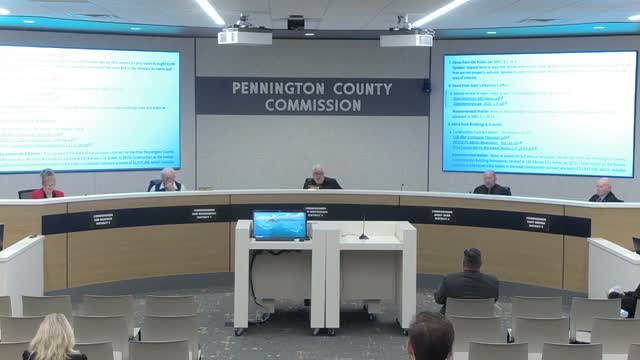
Tyler Sobczak, a senior attorney in the Pennington County State's Attorney's Office, presented the county's annual review of South Dakota's open-meetings requirements on Feb. 17, as required by a 2025 change to state law. Sobczak cited the statute requiring annual review (SDCL 1-25-13) and guided commissioners through the attorney general's pamphlet "Conducting the Public's Business in Public," with a focus on notice rules, recording, executive-session procedure and the referral process for alleged violations.
The presentation stressed that official meetings generally require public notice and that teleconference or electronic meetings are permitted only when the public has advance access. Sobczak explained that agendas and meeting materials must be posted and accessible for at least 24 continuous hours before a meeting and that teleconferences require a location where the public can participate. He also advised caution with executive-session recordings, saying it may be legally permissible in limited circumstances but is not best practice for confidentiality.
Commissioners asked multiple hypotheticals: whether emailing among commissioners can create a meeting, whether phones and instant messages at the dais can be a problem, and whether votes may be taken in executive session. Sobczak recommended strict citation of the statutory subsection when moving into executive session and repeated the board's obligation to resume public action (motions and votes) after coming out of executive session. He told commissioners that alleged violations are typically referred to the Open Meetings Commission and that penalties could range from a reprimand to, in theory, misdemeanor charges under state law, although he said jail or fines have rarely been pursued in practice.
After questions about logistics and transparency, the board voted to formally acknowledge the annual review, placing the review on the record as required by SDCL 1-25-13.
The county's discussion highlighted a broader emphasis from commissioners on transparency: several requested clearer internal procedures for emails and ex parte communications, and staff agreed to incorporate the review into commissioner orientation materials to reduce inadvertent problems by newly seated members.
The presentation stressed that official meetings generally require public notice and that teleconference or electronic meetings are permitted only when the public has advance access. Sobczak explained that agendas and meeting materials must be posted and accessible for at least 24 continuous hours before a meeting and that teleconferences require a location where the public can participate. He also advised caution with executive-session recordings, saying it may be legally permissible in limited circumstances but is not best practice for confidentiality.
Commissioners asked multiple hypotheticals: whether emailing among commissioners can create a meeting, whether phones and instant messages at the dais can be a problem, and whether votes may be taken in executive session. Sobczak recommended strict citation of the statutory subsection when moving into executive session and repeated the board's obligation to resume public action (motions and votes) after coming out of executive session. He told commissioners that alleged violations are typically referred to the Open Meetings Commission and that penalties could range from a reprimand to, in theory, misdemeanor charges under state law, although he said jail or fines have rarely been pursued in practice.
After questions about logistics and transparency, the board voted to formally acknowledge the annual review, placing the review on the record as required by SDCL 1-25-13.
The county's discussion highlighted a broader emphasis from commissioners on transparency: several requested clearer internal procedures for emails and ex parte communications, and staff agreed to incorporate the review into commissioner orientation materials to reduce inadvertent problems by newly seated members.
View the Full Meeting & All Its Details
This article offers just a summary. Unlock complete video, transcripts, and insights as a Founder Member.
✓
Watch full, unedited meeting videos
✓
Search every word spoken in unlimited transcripts
✓
AI summaries & real-time alerts (all government levels)
✓
Permanent access to expanding government content
30-day money-back guarantee
