Residents and commissioners press county to limit heavy industrial access after Clap Mill landfill application
February 16, 2026 | Alamance County, North Carolina
This article was created by AI summarizing key points discussed. AI makes mistakes, so for full details and context, please refer to the video of the full meeting. Please report any errors so we can fix them. Report an error »
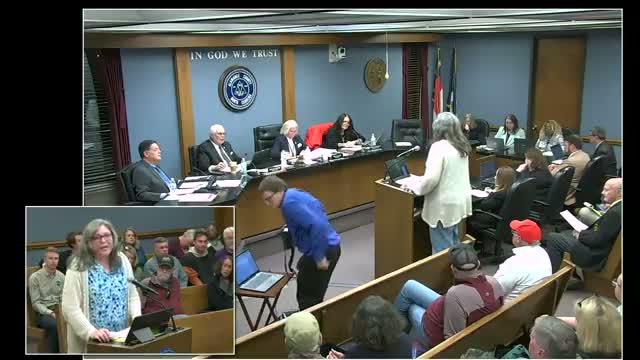
Alamance County commissioners heard more than a half dozen public comments on Feb. 16 opposing a proposed LCID landfill and urging the county to prevent similar developments from using narrow rural roads for heavy truck access.
The first public speaker to raise the issue, Deborah Claire, told commissioners that if the permit is allowed to pass “you will be responsible for a grave disservice” to residents near Clamp Mill Road and said NCDOT engineers had identified missing speed and warning signs on the road. Other residents described projected truck volumes and safety fears; Joe Snyder said the application showed an expected 1,647 vehicle trips per day on Clap Mill.
Matt Kirkpatrick, speaking for Coble Township residents, said the county should expedite an ordinance amendment to “restrict these high impact industrial uses from being accessed on class 1 or 2 roads” and argued Clap Mill Road and similar rural routes were “never meant to carry or serve industrial uses.” Several speakers and commissioners emphasized that narrow sight lines and tight curves make the route unsafe for frequent heavy trucks.
County staff and a county attorney explained the legal limits facing the board. Staff told the board that when NCDOT approves a road connection, that approval generally cannot be reversed for the application at hand; applicants may have vested rights once an application is completed. The attorney said that those legal concepts — including vested rights and ‘permit choice’ between old and new rules — are active considerations for any retroactive ordinance.
Commissioners nonetheless sought a policy pathway to reduce future risks. One commissioner moved, and others seconded, to direct staff to pursue an ordinance that would restrict certain high-impact land uses on low-capacity rural road classifications. The board did not enact an immediate zoning change for the current application but recorded a consensus for staff to draft options restricting heavy-access uses on specified road classes so similar proposals can be limited going forward.
The discussion also touched on DOT responsibilities: commissioners said they had been told DOT would examine signage and shoulders on Clap Mill, but several commissioners and residents noted that signage fixes do not address road geometry and sight-line limitations.
Next steps: staff were asked to draft ordinance language for the board to consider and to continue coordinating with DOT and the planning board; no final zoning change affecting the pending application was adopted during the meeting.
The first public speaker to raise the issue, Deborah Claire, told commissioners that if the permit is allowed to pass “you will be responsible for a grave disservice” to residents near Clamp Mill Road and said NCDOT engineers had identified missing speed and warning signs on the road. Other residents described projected truck volumes and safety fears; Joe Snyder said the application showed an expected 1,647 vehicle trips per day on Clap Mill.
Matt Kirkpatrick, speaking for Coble Township residents, said the county should expedite an ordinance amendment to “restrict these high impact industrial uses from being accessed on class 1 or 2 roads” and argued Clap Mill Road and similar rural routes were “never meant to carry or serve industrial uses.” Several speakers and commissioners emphasized that narrow sight lines and tight curves make the route unsafe for frequent heavy trucks.
County staff and a county attorney explained the legal limits facing the board. Staff told the board that when NCDOT approves a road connection, that approval generally cannot be reversed for the application at hand; applicants may have vested rights once an application is completed. The attorney said that those legal concepts — including vested rights and ‘permit choice’ between old and new rules — are active considerations for any retroactive ordinance.
Commissioners nonetheless sought a policy pathway to reduce future risks. One commissioner moved, and others seconded, to direct staff to pursue an ordinance that would restrict certain high-impact land uses on low-capacity rural road classifications. The board did not enact an immediate zoning change for the current application but recorded a consensus for staff to draft options restricting heavy-access uses on specified road classes so similar proposals can be limited going forward.
The discussion also touched on DOT responsibilities: commissioners said they had been told DOT would examine signage and shoulders on Clap Mill, but several commissioners and residents noted that signage fixes do not address road geometry and sight-line limitations.
Next steps: staff were asked to draft ordinance language for the board to consider and to continue coordinating with DOT and the planning board; no final zoning change affecting the pending application was adopted during the meeting.
Don't Miss a Word: See the Full Meeting!
Go beyond summaries. Unlock every video, transcript, and key insight with a Founder Membership.
✓
Get instant access to full meeting videos
✓
Search and clip any phrase from complete transcripts
✓
Receive AI-powered summaries & custom alerts
✓
Enjoy lifetime, unrestricted access to government data
30-day money-back guarantee
