Fremont County hearing turns heated as landowners, tribes and a resident clash over roaming bison jurisdiction
February 18, 2026 | Fremont County, Wyoming
This article was created by AI summarizing key points discussed. AI makes mistakes, so for full details and context, please refer to the video of the full meeting. Please report any errors so we can fix them. Report an error »
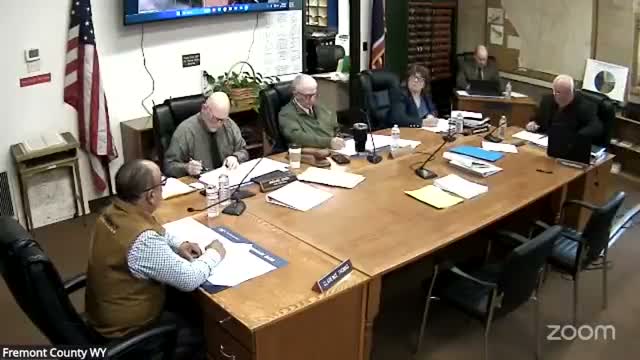
FREMONT COUNTY, Wyo. — A lengthy public exchange at the Fremont County Board of Commissioners' meeting on Feb. 17 centered on who has legal authority over bison that leave reservation trust lands and roam onto privately deeded property.
Tribal representatives and county residents clashed over whether the animals should be treated as wildlife under tribal designation or livestock under Wyoming statute. William Lars, introduced himself as "chairman for the Extension Business Council," said tribal leaders had not been consulted and urged commissioners to require face-to-face communication before policy or enforcement steps are taken: "Mister Benson has not approached the tribe's side... he has not met with us," Lars said.
Mitch Benson, a Fremont County resident who brought the issue forward, told the commission he had contacted the Wyoming Livestock Board and the district brand inspector and that established federal and state legal precedents support state jurisdiction over privately owned bison on diminished lands. "The legal precedence is already established. This is a settled law," Benson said, urging the commission to forward the matter to the governor "to bring clarity to all tribal and non-tribal folks that share this reservation."
Other tribal speakers emphasized sovereign authority and the tribes' own designations. A tribal vice-chair said the tribes treat the herd as wildlife and stressed a preference for negotiated, neighborly solutions: "We designated them as wildlife... we still have sovereign immunity," the speaker said.
Commissioners and other speakers debated practical consequences: potential crop damage, traffic safety if herds reach highways, and questions about how ownership would be identified if bison are unbranded. One commissioner summarized the statutory issue by reading Wyoming statute language that treats bison as exotic livestock and makes an owner liable for damage when animals run at large.
A motion to "acknowledge and enforce private property rights within the diminished lands... and move to forward it to the governor" was put on the floor during discussion. The transcript records the motion being made and debated but does not include a recorded roll-call vote or final outcome in the meeting minutes.
What happens next: no formal county vote on forwarding the request to the governor is recorded in the transcript. Commissioners and tribal leaders agreed on the need for further discussion; several suggested first convening a meeting with tribal governments, livestock authorities and affected landowners to seek practical steps for identification and damage recoupment.
Authorities and references cited during the discussion include a congressional act referenced by speakers as the 1905 Congressional Act regarding diminished lands, Tenth Circuit Court precedent and citations to Wyoming statutes on livestock (including references to Wyoming statute 23-1-102 and a state statute cited in discussion as 11-27-101).
Tribal representatives and county residents clashed over whether the animals should be treated as wildlife under tribal designation or livestock under Wyoming statute. William Lars, introduced himself as "chairman for the Extension Business Council," said tribal leaders had not been consulted and urged commissioners to require face-to-face communication before policy or enforcement steps are taken: "Mister Benson has not approached the tribe's side... he has not met with us," Lars said.
Mitch Benson, a Fremont County resident who brought the issue forward, told the commission he had contacted the Wyoming Livestock Board and the district brand inspector and that established federal and state legal precedents support state jurisdiction over privately owned bison on diminished lands. "The legal precedence is already established. This is a settled law," Benson said, urging the commission to forward the matter to the governor "to bring clarity to all tribal and non-tribal folks that share this reservation."
Other tribal speakers emphasized sovereign authority and the tribes' own designations. A tribal vice-chair said the tribes treat the herd as wildlife and stressed a preference for negotiated, neighborly solutions: "We designated them as wildlife... we still have sovereign immunity," the speaker said.
Commissioners and other speakers debated practical consequences: potential crop damage, traffic safety if herds reach highways, and questions about how ownership would be identified if bison are unbranded. One commissioner summarized the statutory issue by reading Wyoming statute language that treats bison as exotic livestock and makes an owner liable for damage when animals run at large.
A motion to "acknowledge and enforce private property rights within the diminished lands... and move to forward it to the governor" was put on the floor during discussion. The transcript records the motion being made and debated but does not include a recorded roll-call vote or final outcome in the meeting minutes.
What happens next: no formal county vote on forwarding the request to the governor is recorded in the transcript. Commissioners and tribal leaders agreed on the need for further discussion; several suggested first convening a meeting with tribal governments, livestock authorities and affected landowners to seek practical steps for identification and damage recoupment.
Authorities and references cited during the discussion include a congressional act referenced by speakers as the 1905 Congressional Act regarding diminished lands, Tenth Circuit Court precedent and citations to Wyoming statutes on livestock (including references to Wyoming statute 23-1-102 and a state statute cited in discussion as 11-27-101).
View the Full Meeting & All Its Details
This article offers just a summary. Unlock complete video, transcripts, and insights as a Founder Member.
✓
Watch full, unedited meeting videos
✓
Search every word spoken in unlimited transcripts
✓
AI summaries & real-time alerts (all government levels)
✓
Permanent access to expanding government content
30-day money-back guarantee
