Utilities say Las Cruces water measures well below EPA lead action level; city to use Water Trust Board funds for service‑line replacements
February 17, 2026 | Las Cruces, Doña Ana County, New Mexico
This article was created by AI summarizing key points discussed. AI makes mistakes, so for full details and context, please refer to the video of the full meeting. Please report any errors so we can fix them. Report an error »
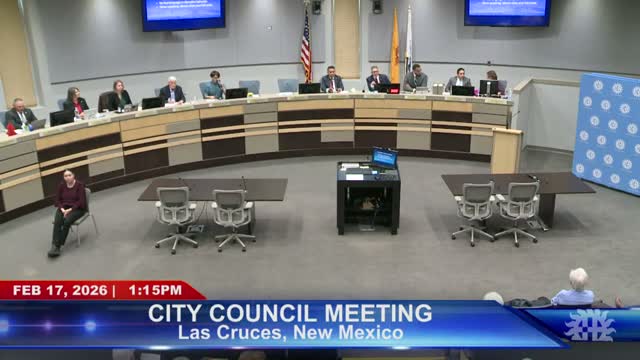
Assistant Utilities Director Carl Clark presented the city’s Consumer Confidence Report (CCR) and answered council questions about lead in drinking water.
Clark said CCRs are required annually by the U.S. Environmental Protection Agency and that the Spanish version is posted online as soon as the mailing goes out. He emphasized the relative quantities involved when discussing parts per billion, explaining the EPA action level for lead is 15 parts per billion while Las Cruces’s water currently measures at about 2 parts per billion. "Our water is at 2 parts per billion," Clark told the council.
Clark said typical sources of lead in drinking systems are corrosion of household plumbing and erosion of natural deposits; the city pulls customer samples and submits them to a state or third‑party lab for testing. When asked by Councilor Matisse whether specific private homes with older galvanized or lead plumbing had been tested, Clark said samples originate at homes and the city can check records for whether a specific address was sampled. He asked councilors to provide addresses if they wanted staff to verify sampling history for individual homes.
Council staff linked the CCR discussion to a $15,000,000 Water Trust Board grant the council accepted later in the meeting to fund lead service line replacement construction and related activities. Grant Manager Gabriela Prats said that once the city completes surveys and identifies lines that are lead, the Water Trust funds will support replacement and construction work.
Clark and other staff also noted the city mails the CCR to residents and maintains an online version; they said the city’s local water quality lab participates in the testing ecosystem but that report data is pulled from the state lab records compiled from city samples.
The council did not take immediate policy action on CCR content beyond accepting related grant funding later in the meeting; staff said they will continue the sampling and outreach process to identify properties for replacement work and will return with schedules and details.
Clark said CCRs are required annually by the U.S. Environmental Protection Agency and that the Spanish version is posted online as soon as the mailing goes out. He emphasized the relative quantities involved when discussing parts per billion, explaining the EPA action level for lead is 15 parts per billion while Las Cruces’s water currently measures at about 2 parts per billion. "Our water is at 2 parts per billion," Clark told the council.
Clark said typical sources of lead in drinking systems are corrosion of household plumbing and erosion of natural deposits; the city pulls customer samples and submits them to a state or third‑party lab for testing. When asked by Councilor Matisse whether specific private homes with older galvanized or lead plumbing had been tested, Clark said samples originate at homes and the city can check records for whether a specific address was sampled. He asked councilors to provide addresses if they wanted staff to verify sampling history for individual homes.
Council staff linked the CCR discussion to a $15,000,000 Water Trust Board grant the council accepted later in the meeting to fund lead service line replacement construction and related activities. Grant Manager Gabriela Prats said that once the city completes surveys and identifies lines that are lead, the Water Trust funds will support replacement and construction work.
Clark and other staff also noted the city mails the CCR to residents and maintains an online version; they said the city’s local water quality lab participates in the testing ecosystem but that report data is pulled from the state lab records compiled from city samples.
The council did not take immediate policy action on CCR content beyond accepting related grant funding later in the meeting; staff said they will continue the sampling and outreach process to identify properties for replacement work and will return with schedules and details.
Don't Miss a Word: See the Full Meeting!
Go beyond summaries. Unlock every video, transcript, and key insight with a Founder Membership.
✓
Get instant access to full meeting videos
✓
Search and clip any phrase from complete transcripts
✓
Receive AI-powered summaries & custom alerts
✓
Enjoy lifetime, unrestricted access to government data
30-day money-back guarantee
