Billings residents urge Stagecoach Trail as city hears 30% design and funding update
February 17, 2026 | Billings, Yellowstone, Montana
This article was created by AI summarizing key points discussed. AI makes mistakes, so for full details and context, please refer to the video of the full meeting. Please report any errors so we can fix them. Report an error »
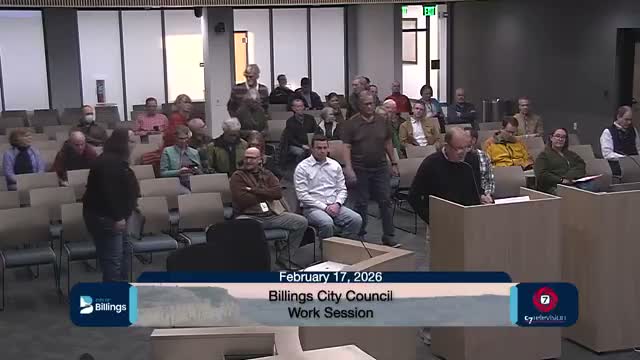
A packed public-comment period Monday night put early political cover behind the Stagecoach multiuse trail as Billings city engineers presented a 30% design update and a funding picture that relies heavily on federal and private money.
“Let's build a Stagecoach Trail,” said Jim Nichols, a Billings resident, one of a string of speakers who urged council support for the trail that would connect Rimrock Road to the Skyland Trail and create safer, nonmotorized access to the Rim Rocks.
City engineer Mac Fogelsung told council the project team and HDR Engineering have three conceptual routes under study: a higher-cost option bolted onto the Zimmerman Trail (estimated about $7.3 million); a mechanically challenging, steep “Incline of Regret” with rockfall and fill issues; and a middle “Stagecoach Rise” route using switchbacks that would reduce grade to roughly 8–8.5% and appears to meet current budget projections. Fogelsung said construction estimates for the preferred middle option are roughly $4.5 million with a 10% contingency that brings the working number near $5 million.
The funding package centers on a $4.8 million Transportation Alternatives (TA) federal grant, matched by Billings TrailNet and trail-stewardship contributions, with additional city funds from Parks & Recreation and general funds to cover remaining costs. Fogelsung said the city's construction contribution under current estimates would be about $750,000.
Council members pressed staff on cost risks, bid timing and trade-offs. Fogelsung suggested options to reduce cost if bids exceed expectations: shorten the trail alignment (a round figure saving of about $300,000 on one segment), stage construction across multiple seasons to lower contractor premiums, or pursue private fundraising. He also said staff will check whether submitting design-phase costs for TA reimbursement could obligate the city to repay if the project is never built and recommended not drawing TA funds until construction bids clarify viability.
Neighbors raised privacy and maintenance concerns for segments above homes. Fogelsung said the project team is exploring a split-rail fence as a baseline and bidding screening fence alternates where warranted, but cautioned that full screening may be unaffordable. He also said maintenance is expected to be similar to existing Skyline Trail and that the Stagecoach Trail team has discussed stewardship with Parks and TrailNet.
Next steps: the project remains in design (30% stage reported), staff will continue community outreach and refine costs, and the team is targeting a fall–winter bidding period and possible construction in 2027 if funding and bids align. No council vote or binding commitment was recorded at the meeting; staff asked for feedback and indicated they could proceed without a formal direction if the council’s consensus aligned with the staff recommendation.
“Let's build a Stagecoach Trail,” said Jim Nichols, a Billings resident, one of a string of speakers who urged council support for the trail that would connect Rimrock Road to the Skyland Trail and create safer, nonmotorized access to the Rim Rocks.
City engineer Mac Fogelsung told council the project team and HDR Engineering have three conceptual routes under study: a higher-cost option bolted onto the Zimmerman Trail (estimated about $7.3 million); a mechanically challenging, steep “Incline of Regret” with rockfall and fill issues; and a middle “Stagecoach Rise” route using switchbacks that would reduce grade to roughly 8–8.5% and appears to meet current budget projections. Fogelsung said construction estimates for the preferred middle option are roughly $4.5 million with a 10% contingency that brings the working number near $5 million.
The funding package centers on a $4.8 million Transportation Alternatives (TA) federal grant, matched by Billings TrailNet and trail-stewardship contributions, with additional city funds from Parks & Recreation and general funds to cover remaining costs. Fogelsung said the city's construction contribution under current estimates would be about $750,000.
Council members pressed staff on cost risks, bid timing and trade-offs. Fogelsung suggested options to reduce cost if bids exceed expectations: shorten the trail alignment (a round figure saving of about $300,000 on one segment), stage construction across multiple seasons to lower contractor premiums, or pursue private fundraising. He also said staff will check whether submitting design-phase costs for TA reimbursement could obligate the city to repay if the project is never built and recommended not drawing TA funds until construction bids clarify viability.
Neighbors raised privacy and maintenance concerns for segments above homes. Fogelsung said the project team is exploring a split-rail fence as a baseline and bidding screening fence alternates where warranted, but cautioned that full screening may be unaffordable. He also said maintenance is expected to be similar to existing Skyline Trail and that the Stagecoach Trail team has discussed stewardship with Parks and TrailNet.
Next steps: the project remains in design (30% stage reported), staff will continue community outreach and refine costs, and the team is targeting a fall–winter bidding period and possible construction in 2027 if funding and bids align. No council vote or binding commitment was recorded at the meeting; staff asked for feedback and indicated they could proceed without a formal direction if the council’s consensus aligned with the staff recommendation.
View the Full Meeting & All Its Details
This article offers just a summary. Unlock complete video, transcripts, and insights as a Founder Member.
✓
Watch full, unedited meeting videos
✓
Search every word spoken in unlimited transcripts
✓
AI summaries & real-time alerts (all government levels)
✓
Permanent access to expanding government content
30-day money-back guarantee
