Committee opens hearing on HB 280, a market-based sourcing and 'highly digitized' apportionment bill
February 13, 2026 | 2026 Legislature Alaska, Alaska
This article was created by AI summarizing key points discussed. AI makes mistakes, so for full details and context, please refer to the video of the full meeting. Please report any errors so we can fix them. Report an error »
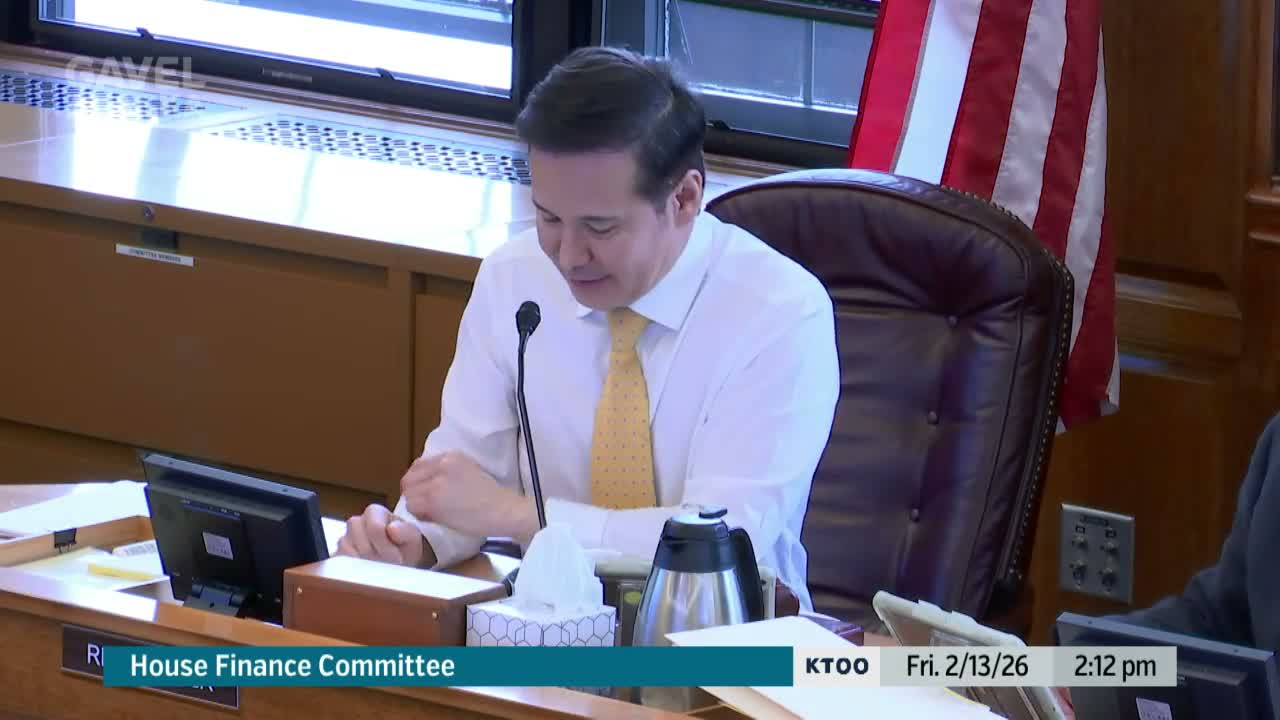
The House Finance Committee received a presentation and opened questions on House Bill 280 on Feb. 13, a proposal to update corporate apportionment rules for Alaska in the digital economy.
Bridal Anderson, staff to Representative Neil Foster, introduced HB 280 and said the bill has two reforms: adopting market-based sourcing for the Multistate Tax Compact portion of Alaska law and creating a single-sales apportionment method for "highly digitized" businesses in state corporate income tax. Anderson told the committee the proposal is substantially similar to components of a prior vetoed measure (Senate Bill 113) and does not change corporate tax rates or brackets.
Under the bill, a business would be "highly digitized" if 50% or more of its Alaska sales are from: tangible property purchased by internet, intangible property delivered electronically, or services delivered electronically (services related to computing/electronic transmission). For those businesses the apportionment would be a single-sales factor; traditional brick-and-mortar and other businesses would continue to use Alaska's existing three-factor apportionment (sales, property, payroll).
Michael Williams, corporate tax manager at the Alaska Department of Revenue, said departmental modeling suggests market-based sourcing could yield roughly $15 million in net revenue while the highly digitized component could contribute around $50 million (ranges emphasized). "Market based sourcing probably is about a $15,000,000 net revenue impact, and then the, highly digitized component has roughly about a another $50,000,000," he said.
Members asked detailed implementation questions. Topics included whether the 50% threshold could create incentives for tax planning; how companies with a small Alaska physical footprint (for example, an Amazon distribution center) would be treated; whether companies would stop shipping to Alaska or pass tax costs to consumers; and the time needed for the Department of Revenue to draft implementing regulations. Anderson and Williams said further analysis and follow-up would be provided on company-level impacts, regulatory timelines, and modeling assumptions.
Anderson also alerted members that sections 8 and 9 address transition and include a retroactive clause (section 9) establishing an effective date of Jan. 1, 2026, a point several members flagged as complicating implementation and enforcement. Williams noted the Multistate Tax Commission has model regulations for market-based sourcing that could be adapted but agreed that administrative work would be needed if the committee advances the bill.
The department's fiscal-note range discussed in the hearing (roughly $25 million to $65 million) was reiterated in committee Q&A and remains the working estimate; committee staff said more detailed modeling and examples would be provided to members as the bill moves forward. The hearing concluded with the committee signaling more questions and follow-up would be accepted as staff and DOR prepare supplemental materials.
Bridal Anderson, staff to Representative Neil Foster, introduced HB 280 and said the bill has two reforms: adopting market-based sourcing for the Multistate Tax Compact portion of Alaska law and creating a single-sales apportionment method for "highly digitized" businesses in state corporate income tax. Anderson told the committee the proposal is substantially similar to components of a prior vetoed measure (Senate Bill 113) and does not change corporate tax rates or brackets.
Under the bill, a business would be "highly digitized" if 50% or more of its Alaska sales are from: tangible property purchased by internet, intangible property delivered electronically, or services delivered electronically (services related to computing/electronic transmission). For those businesses the apportionment would be a single-sales factor; traditional brick-and-mortar and other businesses would continue to use Alaska's existing three-factor apportionment (sales, property, payroll).
Michael Williams, corporate tax manager at the Alaska Department of Revenue, said departmental modeling suggests market-based sourcing could yield roughly $15 million in net revenue while the highly digitized component could contribute around $50 million (ranges emphasized). "Market based sourcing probably is about a $15,000,000 net revenue impact, and then the, highly digitized component has roughly about a another $50,000,000," he said.
Members asked detailed implementation questions. Topics included whether the 50% threshold could create incentives for tax planning; how companies with a small Alaska physical footprint (for example, an Amazon distribution center) would be treated; whether companies would stop shipping to Alaska or pass tax costs to consumers; and the time needed for the Department of Revenue to draft implementing regulations. Anderson and Williams said further analysis and follow-up would be provided on company-level impacts, regulatory timelines, and modeling assumptions.
Anderson also alerted members that sections 8 and 9 address transition and include a retroactive clause (section 9) establishing an effective date of Jan. 1, 2026, a point several members flagged as complicating implementation and enforcement. Williams noted the Multistate Tax Commission has model regulations for market-based sourcing that could be adapted but agreed that administrative work would be needed if the committee advances the bill.
The department's fiscal-note range discussed in the hearing (roughly $25 million to $65 million) was reiterated in committee Q&A and remains the working estimate; committee staff said more detailed modeling and examples would be provided to members as the bill moves forward. The hearing concluded with the committee signaling more questions and follow-up would be accepted as staff and DOR prepare supplemental materials.
View the Full Meeting & All Its Details
This article offers just a summary. Unlock complete video, transcripts, and insights as a Founder Member.
✓
Watch full, unedited meeting videos
✓
Search every word spoken in unlimited transcripts
✓
AI summaries & real-time alerts (all government levels)
✓
Permanent access to expanding government content
30-day money-back guarantee
