Senate committee examines Gross Value Reduction: temporary benefit or loophole?
February 16, 2026 | 2026 Legislature Alaska, Alaska
This article was created by AI summarizing key points discussed. AI makes mistakes, so for full details and context, please refer to the video of the full meeting. Please report any errors so we can fix them. Report an error »
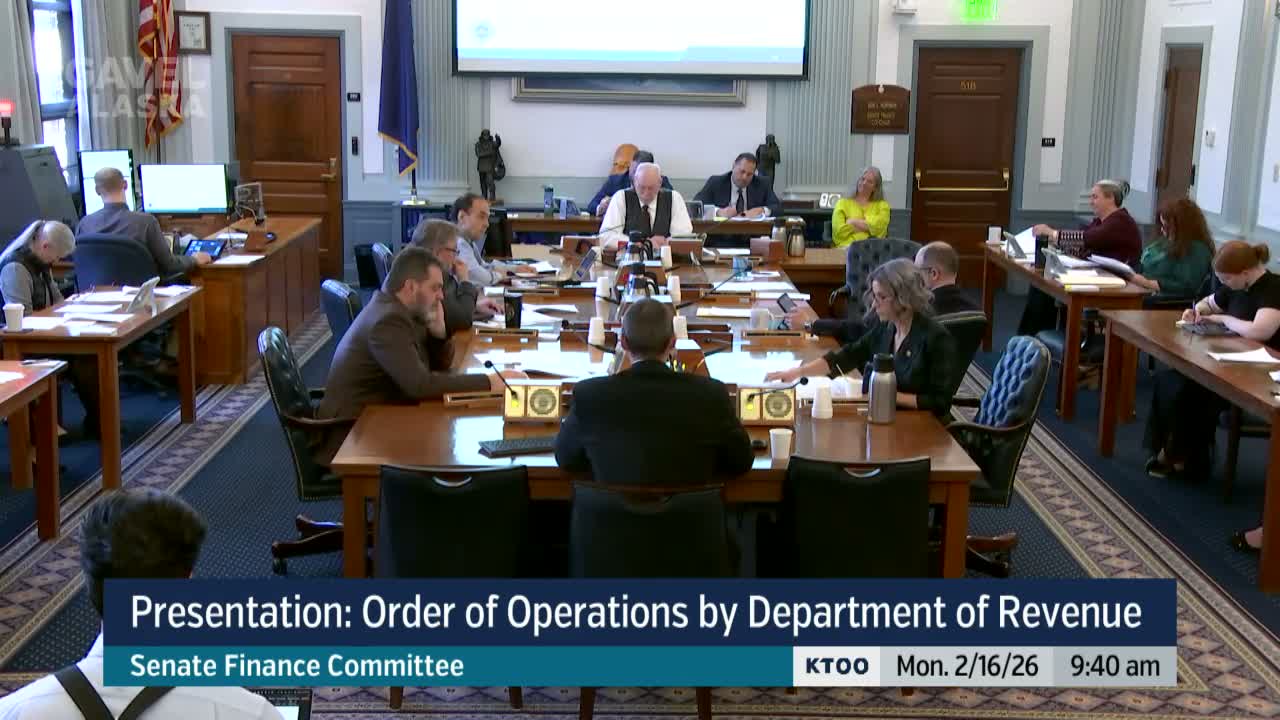
The Senate Finance Committee on Feb. 16 heard a detailed explanation of Gross Value Reduction (GVR) from Dan Stickle of the Department of Revenue and asked how the incentive affects state revenue and development decisions.
Stickle summarized GVR as a temporary statutory benefit enacted as part of Senate Bill 21 that allows producers to exclude 20% (or 30% for some state-lease fields with higher royalty) of qualifying new-field oil from the production tax net-profit calculation for up to seven years (or three years if oil prices exceed $70 per barrel). "This is a temporary tax benefit ... the companies essentially get a tax holiday for 20 or 30% of the oil produced from new fields," Stickle said.
The GVR package includes a flat $5 per taxable-barrel credit for GVR-eligible oil. Stickle repeatedly told the committee that most of the measurable revenue effect comes not from the 20% vs 30% gross-value deduction but from the $5 per-barrel credit because that credit can be used — in specific company situations where sliding-scale credits are forgone — to reduce taxes below the 4% minimum floor.
Key points from the Department's slides: historically GVR-eligible production represented roughly 3–8% of North Slope output but is forecast to rise as new projects come online, potentially reaching about 40% of production in the forecasted peak around FY2033 if Pika and Willow-scale projects proceed. The Department said it looked at the revenue effect of 20% vs 30% and found the difference was less than $10 million over a 10-year forecast, but warned that confidentiality limits prevent publishing field-by-field breakdowns.
Committee members pressed for additional context. Senator Kaufman asked whether projects that claim GVR incentives would be economic without them; Stickle said many investments are marginal under current price/cost conditions and that separate, detailed field-level modeling exists but was not included in the brief. Several senators recommended additional scenario work that would show a counterfactual of ‘‘no new-field development’’ to test policy trade-offs.
The Department emphasized the temporary nature of GVR benefits and that effects should ebb once GVR-eligible fields graduate from the program. Stickle concluded: "The impact of GVR, it's really all about the soft floor." The committee did not take formal action but directed staff to provide further analyses in future briefings.
Stickle summarized GVR as a temporary statutory benefit enacted as part of Senate Bill 21 that allows producers to exclude 20% (or 30% for some state-lease fields with higher royalty) of qualifying new-field oil from the production tax net-profit calculation for up to seven years (or three years if oil prices exceed $70 per barrel). "This is a temporary tax benefit ... the companies essentially get a tax holiday for 20 or 30% of the oil produced from new fields," Stickle said.
The GVR package includes a flat $5 per taxable-barrel credit for GVR-eligible oil. Stickle repeatedly told the committee that most of the measurable revenue effect comes not from the 20% vs 30% gross-value deduction but from the $5 per-barrel credit because that credit can be used — in specific company situations where sliding-scale credits are forgone — to reduce taxes below the 4% minimum floor.
Key points from the Department's slides: historically GVR-eligible production represented roughly 3–8% of North Slope output but is forecast to rise as new projects come online, potentially reaching about 40% of production in the forecasted peak around FY2033 if Pika and Willow-scale projects proceed. The Department said it looked at the revenue effect of 20% vs 30% and found the difference was less than $10 million over a 10-year forecast, but warned that confidentiality limits prevent publishing field-by-field breakdowns.
Committee members pressed for additional context. Senator Kaufman asked whether projects that claim GVR incentives would be economic without them; Stickle said many investments are marginal under current price/cost conditions and that separate, detailed field-level modeling exists but was not included in the brief. Several senators recommended additional scenario work that would show a counterfactual of ‘‘no new-field development’’ to test policy trade-offs.
The Department emphasized the temporary nature of GVR benefits and that effects should ebb once GVR-eligible fields graduate from the program. Stickle concluded: "The impact of GVR, it's really all about the soft floor." The committee did not take formal action but directed staff to provide further analyses in future briefings.
Don't Miss a Word: See the Full Meeting!
Go beyond summaries. Unlock every video, transcript, and key insight with a Founder Membership.
✓
Get instant access to full meeting videos
✓
Search and clip any phrase from complete transcripts
✓
Receive AI-powered summaries & custom alerts
✓
Enjoy lifetime, unrestricted access to government data
30-day money-back guarantee
