Senate committee briefed on North Slope gas tax and how a pipeline could alter revenue outcomes
February 16, 2026 | 2026 Legislature Alaska, Alaska
This article was created by AI summarizing key points discussed. AI makes mistakes, so for full details and context, please refer to the video of the full meeting. Please report any errors so we can fix them. Report an error »
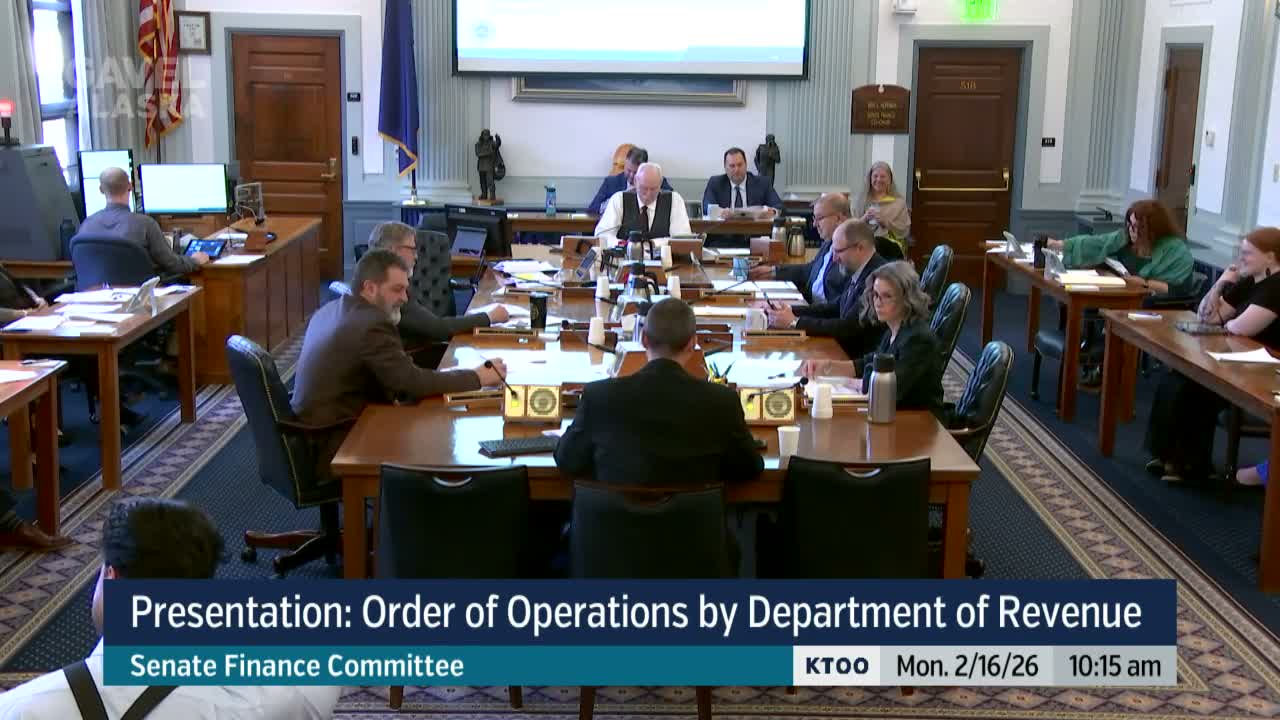
The Senate Finance Committee received an overview of the North Slope gas tax on Feb. 16 and heard how gas sales could interact with oil tax mechanics to produce multiple revenue outcomes depending on company portfolios and credit usage.
Dan Stickle told the committee that North Slope gas is a separate tax segment subject to a flat 13% gross tax and — for qualifying in-state sales — a ceiling of 17.7 cents per thousand cubic feet (Mcf). "The North Slope gas tax is a separate ... segment, which has a gross tax," he said, adding that "if a company also has oil production, it gets very complicated very quickly." Lease expenditures related to gas production can be applied against the oil tax segment and thereby reduce oil taxes, while statewide application of credits and the minimum floor can produce outcomes ranging from collecting the full 13% gross tax to seeing an overall tax reduction.
Stickle used a simplified illustration: 250 million cubic feet per day sold at $1.50/Mcf yields an annual gross value of about $110 million (after royalty and on-site use) and, as a stand-alone gas calculation, a 13% gross tax liability of roughly $14 million. When oil operations and lease-expenditure offsets are combined, some hypothetical companies in the Department’s slides paid less tax once gas production was layered in, while others paid more or the full 13% depending on whether they were already at the minimum tax floor or using GVR credits.
Committee members asked how these illustrations would scale to a full pipeline project. Stickle said scale effects are large — he cited public conversations placing full-pipeline flows in the neighborhood of 3.5 billion cubic feet per day — and that the mechanics would scale, but that more detailed project-specific modeling is necessary to account for capital spending, debt-service and potential offsets in oil production.
The Department offered to return with modeling that layers in larger pipeline scenarios, field‑level expenditures (inflation-adjusted), and an analysis of how different contract and sale structures could change net revenue to the state.
Dan Stickle told the committee that North Slope gas is a separate tax segment subject to a flat 13% gross tax and — for qualifying in-state sales — a ceiling of 17.7 cents per thousand cubic feet (Mcf). "The North Slope gas tax is a separate ... segment, which has a gross tax," he said, adding that "if a company also has oil production, it gets very complicated very quickly." Lease expenditures related to gas production can be applied against the oil tax segment and thereby reduce oil taxes, while statewide application of credits and the minimum floor can produce outcomes ranging from collecting the full 13% gross tax to seeing an overall tax reduction.
Stickle used a simplified illustration: 250 million cubic feet per day sold at $1.50/Mcf yields an annual gross value of about $110 million (after royalty and on-site use) and, as a stand-alone gas calculation, a 13% gross tax liability of roughly $14 million. When oil operations and lease-expenditure offsets are combined, some hypothetical companies in the Department’s slides paid less tax once gas production was layered in, while others paid more or the full 13% depending on whether they were already at the minimum tax floor or using GVR credits.
Committee members asked how these illustrations would scale to a full pipeline project. Stickle said scale effects are large — he cited public conversations placing full-pipeline flows in the neighborhood of 3.5 billion cubic feet per day — and that the mechanics would scale, but that more detailed project-specific modeling is necessary to account for capital spending, debt-service and potential offsets in oil production.
The Department offered to return with modeling that layers in larger pipeline scenarios, field‑level expenditures (inflation-adjusted), and an analysis of how different contract and sale structures could change net revenue to the state.
Don't Miss a Word: See the Full Meeting!
Go beyond summaries. Unlock every video, transcript, and key insight with a Founder Membership.
✓
Get instant access to full meeting videos
✓
Search and clip any phrase from complete transcripts
✓
Receive AI-powered summaries & custom alerts
✓
Enjoy lifetime, unrestricted access to government data
30-day money-back guarantee
