Alaska Department of Law warns of heavy caseloads, staffing strains and rising trial costs
February 16, 2026 | 2026 Legislature Alaska, Alaska
This article was created by AI summarizing key points discussed. AI makes mistakes, so for full details and context, please refer to the video of the full meeting. Please report any errors so we can fix them. Report an error »
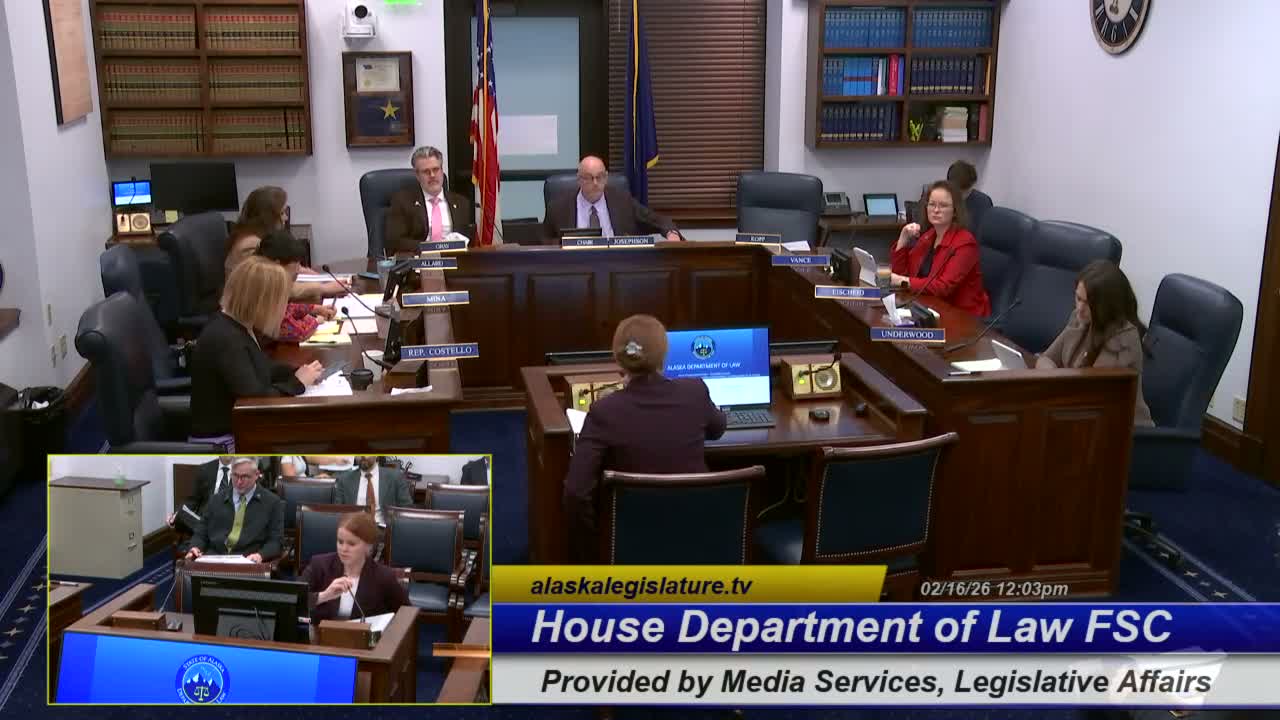
Juneau — The Alaska Department of Law told the House Finance Department of Law Subcommittee on Feb. 16 that prosecutors are carrying heavy workloads and that staffing and trial-cost pressures could prompt future budget requests.
"The mission of the Criminal Division is to seek justice, promote public safety, and further public respect for government," Deputy Attorney General Angie Kemp said as she outlined the division's FY27 budget priorities and operational metrics. Kemp said the division has 147 attorney positions overall and that attorney vacancies have fallen to about 5 percent — roughly seven positions — while some support-staff vacancies remain elevated.
Kemp highlighted caseload and staffing math: the division counts about 121 attorneys dedicated to prosecutions (excluding appellate and central-office specialty roles) with an average combined caseload of about 167 cases per attorney (median 169) as of Jan. 13. She said that if the division were fully staffed the average would fall to about 145; the department's target remains roughly 85–100 cases per attorney.
The deputy attorney general told the committee that hiring trends complicate capacity. In FY25, 56 percent of prosecutors hired had no prior license experience, a statistic she said reflects a common practice of hiring recent law graduates before bar admission. "There is a qualitative difference between someone who comes to the division with prosecution experience and someone who does not," Kemp said, adding that early-career hires increase supervisory demands.
Kemp also reviewed case-age and trial-volume indicators. She said the average felony case age is about one to one-and-a-half years, roughly 80 percent of felonies are less than two years old, and only about 3 percent of felonies are older than five years (those are typically complex, discovery-heavy matters). For FY25, she reported roughly 173 felony trials and about 1,500 trial days (which she said is roughly equivalent to six courtrooms running continuously); the division's felony conviction rate was about 82 percent, and the misdemeanor conviction rate about 66 percent.
On cost pressures, Kemp warned of rising expenditures tied to trials, particularly witness travel. She estimated the per-felony trial cost rose from about $1,700 in FY19 to about $3,900 in FY24 and said the last supplemental for witness travel was in 2008. "We're doing the best we can to live within our means," she told the committee, and foreshadowed that the department might return seeking additional operating funds.
The department described measures aimed at easing strain: an expanded training unit and a prosecutor academy, a stipended internship pipeline that has produced hires (three 2L interns have been hired to date), use of central-office subject-matter experts to support smaller offices, and exploration of diversion programs and tribal/nonprofit agreements. Administrative Services Director Amber LeBlanc said the department has repurposed vacancy savings over the past two years to fund division needs and that the largest savings occur when attorney positions are vacant.
Members pressed for more detail on rural coverage, noting communities such as Kotzebue and Nome. Kemp said Kotzebue was fully staffed at the attorney level and acknowledged Nome had a vacancy; she said central-office attorneys and special prosecutions provide temporary coverage "but it's not necessarily long-term sustainable." The department did not report any formal new position requests in the FY27 submission but said prior year position requests were removed from the enacted budget.
The subcommittee did not take formal action on any bills or motions during the hearing. The department's next appearance is scheduled for the subcommittee's Feb. 23 meeting, when governor's FY27 amendments are due for review.
— Reporting by the House Finance Department of Law Subcommittee meeting on Feb. 16, 2026. "For the record, Angie Kemp, deputy attorney general, with the Department of Law," Kemp stated at the start of her presentation.
"The mission of the Criminal Division is to seek justice, promote public safety, and further public respect for government," Deputy Attorney General Angie Kemp said as she outlined the division's FY27 budget priorities and operational metrics. Kemp said the division has 147 attorney positions overall and that attorney vacancies have fallen to about 5 percent — roughly seven positions — while some support-staff vacancies remain elevated.
Kemp highlighted caseload and staffing math: the division counts about 121 attorneys dedicated to prosecutions (excluding appellate and central-office specialty roles) with an average combined caseload of about 167 cases per attorney (median 169) as of Jan. 13. She said that if the division were fully staffed the average would fall to about 145; the department's target remains roughly 85–100 cases per attorney.
The deputy attorney general told the committee that hiring trends complicate capacity. In FY25, 56 percent of prosecutors hired had no prior license experience, a statistic she said reflects a common practice of hiring recent law graduates before bar admission. "There is a qualitative difference between someone who comes to the division with prosecution experience and someone who does not," Kemp said, adding that early-career hires increase supervisory demands.
Kemp also reviewed case-age and trial-volume indicators. She said the average felony case age is about one to one-and-a-half years, roughly 80 percent of felonies are less than two years old, and only about 3 percent of felonies are older than five years (those are typically complex, discovery-heavy matters). For FY25, she reported roughly 173 felony trials and about 1,500 trial days (which she said is roughly equivalent to six courtrooms running continuously); the division's felony conviction rate was about 82 percent, and the misdemeanor conviction rate about 66 percent.
On cost pressures, Kemp warned of rising expenditures tied to trials, particularly witness travel. She estimated the per-felony trial cost rose from about $1,700 in FY19 to about $3,900 in FY24 and said the last supplemental for witness travel was in 2008. "We're doing the best we can to live within our means," she told the committee, and foreshadowed that the department might return seeking additional operating funds.
The department described measures aimed at easing strain: an expanded training unit and a prosecutor academy, a stipended internship pipeline that has produced hires (three 2L interns have been hired to date), use of central-office subject-matter experts to support smaller offices, and exploration of diversion programs and tribal/nonprofit agreements. Administrative Services Director Amber LeBlanc said the department has repurposed vacancy savings over the past two years to fund division needs and that the largest savings occur when attorney positions are vacant.
Members pressed for more detail on rural coverage, noting communities such as Kotzebue and Nome. Kemp said Kotzebue was fully staffed at the attorney level and acknowledged Nome had a vacancy; she said central-office attorneys and special prosecutions provide temporary coverage "but it's not necessarily long-term sustainable." The department did not report any formal new position requests in the FY27 submission but said prior year position requests were removed from the enacted budget.
The subcommittee did not take formal action on any bills or motions during the hearing. The department's next appearance is scheduled for the subcommittee's Feb. 23 meeting, when governor's FY27 amendments are due for review.
— Reporting by the House Finance Department of Law Subcommittee meeting on Feb. 16, 2026. "For the record, Angie Kemp, deputy attorney general, with the Department of Law," Kemp stated at the start of her presentation.
Don't Miss a Word: See the Full Meeting!
Go beyond summaries. Unlock every video, transcript, and key insight with a Founder Membership.
✓
Get instant access to full meeting videos
✓
Search and clip any phrase from complete transcripts
✓
Receive AI-powered summaries & custom alerts
✓
Enjoy lifetime, unrestricted access to government data
30-day money-back guarantee
