Department of Law details quality-of-life initiative to target retail theft, partners with municipality attorneys
February 16, 2026 | 2026 Legislature Alaska, Alaska
This article was created by AI summarizing key points discussed. AI makes mistakes, so for full details and context, please refer to the video of the full meeting. Please report any errors so we can fix them. Report an error »
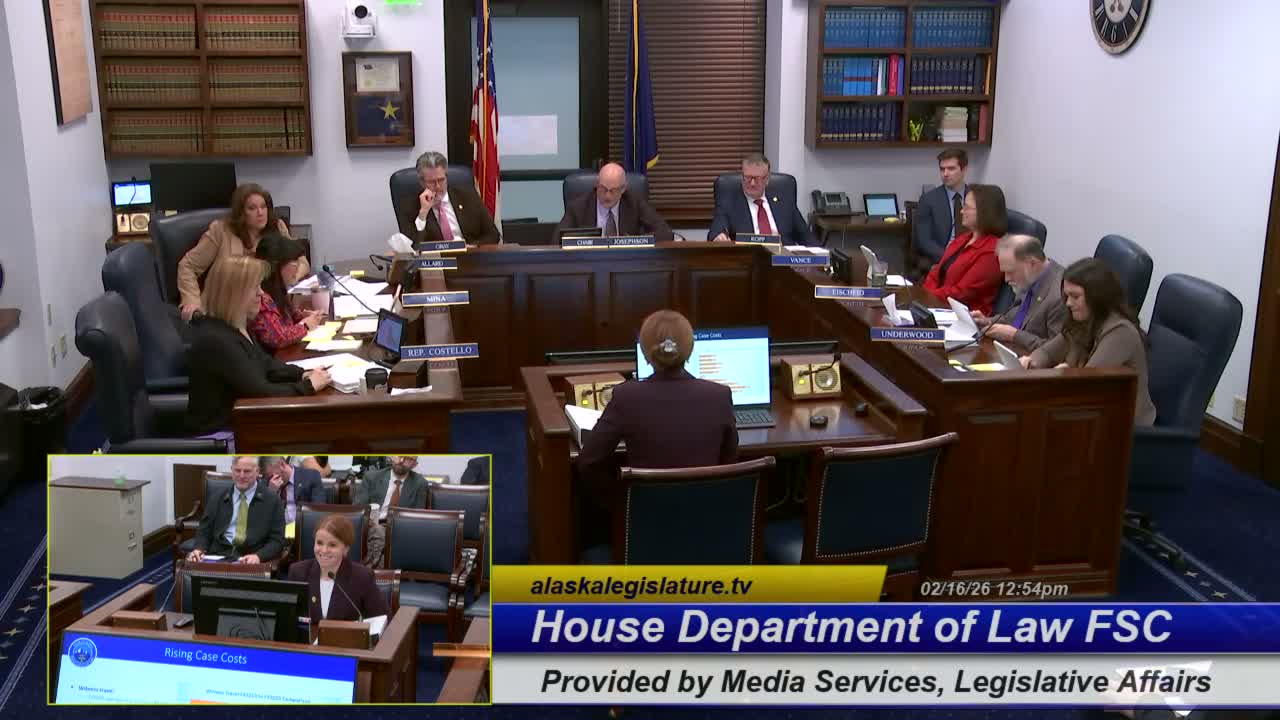
Juneau — The Alaska Department of Law described a quality-of-life initiative to the House Finance Department of Law Subcommittee on Feb. 16 that is designed to reduce retail theft and address conduct that affects use of public spaces, while attempting to minimize new state resource needs.
Deputy Attorney General Angie Kemp said the initiative "is designed to tackle two prongs, combating retail theft and addressing conduct impacting the use and enjoyment of public spaces." She told the committee that the state does not plan to request additional department resources for the initiative at this time, because it intends to redeploy existing attorneys in coordination with municipal counsel.
Kemp described plans for personnel and partnerships: "The plan is for we have one leading the initiative, Mr. Skidmore, and then an Anchorage attorney position, and then eventually, a municipal — Matthew Palmer, excuse me — attorney will help with the initiative from the Department of Law's side." She added that the Municipality of Anchorage has indicated it would dedicate three positions to assist with state work under a task-force-style arrangement.
Members pressed on how the initiative would intersect with local ordinances and behavioral-health supports. Representative Mina noted Anchorage Ordinance AO 2026-10 includes language emphasizing access to behavioral-health treatment and shelter connections; Kemp said conversations with the Department of Health and municipal attorneys are beginning and that housing is a persistent challenge. She said the department is exploring diversion strategies, signing on with nonprofits and tribal governments and that about 39 tribes have signed diversion agreements to date.
Kemp emphasized cross-training and information-sharing with municipal attorneys: municipal attorneys are being trained by Department of Law staff on grand-jury presentation and higher-level prosecutions, while the department assists municipalities with ordinance drafting and enforcement strategy. "It's an exchange of resources, not an increase in resources," she told the subcommittee.
The committee did not vote on the initiative during the hearing. Members requested further updates on how state agencies (including the Department of Health) will participate and on how municipal ordinances will be coordinated with state enforcement priorities.
— Reporting from the House Finance Department of Law Subcommittee hearing, Feb. 16, 2026.
Deputy Attorney General Angie Kemp said the initiative "is designed to tackle two prongs, combating retail theft and addressing conduct impacting the use and enjoyment of public spaces." She told the committee that the state does not plan to request additional department resources for the initiative at this time, because it intends to redeploy existing attorneys in coordination with municipal counsel.
Kemp described plans for personnel and partnerships: "The plan is for we have one leading the initiative, Mr. Skidmore, and then an Anchorage attorney position, and then eventually, a municipal — Matthew Palmer, excuse me — attorney will help with the initiative from the Department of Law's side." She added that the Municipality of Anchorage has indicated it would dedicate three positions to assist with state work under a task-force-style arrangement.
Members pressed on how the initiative would intersect with local ordinances and behavioral-health supports. Representative Mina noted Anchorage Ordinance AO 2026-10 includes language emphasizing access to behavioral-health treatment and shelter connections; Kemp said conversations with the Department of Health and municipal attorneys are beginning and that housing is a persistent challenge. She said the department is exploring diversion strategies, signing on with nonprofits and tribal governments and that about 39 tribes have signed diversion agreements to date.
Kemp emphasized cross-training and information-sharing with municipal attorneys: municipal attorneys are being trained by Department of Law staff on grand-jury presentation and higher-level prosecutions, while the department assists municipalities with ordinance drafting and enforcement strategy. "It's an exchange of resources, not an increase in resources," she told the subcommittee.
The committee did not vote on the initiative during the hearing. Members requested further updates on how state agencies (including the Department of Health) will participate and on how municipal ordinances will be coordinated with state enforcement priorities.
— Reporting from the House Finance Department of Law Subcommittee hearing, Feb. 16, 2026.
View the Full Meeting & All Its Details
This article offers just a summary. Unlock complete video, transcripts, and insights as a Founder Member.
✓
Watch full, unedited meeting videos
✓
Search every word spoken in unlimited transcripts
✓
AI summaries & real-time alerts (all government levels)
✓
Permanent access to expanding government content
30-day money-back guarantee
